
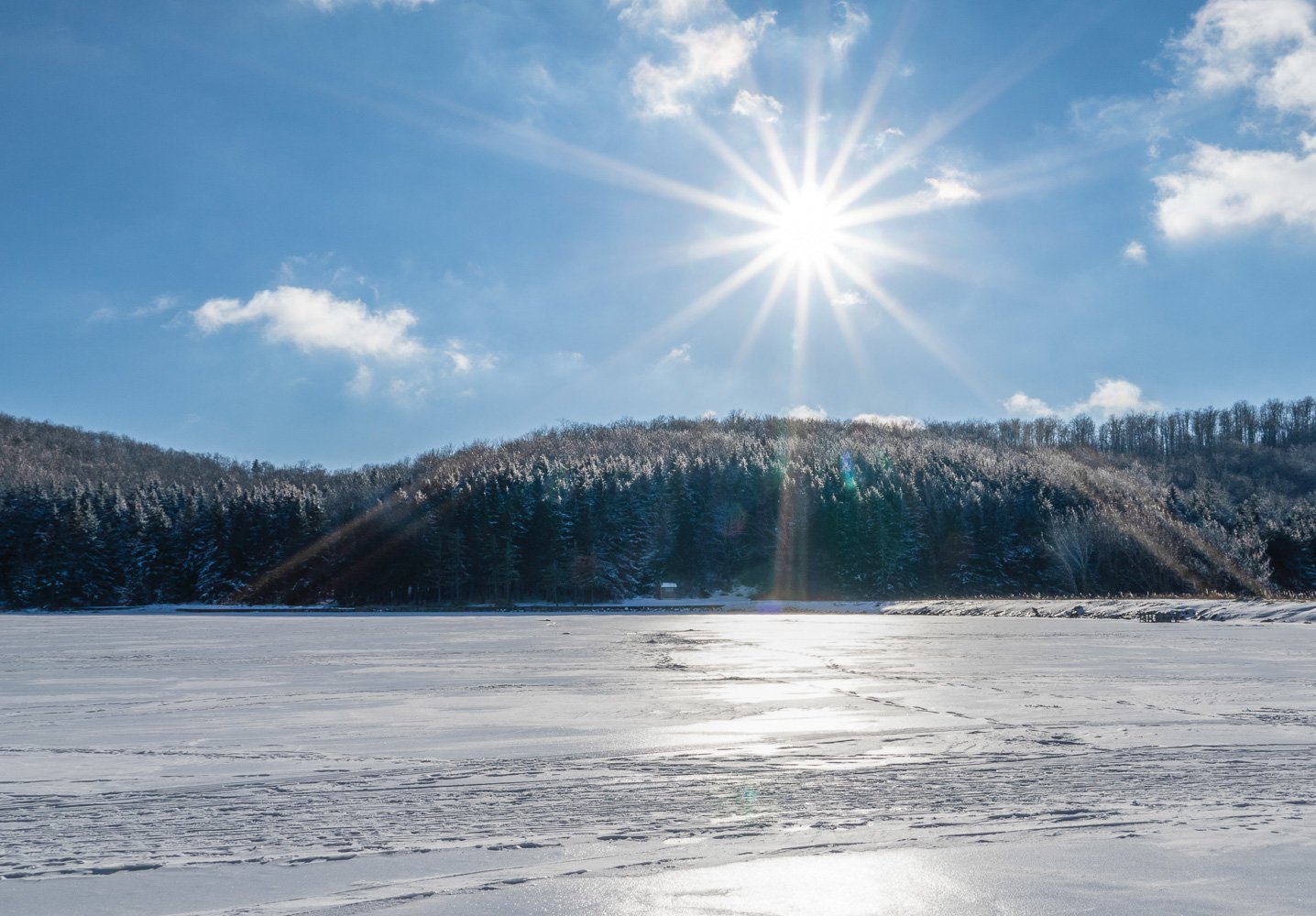
Feature Photo: An ice-covered Spruce Knob Lake sitting pretty
under bluebird winter skies. Photo by Taira Gainer-Sarfino
Written by Taira Gainer-Sarfino
Solitude, silence, and stillness await in the splendor of a snow-covered forest. Trekking up the Mountain State’s highest peak in the dead of winter is not for the faint of heart; a four-wheel-drive vehicle is a requisite. It’s a little daunting perhaps, stupid even, but the lure is strong. This blue, cold January day is biting, but the thrill of finding a new way to fish in West Virginia feels warming and enticing.
Sitting pretty at 3,840 feet in elevation, Spruce Knob Lake is the highest lake in West Virginia. A prolific year-round fishery, this gemstone of a lake annually ranks near the top of the state’s trophy trout waters. On any given day during the spring through fall, anglers can be seen dotting the shoreline or floating out on a jon boat.
Typically seen as a deep azure lake surrounded by hunter-green conifers, Spruce Knob Lake’s frozen terrain appears quite different today, yet it still feels just as welcoming. As I crest the earthen dam and lay eyes upon the lake, I feel as though I am transported to another world.

A typical scene on Spruce Knob Lake in the thick of winter. Photo by Taira Gainer-Sarfino
The 23-acre reservoir boasts scenery that rivals a high-alpine lake in the Canadian wilderness. Towering red spruce trees surround the lake; their snow-encrusted branches scrape together as the wind sifts through them. Breathing in the cold, dry air ignites my soul. The ice grumbles underneath my feet as I test out the glazed surface, and the old adage about judging ice races through my mind. Thin and crispy is way too risky, but thick and blue is tried and true.
I should probably note that this adventure was not a spur-of-the-moment, impromptu notion. Based on my own research and conversations with knowledgeable folks prior to the trip, a general guideline is that ice should be about five inches thick before setting foot upon it. Thankfully, remnant holes of past ice fisherfolk around the edge of the lake allow me to check the depth. The ice is plenty thick, so I grab my gear—pole, tacklebox, and ice tip-up—and begin making my way across the lake to an idyllic fishing spot.

Tools of the trade. Photo by Taira Gainer-Sarfino
I have always been told that you can’t call it an adventure unless it’s tinged with a little bit of danger. And although there are plenty of risks today—falling through the ice, hypothermia, getting my car stuck in a ditch—I feel prepared. Wearing plenty of layers and making sure my extremities are covered makes the cold a little more bearable. I’m also wearing a solid pair of insulated waterproof boots and full-body thermal suspenders. In my car are extra blankets, food, water, and clothes in case I get wet—or stranded along the snow-covered road.
To be sincere, sitting in one place for hours in the cold did not initially enthrall me. In fact, it was the primary aspect of this quest that I was least thrilled about. In my typical fishing adventures, I’m hiking several miles along a stream bank, blissfully fishing the entirety of the warm day away. But now, I find myself sitting on a bucket in the middle of a frozen lake, repeatedly bobbing my fishing line in and out of the cold, dark water, waiting patiently for something that might not even happen. I embrace these moments where I need absolutely nothing, so I let my mind wander into the realm of self-introspection and reflection. That’s the beauty of fishing regardless of the conditions—it’s just me and my thoughts.
I developed an appreciation for the beauty and wonder of the outdoors at an early age—some of my most precious and vivid memories were fishing with my dad as a kid. I was fortunate to grow up in Randolph County, where I could fish the hundreds of trout streams, rivers, and lakes—including Spruce Knob Lake—that wind their way through these beautiful West Virginia highlands. I treasure my many moments that bring an overall sense of wellbeing when exploring these Appalachian waterways.
Even though the windborne squalls are swirling around me and I can no longer feel my cheeks, I truly am content. I find inner peace and tranquility in the simple things: the glint of a stream rushing across the rocks, the wind whispering its deepest secrets, the crispness of snow at dawn before the sun peeks over the hills. Sometimes the quality of silence found in nature itself can bring a calmness that defies explanation.
With winter’s chill deterring most anglers, I find true solace in this secluded setting high up in the mountains. Yet the frozen forest is alive with the shifting earth, the chorus of songbirds, and the soft rustling of a woodland critter scurrying through the untrammeled snowfall. Although I can’t see them, I imagine the lake’s numerous trout flitting around below the thick ice. It’s moments like these that help me forget my daily troubles and immerse myself in the serene sounds of solitude.

The author dipping her line in the icy waters of Spruce Knob Lake. Photo courtesy Taira Gainer-Sarfino
Fishing is the only activity that allows me to escape the hectic pace of life. It’s a meditative state where time simultaneously stands still while the hours fly by unnoticed. Even the flow states I find while skiing or mountain biking can’t quite capture the feeling. Ultimately, it’s about finding the time to just sit and breathe.
I snap out of my thoughts and back to reality when I feel a tug on the end of my fishing line: the anticipated bite! But my movements are so slow and delayed that I lose the fish. Despite my frozen limbs, my blood is pumping with excitement. I continue to fish for another hour or so before realizing that it’s time to pack up and head home. Even though I’m leaving empty-handed, I trudge back to my car feeling satisfied. The serenity I experienced during this magical winter day resulted in much more than a sought-out fish.