


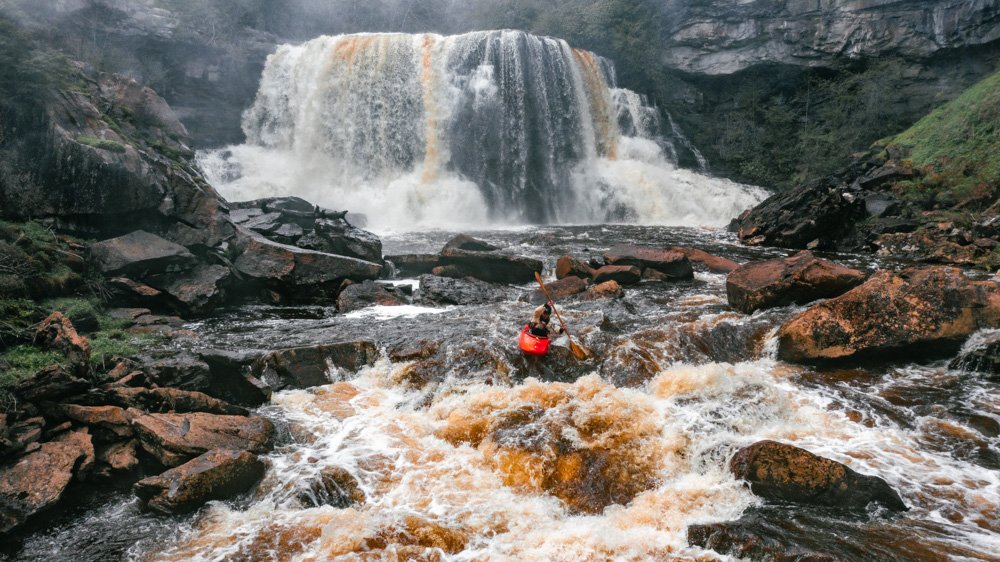
FEATURE PHOTO: Jared Seiler drops in below the iconic drop
of Blackwater Falls on the Upper Blackwater River. Photo by Mark Moody
Written by Jesse Shimrock
Among the committed congregation of whitewater enthusiasts who call Appalachia’s righteous rivers home, there are certain days when the whitewater kingdom opens its pearly gates. As the holy water unleashes from the skies with great vengeance, the river swells beyond its walls and beckons us with the temptation of the unknown. For thine canyon is the realm of the high-water kingdom in all her power and glory. These extraordinary days are referred to by our congregation with a hallowed name: Church Flows.
I have long yearned for an experience that devours the ego, commands transcendence, and culminates in a full surrender to a higher power. Ultimately, childbirth was not in my biological cards, and so began the quest to discover my own vision of the almighty.
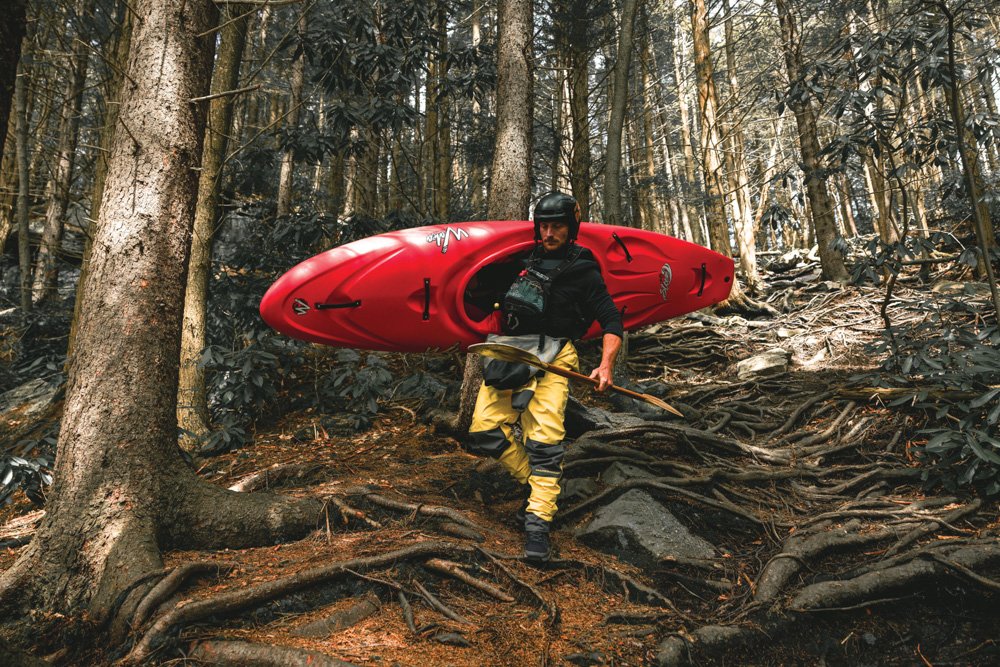
The author carries his kayak down the steep trail to the put-in of the Upper Blackwater. Photo by Mark Moody
Most traditional sports rely on a two-dimensional playing field, implying that the movements are largely confined to a forward and backward or side to side plane of play. Let’s take football, baseball, or wrestling for example. A player can run, jump, leap, roll, or dive, all while the medium beneath them remains the same. A race car can reach nearly uncontrollable conditions, but the tarmac stays steady and constant. Reaching further into the extreme, adventure sports such as skiing, surfing, and motocross involve a chaotic ballet with gravity, which operates within a mostly predictable up and down relationship, sans the occasional avalanche. Yes, that dance with Earth’s might can certainly devour the ego and grant a one-way ticket to the holy land, but this often occurs by happenstance and not with direct intent.
Throughout my childhood, I played all of these traditional and adventure sports with great joy. Yet deeper down, my psyche sensed a yearning for something more divine. Near the end of a torturous freshman year of wrestling, right as the long winter’s snowpack was recharging the Appalachian water table, my wrestling coach approached me with an opportunity that would ultimately charge my spirit with decades of bountiful exploration and open a conduit for my pursuit of the almighty. His offer was a gift: learning the art of whitewater kayaking. I quickly realized I was holding the scripture to shatter the two-dimensional mold. The river became the third axis.
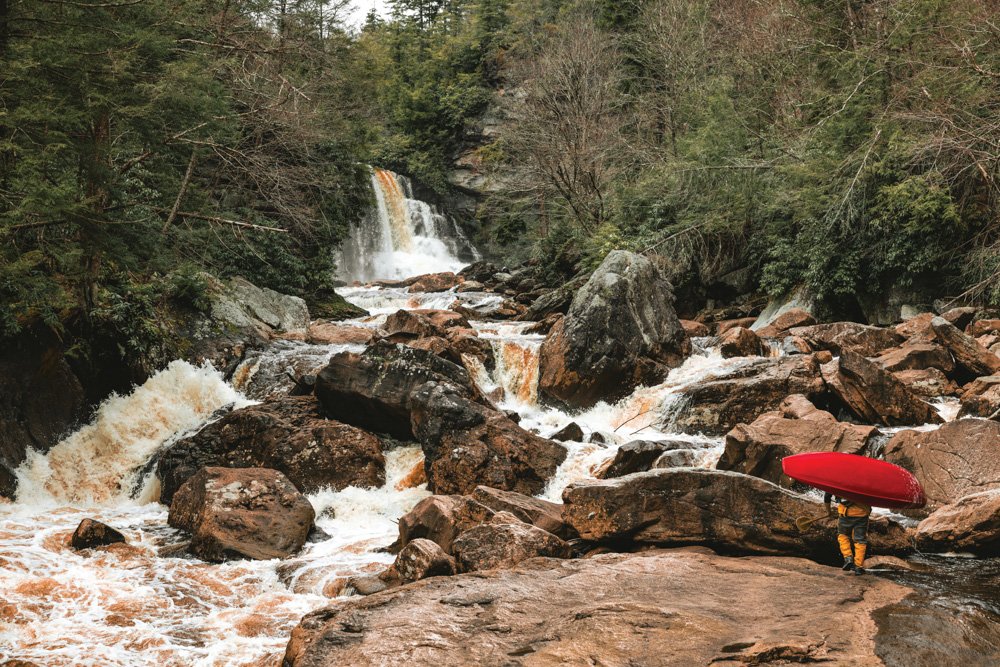
The author at the put-in below Blackwater Falls. Photo by Mark Moody
Whitewater is a dynamic, living force. The water doesn’t just push; it pulls, surges, and rolls beneath you, creating an environment where every paddle stroke dictates whether you stay on your line, synced with the flow, or get swallowed into the depths of disorientation. I was no longer just moving through space, I was interacting with it, and boy was it interacting with me. Conventional brute strength, a classical athletic tactic, was suddenly useless here. I had to learn to work with the power of the water and harness the chaos into a more controlled motion, like a dance with an unpredictable partner that required my full presence and surrender to the process.
As humans, we have an innate desire to classify, perhaps out of instinct, but likely more often out of necessity. Tax brackets, security clearances, difficulty levels, clothing sizes, everything. Whitewater is no exception and was subject to a primitive classification system early in its evolution, which ranks rapids in a difficulty scale of class I through V, with class V being the most difficult (and often, the most dangerous). Despite the ever-changing nature of rivers, outrageous variations in flow, enormous gradient differentials, geologic complexities that defy logic, and the rapid advance of skill, technology, and equipment, this simple classification system remains unchanged. Across the world, all rapids are still reduced to a range of five numbers, with class VI still standing as the supposed threshold where a rapid is considered unrunnable. Ah, to label something as unrunnable, unachievable, impossible—the chalice of temptation hath been dangled!
Every whitewater kayaker begins their journey in the same place: sitting in a kayak for the first time, struggling to paddle in a straight line, with only a glimmer of hope that they might one day channel their inner Inuit (the Indigenous people who invented the kayak roll for survival in Arctic waters) and roll back up. But from this shared starting point, the progress matrix becomes far less predictable. For some, it clicks instantly, and progression is swift. For others, years pass as they settle into their comfort zone within the confines of the five-tier classification system.
One of the more intriguing aspects of this classification system is the concept of standard flow: the benchmark that defines a river’s character at average water levels. Thanks to dams constructed by agencies like the U.S. Army Corps of Engineers and the Civilian Conservation Corps, many rivers have become whitewater playgrounds with reliably predictable flows. Iconic whitewater runs such as the Gauley, Youghiogheny, and Savage rivers exist today largely due to these harnessed flows.
Learning to navigate rivers within these flows becomes an obsession for some. And while no river is ever truly static, standard flows offer a certain level of comfort and reliability. The same boulders pillow the water in a constant direction; a familiar surf wave crests at the same location; the choice line remains steady throughout a given rapid. This engineered predictability allows a kayaker to develop an intimate understanding of the river’s personality.
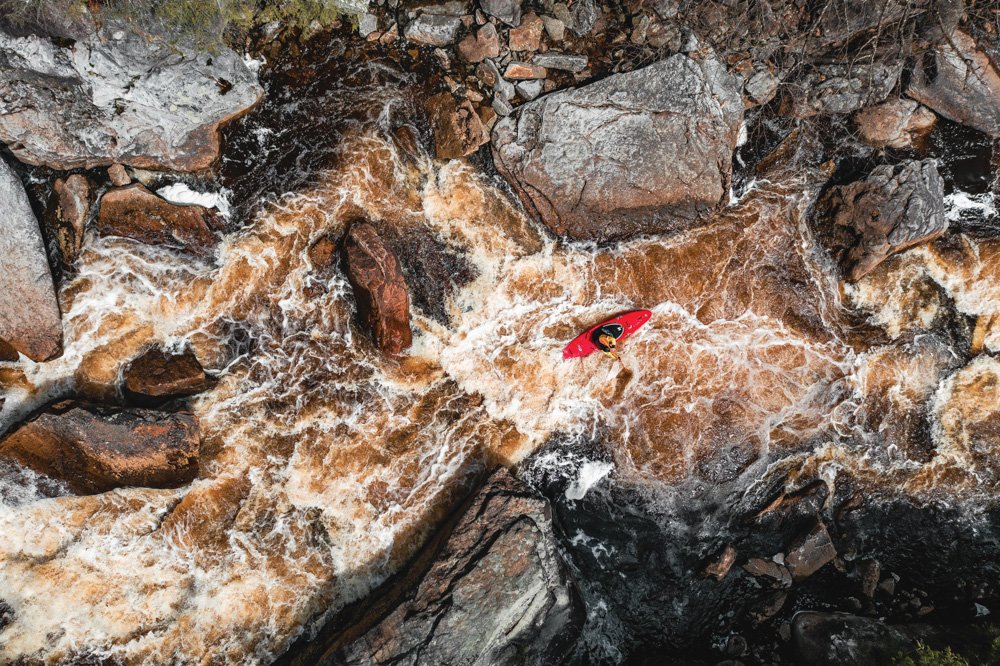
Jesse Shimrock navigates the chaotic and unpredictable flows of the Upper Blackwater River at high water. Photo by Mark Moody
That is, until the water rises, consuming the familiar and transforming the playing field into an unrecognizable battlefield. As the river rises, so too do the stakes. The friendly eddy that always allowed you a moment to breathe becomes an undulating whirlpool grabbing at the edges of your boat, threatening a toss into the looming chaos below.
Kayaking whitewater at high flows is an artform. It demands reverence, composure, and a level of trust that borders on the spiritual as the environment around you secretes pure mayhem, with water exploding unpredictably like an aquatic grenade. The river swallows the air around it as the power beneath the surface regurgitates upward like a rolling boil. When the river reaches these levels, the element of control is purely an illusion. Heaven and hell are in the same room.
This event horizon is the edge of the great doubt. For some this is the turning point, the retreat to the familiar. For others, this is where the universe opens its arms. No one has ever explained it better than my dear friend and sensei Jim Snyder: “When in doubt, remember that the universe always tends toward the ambiguous. You can bet on it.”
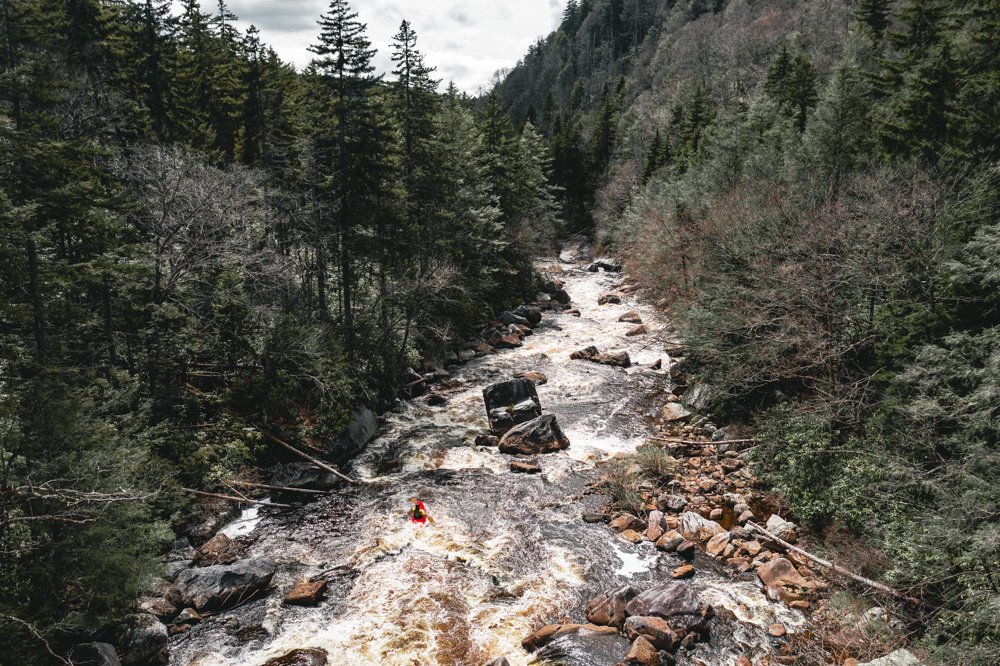
Jared Seiler and Jesse Shimrock weave between boulders in the frothy waters of the Blackwater River. Photo by Mark Moody
I’ve sat on that statement for quite some time, but I believe that in the context of whitewater, it suggests that, despite all the training, classifications, and expectations, the river is incapable of conforming to definitions. Adaptability, intuition, and an acceptance of the unknown are essential. This juncture in whitewater is where we give in to the divine and enter our holy place.
There’s a sort of solitude that comes with putting on the water in these conditions, an acceptance that you’re entering something far greater than yourself. There’s no room for ego, or for error. There’s no forgiveness for a second guess, which, if made, always dominates the first. It is in these moments that I find something far deeper than my pursuit of mastery, my perfect line, my fastest time—I find communion. The rhythm of my paddle in the water as my hymn, the rapids a scripture written in fluid motion, the river as my sacred force delivering me into the light at the end of its canyon walls. This is my church.
Jesse Shimrock is a long-tenured disciple of the whitewater chapel. He built his home on the banks of the Youghiogheny River, where he and his partner are raising a river rat of their own.