
The Sun Lovers
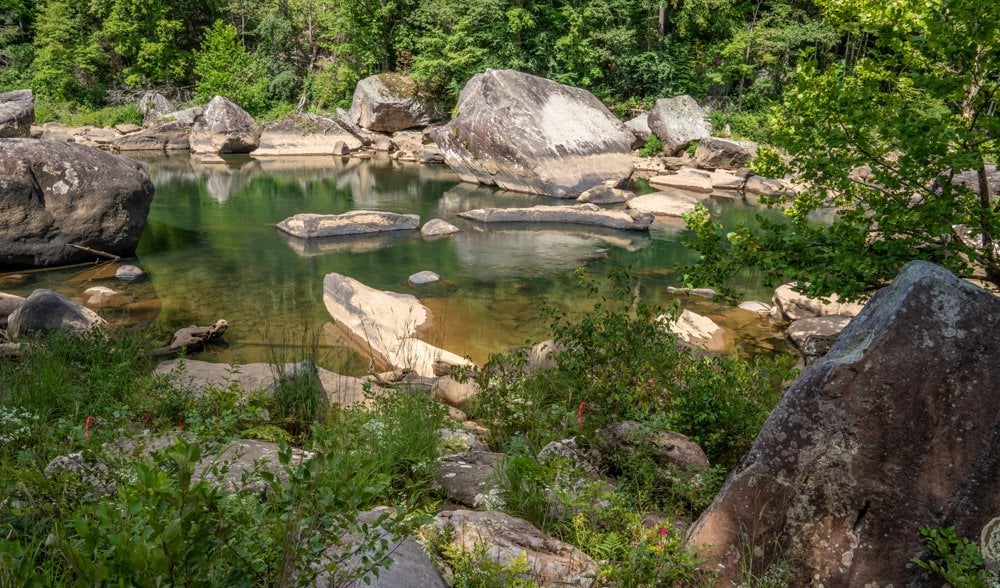
We hop into the National Park Service vehicle and begin winding our way along backroads toward the Gauley River. The roads are steep, chunky, and narrow, requiring us to move slowly and stay tuned to oncoming traffic. Eventually, we turn onto an old railroad grade that follows the curves of the river upstream. When I think of the Upper Gauley, I envision massive flows of water, churning rapids, and raucous boaters eager for carnage. But on this late summer day, the river is calm and low. Instead of a raging torrent, I see a trickle wending its way through giant boulders that are typically hidden beneath the notorious rapids.
As we navigate our way down the road, we spot a Cooper’s hawk flying from branch to branch. Then, Doug Manning, a biologist at the New River Gorge National Park and Preserve, hits the brakes to point out a fern growing on a small cliff on the side of the road. We get out to look at a walking fern, whose elongated, arrow-shaped leaves arch down the shaded rock face. When the leaf tips make contact with the rock, they establish roots that give rise to new ferns, allowing the plant to essentially walk across the landscape. After a brief, awe-filled moment, we get back in the car to continue on our journey. The walking fern is a treat to find, but it’s just one of many amazing plants we’re about to see.

Looking across a prime example of a river scour prairie from atop a boulder along the rugged shore of the Gauley River. Photo by Dylan Jones
Today, our goal is to visit several riverscour prairies, a unique type of plant community created by raging rapids and maintained by periodic floods. In West Virginia, the abundant whitewater that draws in paddlers from around the world provides the perfect environment for riverscour prairies. They occur on cobble bars, bedrock, and bouldery substrates next to steep sections of the Gauley, New, Cheat, Greenbrier, Tygart, Potomac, and several other of our state’s rivers. During flooding events, the rushing waters snap woody plants from their roots, making room for sun-loving plants that thrive in the open and inundated conditions.
“There’s a whole bunch of state-rare plants that occur in the New River and Gauley that don’t occur anywhere else,” says Stephanie Perles, a plant ecologist for the Eastern Rivers and Mountains Inventory and Monitoring Network (ERMN) for the National Park Service. In West Virginia, this network monitors the New River Gorge National Park and Preserve, the Gauley River National Recreation Area, and the Bluestone National Scenic River. The riparian habitats that line the banks of these rivers, including riverscour prairies, comprise just 2% of the parks’ 88,000 acres but contain a whopping 65% of the parks’ plant diversity. Roughly 50 plant species that are rare in the state of West Virginia occur only in these riparian areas, and some can only be found in riverscour prairies.

The rugged shores of the Gauley River seem harsh for life, but play host to a wide array of the region’s biodiversity. Photo by Dylan Jones
The riverscour prairies of the Gauley River are home to the world’s largest population of the federally threatened plant Virginia spiraea (Spiraea virginiana). The Monongahela Barbara’s-buttons (Marshallia pulchra), a plant that produces beautiful firework-shaped flowers with curly lilac petals, solely occurs in the riverscour prairies of West Virginia, Pennsylvania, Tennessee, and Kentucky. Similar to the quintessential prairies of the Midwest, riverscour prairies in West Virginia host tall grasses, including big bluestem (Andropogon gerardii), switchgrass (Panicum virgatum), and Indian grass (Sorghastrum nutans). These habitats are also home to highly specialized plants like riverbank goldenrod (Solidago simplex var. racemosa) and wild blue indigo (Baptisia australis), whose dried seed pods sound like a rattlesnake when they’re touched.

A Liatris scariosa flower blooms in early August, photo by Nikki Forrester
The few shrubs and trees that do establish in riverscour prairies are gnarled and battered by the floodwaters, preventing them from growing too straight or tall. In contrast, riverscour prairie plants are well adapted to withstand floods, submersion, sun, and heat. They have deep roots that anchor them into the cobbles and rapidly resprout after scouring events. And during the dog days of summer, these deep roots allow riverscour prairie plants to access water and nutrients despite the extremely hot and dry conditions.
Riparian rarities
Manning checks his map before pulling off in a grassy nook on the side of the old railroad grade. We hike down a steep, rocky drainage before popping out into a riverscour prairie below a rapid on the Gauley. The first thing I notice is the towering flowers, filled with bees, butterflies, wasps, and other pollinators. The plants sprout from tiny crevices between the cobbles and boulders, where just a trace amount of soil can be seen. We scurry across several large boulders and perch atop one overlooking the river. At a flow of around 250 cubic feet per second (cfs), we’re shocked to spot the bright reds and greens of kayaks eddied out above the rapid.
“This is one of the sites where we’re doing recovery work for Virginia spiraea,” Manning tells me while we wait for the kayakers to paddle by. Virginia spiraea is a federally threatened plant, with most populations containing just a few individuals. Over the past several decades, scientists have documented declining populations of Virginia spiraea throughout the Gauley and Meadow rivers. These declines are primarily attributed to habitat destruction, invasive plants, and a reduction in scouring events due to upstream dams.
The National Park Service started their recovery work on Virginia spiraea in 2020. “The first thing we did was go out and monitor all of the Virginia spiraea that was known to occur in the Gauley River National Recreation Area, including the Meadow River,” says Manning, noting that some of earliest data collected on the species was from the 1990s. “Most of the sites seem to be stable, but we had 10 sites where we determined that Virginia spiraea had declined from previous monitoring efforts.”

National Park Service biologist Doug Manning gazes at a sunny riverscour prairie, photo by Dylan Jones
To support Virginia spiraea populations throughout the New River Gorge National Park and Preserve, Manning and his colleagues remove invasive plants that shade out the rare and threatened plants. Walking along the riverscour prairie, Manning shows me a bright-blue stump of an autumn olive (Elaeagnus umbellata), one of the most common invasive species in riverscour prairies.
“In areas where we have Virginia spiraea and other rare species, we take a very focused approach to how we treat invasives,” he says. Instead of doing a broad application of pesticides, the scientists cut down the invasive plants and daub the exposed stumps with chemicals so they don’t resprout. “There’s really no risk to having any sort of spill or non-target effects,” he describes. They also apply potent blue dye to the stumps so they know which invasive plants have been treated.

Virginia spiraea, a federally threatened plant species; the world’s largest population of Virginia spiraea is in the Gauley River, photo by Dylan Jones
Along with removing invasive plants, Manning and his team augment the declining populations. “The good news for Virginia spiraea is that it reproduces asexually really, really well,” Manning says. Since 2023, the team has tried several methods for increasing populations of Virgina spiraea. One approach involved taking fresh cuttings from young plants, sending them to a botanical garden in Delaware for propagation, and then replanting them in the riverscour prairies once they reached a larger size. While the approach was quite effective, Manning says another approach called live staking was much faster and easier. “We just take a hardwood cutting, create a little pilot hole using a piece of rebar, and then plant the cutting,” he says. The cutting then grows roots, anchors itself into rocks, and grows a new plant. So far, Manning and his colleagues have planted 46 Virginia spiraea cultivated from cuttings at this particular site.
Manning also works with local landowners to recover the threatened species throughout the region. Using historical data as a guide, Manning sent letters to 19 local landowners to inform them that the threatened plant might occur on their properties. “It was really heartening to see the number of responses we got,” he says. Manning helped educate landowners on how they could protect Virginia spiraea on their property. Several landowners were also eager to share cuttings with Manning and his team so they could establish the plant within the bounds of the Bluestone National Scenic River. Although Virginia spiraea likely occurred along the Bluestone River historically, there haven’t been any confirmed sightings of the plant for decades. Now that Virginia spiraea is planted back on federal land, it’s protected by federal law and policy. “It’s been a really cool project in terms of the success that we’re having and seeing other people wanting to join this effort,” says Manning. Other national parks, including Great Smoky Mountains, are now working on conserving Virginia spiraea.
Monitoring change
Ultimately, the long-term success of Virginia spiraea and riverscour prairie communities requires maintaining the periodic floods that provide the open, sunny habitats these plants need to thrive. To keep tabs on how and why the riverscour prairies of the New River Gorge region are changing, Perles and her team at the ERMN conduct regular monitoring to survey the abundance of native plants, tree cover, and invasive species. This information is then passed along to biologists, like Manning, to help them devise good management strategies.

The stump of an invasive autumn olive tree that’s been treated with pesticides and dyed blue so scientists know it’s been treated, photo by Dylan Jones
There are nine riverscour prairie sites in the New River Gorge National Park and Preserve that Perles and her team have monitored since 2012. “I wish we could raft in, but when there’s enough water in the Gauley to raft, the riverscour prairies are usually underwater,” she says. After a long hike in, the scientists set up one-square-meter plots in the same places along the riverscour prairies every year. The team records every plant that’s growing inside the plot, how much area each plant takes up, and what portion of the plot is shaded by trees and woody shrubs. Then they move onto the next plot, often sampling up to 60 plots per site depending on how large the riverscour prairie is.
Throughout the day, the researchers document any invasive plants they see. Over the past 13 years, they’ve found that invasive species, including autumn olive, sericea lespedeza (Lespedeza cuneata), purple loosestrife (Lythrum salicaria), Japanese knotweed (Polygonum cuspidatum), and multiflora rose (Rosa multiflora) occur at low abundance in many prairie sites.
The team has also observed a decline in the area covered by grasses, sedges, and rushes in riverscour prairies. “That means the prairie grasses like big bluestem, little bluestem, switchgrass, and cordgrass that are unique to these habitats are decreasing,” Perles says. “We are slowly losing native plants from these habitats as well.” On a brighter note, the team hasn’t seen any changes in the amount of area covered by trees and shrubs. “Our concerns about woody plants increasing and shading out the diversity of prairie plants hasn’t been proven yet, thankfully,” she says.

Euphorbia corollata. Photo by Nikki Forrester
One outstanding question is how the occurrence of scouring events has changed over time as a result of upstream dams regulating water temperature, timing, and volume. Manning says he’d like to put gauges and cameras along the New, Gauley, and Bluestone rivers to better understand what flow rates equate to scouring events. Although the Bluestone and Summersville dams have changed water patterns from what they were historically, Manning says they also provide opportunities to facilitate scouring events. “Ideally, someday we will collaborate with the Army Corps of Engineers to facilitate high-water events that can help maintain this habitat,” Manning says.
Ripe for recovery
In a rapidly changing world with limited funding and staff, it can be challenging to determine which regions, habitats, and species to focus on for conservation and restoration projects. The New River Gorge National Park and Preserve is no different. With 88,000 acres to manage and a handful of employees, park staff at the New have to choose where to focus their efforts. “The river corridor came out as a high priority, both ecologically and for visitor experience,” says Perles.

A thriving Virginia spiraea along the Gauley River. Photo by Dylan Jones
Removing invasive plants and recovering Virginia spiraea populations are just two pieces of the conservation puzzle. Maintaining riparian plant communities and riverscour prairies far into the future also requires some thoughtful efforts by those who develop riverfront properties and enjoy paddling these amazing rivers. From selecting low-impact sites for development to avoiding trampling rare plants during a lunch stop, we can help preserve these rare and special places.
After watching the paddlers navigate Lost Paddle rapid, Manning shows me several Virginia spiraea plants: some that naturally occur and others that were grown from cuttings. Although it’s past their flowering season, I admire the soft, green leaves and robust form of the sprawling shrubs. They don’t seem to have any problem tolerating the direct sun exposure. I, on the other hand, am feeling overheated and dehydrated.
We pack up our gear, hike back uphill, and move onto another riverscour prairie site, one Manning has never visited before. It looks quite different than the previous prairie, with a flatter cobble bar, fewer stunted sycamore trees, and fields of waving grasses. Manning tells me that no two riverscour prairies are alike. The riverscour prairies on the New host different plant communities than the ones on the Gauley or the Bluestone. Each is shaped by the unique features of the surrounding river and forest.
On this late afternoon in early August, it doesn’t take long for the blazing sun to warp my brain into thinking about nothing but water. We hike out as quickly as our bodies allow and drive a few more minutes up the road to a dirt pull off. I rush down to the river, scramble up a large boulder, and plunge into a deep pool of cool, clear water. Floating on my back, I look around, taking it all in—the bright blue sky, puffy white clouds, tree-covered hillsides, darting dragonflies, and, of course, the endless rare plants that live along the river corridor. “One of the reasons I love Viriginia spiraea is because I get to work in a beautiful place like this,” Manning says. “It’s the perfect place to be on a West Virginia summer day.”
Nikki Forrester is co-publisher of Highland Outdoors. She never ceases to be amazed by the Mountain State’s rare and special plants.