



It was one of those perfect winter ski days. The kind you dream about in the suffocating heat and humidity of peak summer. Snowflakes smaller than dust specks sparkled against a bright blue sky, while red spruce trees bent toward the faint ski trail, beckoning me farther into the woods. The frozen rain from the previous night topped with a fresh layer of powdery snow smoothed out the sharp needles, transforming the trees into fairytale creatures with blunt noses and calm smiles. If I could survive out here, I’d happily call this place home.
I continued up the trail, eager to find solitude among the spruce. After a steep climb, I popped out into an opening in the frozen forest and stopped for a snack. I took off my skis and glanced around at what appeared to be an untouched expanse of snow. Upon closer inspection, I noticed a faint indentation: two irregular ovals followed by two small circles that resembled askew exclamation marks. Then I saw another and another. I followed the tracks to the base of a red spruce tree, where a small pocket of snow was carved out to create a cozy nook. I bent down and looked inside with the hopes of finding an elusive snowshoe hare. But alas, it had already moved on.
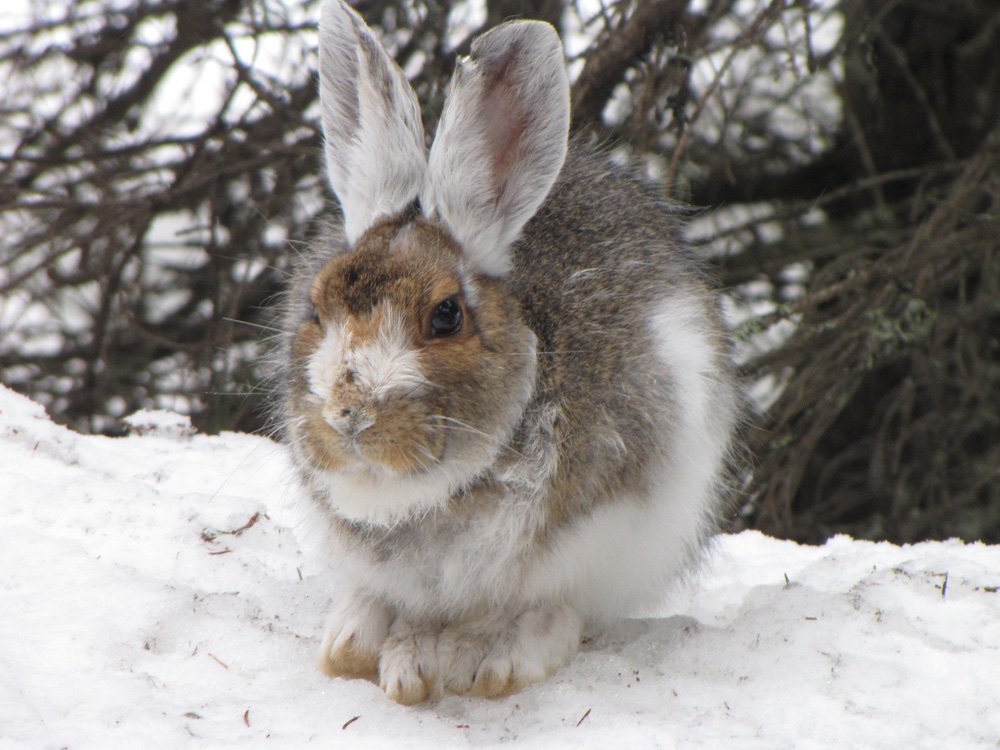
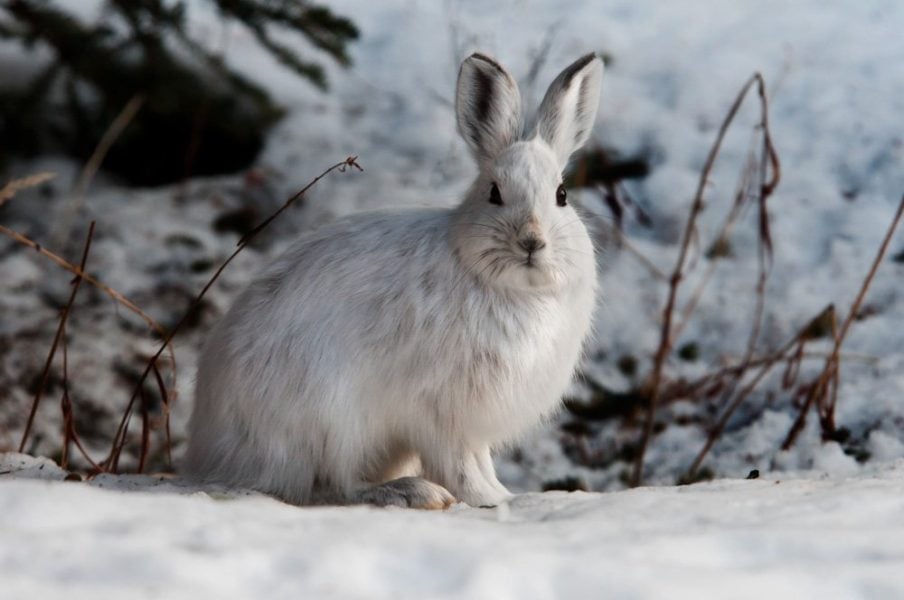
During the fall, snowshoe hares shed their brown fur and replace it with a warm, white, winter coat. This molting process takes about 50 days and starts with the fur on their ears and faces. Photo by Marketa Zimova
As cryptic, crepuscular creatures, snowshoe hares (Lepus americanus) are rarely seen by humans. During the summer, their brown fur blends into the brush, while in the winter, their fluffy, white coats help them disappear amid the snowpack. Their camouflaged fur is key to their survival—snowshoe hares are tasty treats for bobcats, coyotes, foxes, birds of prey, and humans. Few live longer than a year.
Which isn’t to say they’re not thriving as a species. Snowshoe hares breed, as they say, like rabbits, often producing three litters each summer of two to four hares each. But unlike rabbits, baby snowshoe hares are born aboveground with their eyes open and bodies covered in fur. Within a few hours, they start hopping around and nibbling on herbaceous plants.
To keep warm during the winter, snowshoe hares develop a thick, dense coat of white fur. Their large, furry feet are coated in thick bristles that help them stay atop the surface of the snow. Because their food sources are limited to twigs, bark, and needles, they conserve energy by spending their days in snowy crevices beneath evergreen boughs.
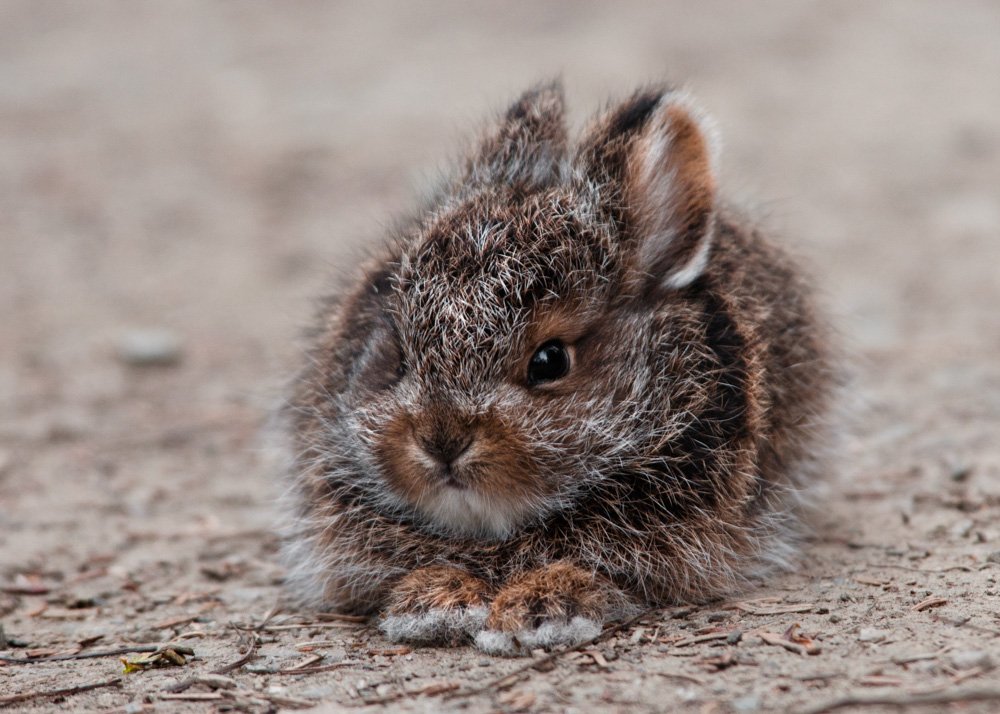
Baby snowshoe hares are born with their eyes open and fully furred. They even start hopping around within hours of being born. Photo by Tim Rains (NPS)
In the Mountain State, snowshoe hares tend to occupy remote spruce forests, bogs, and shrubby habitats above 3,000 feet in elevation. “Some people don’t even realize they’re here,” says Holly Morris, the furbearer and small game project leader for the West Virginia Division of Natural Resources (WVDNR). On the East Coast, West Virginia is the southernmost part of the snowshoe hare’s range, which extends north following the Appalachian Mountains. They also live in boreal forests throughout Alaska, Cananda, and the northern continental U.S.
The exceptional ability of snowshoe hares to hide from predators can make it challenging for scientists to learn more about them. “In West Virginia and Pennsylvania, we know they’re there, but we don’t have a good understanding of what kind of habitats they need to thrive or how big populations are,” says Marketa Zimova, an assistant professor at Ohio University who studies how snowshoe hares are responding to climate change.
On the right track
Even when the hares themselves are hard to spot, the winter landscape can reveal their presence, whether it be their characteristic snowshoe-shaped footprints or hollowed out nooks in the snow. A keen eye might notice twigs cut at clean angles by a snowshoe hare’s two front teeth and the scat that results from eating said ruffage. In 2023, a team of scientists in West Virginia began searching for signs of snowshoe hares throughout the state to gain a better understanding of how many are here and where they reside.
“The historical range for snowshoe hares is based on a 1965 map that ranges from Tucker and Grant counties all the way down to Greenbrier County,” says Mack Frantz, a zoologist for the WVDNR who is involved with the project. Using this map, Frantz and his colleagues set up cameras at 50 sites where they knew snowshoe hares occurred in the past to measure population densities. “We were seeing snowshoe hares in those areas about 55 percent of the time,” he says.
In 2024, the team expanded their search to new sites within the historical range that featured habitat characteristics preferred by snowshoe hares, namely high-elevation coniferous forests, bogs, and swamps. “One area that’s unique to West Virginia is Canaan Valley. It forms natural frost pockets, which just seem like the perfect environments for snowshoe hares,” says Frantz. When sampling the new sites, the team spotted snowshoe hares roughly a third of the time, which Frantz says is encouraging.
While out in the field, scientists also collected fecal pellets to conduct genetic analyses on snowshoe hares and other lagomorphs (a group of mammals that includes hares, rabbits, and pikas). “The pellets look like big peanut M&Ms,” says Madison Miller, a Ph.D student at West Virginia University who is doing the genetics work. By extracting DNA from each fecal pellet, she can identify not only which species it came from, but which individual. Of the 180 samples Miller has tested so far, about 45 were from snowshoe hares. And because the researchers are sampling the same sites more than once, they can use the pellets to track how many individuals are found in a given area over time, allowing them to estimate population density.
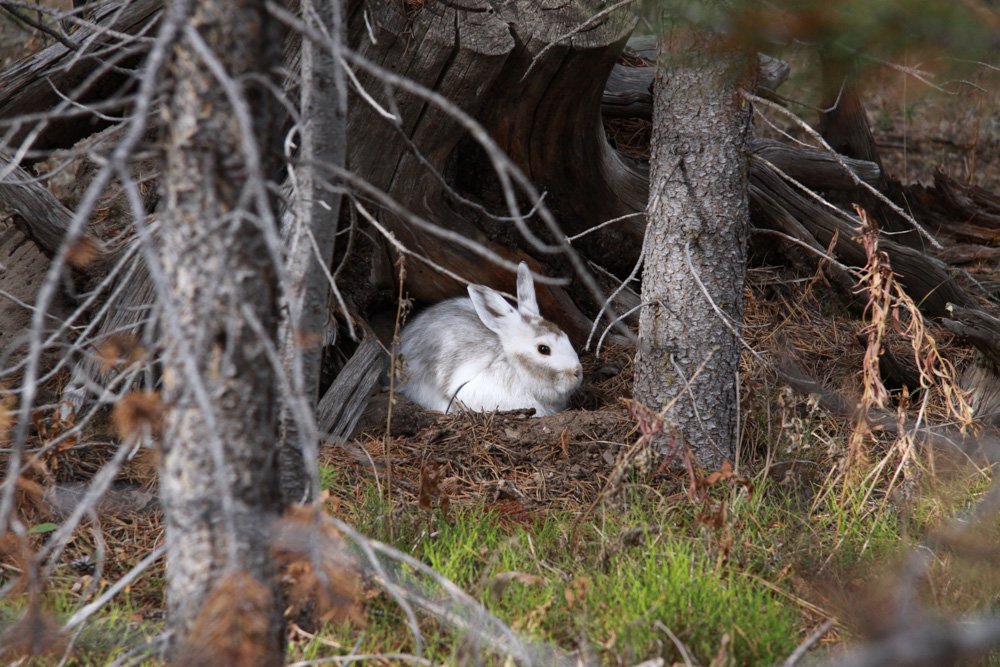
Without snow, snowshoe hares stick out against the browns and greens in their habitat, making them more susceptible to predation. Photo by Marketa Zimova
Along with population data, Miller is testing the fecal pellets for parasites and disease. Although the work is still in progress, she aims to uncover what parasites are there, how prevalent they are, and what impacts they might have on the health of the snowshoe hares. According to Frantz, this study was prompted, in part, by the detection of Rabbit Hemorrhagic Disease Virus (RHDV) in Fayette and Union counties in Pennsylvania. “As the crow flies, that’s 20 minutes from Morgantown,” says Frantz.
RHDV is a highly contagious virus that infects most rabbit and hare species in the U.S. and has a 50—100 percent mortality rate, often causing animals to suddenly die within one to five days after they are infected. Although it primarily occurs in the southwestern U.S., the speed at which the virus can spread, along with the high fatality, makes it an important disease to keep tabs on. “There’s definitely a chance that it could come over here,” says Miller.
As part of a separate project, Miller is using data from the USDA’s Animal and Plant Health Inspection Service to assess patterns of virus transmission and predict how the disease might spread in the state if, or when, it arrives here. “If snowshoe hares are facing new threats from climate change and disease, it’s really important to have that baseline knowledge of where they are and how many are there to be able to establish management and conservation practices instead of just blindly hoping they’ll be okay,” Miller says.
Dressed for success
When asked to picture a snowshoe hare, one of the first things that comes to mind is its brilliant white coat. While it may look showy to us, the snowshoe hare’s white fur serves as camouflage in the snow, reducing the animal’s risk of predation. As the days grow shorter in the fall, snowshoe hares begin swapping out their brown summer coats for warm, white fur. This molting process, which lasts about 50 days, is principally regulated by changes in day length. White fur grows first on their faces and ears, and then progresses in a wave down their bodies until the full transformation is complete.
But with lower and more variable snowpack in the northern hemisphere due to climate change, the white coats of snowshoe hares often stand out against the bleak brown backdrop of winter. “We are interested in whether they can change the timing of their molting, because now in many places snow comes later and melts earlier,” says Zimova, noting that this process is primarily regulated by day length and not the current snow conditions. “There is some flexibility in the process. They can adjust the speed of the molts by up to three weeks based on immediate conditions, but there’s a limit to it. Hares still become color mismatched during winters with very short snow seasons.”
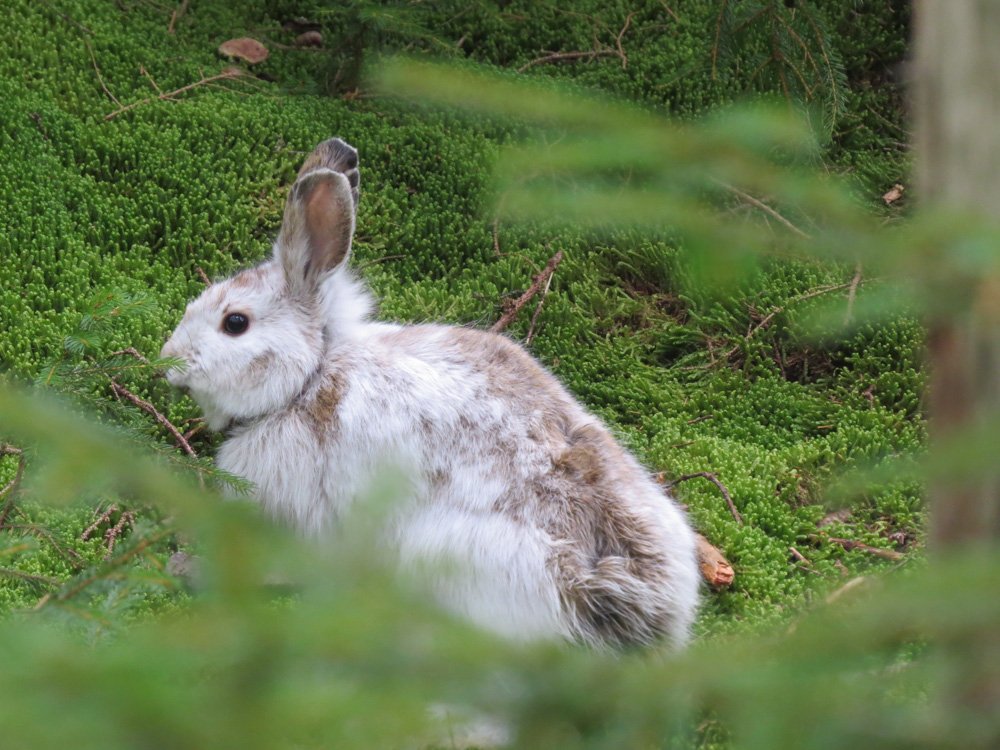
A snowshoe hare stands out against the lush moss atop Gaudineer Knob in West Virginia. Photo by Marketa Zimova
There’s also a major consequence for snowshoe hares whose winter coats don’t match their environments—death. “When we first worked on mismatch out west, we found that there is increased predation risk when hares become mismatched,” she says. Now Zimova and her colleagues are looking at whether the same pattern holds true on the East Coast of the U.S. by setting up camera traps to evaluate the prevalence of mismatch and how it impacts snowshoe hare survival. “We just assume that the consequences of mismatch are similar across North America, but we aren’t really sure,” she says. For instance, she said that in Wisconsin, predation risk was much higher for snowshoe hares with mismatched coats than it was for snowshoe hares in Montana. But in areas with thick, brushy shrubs, snowshoe hares were still able to avoid predation even if their coats stood out in the snowless landscape.
Although the team is still crunching the data on coat mismatch and predation risk in the Mountain State, Zimova has a hunch that the risks will be high given that many of the high-elevation spruce habitats have relatively little understory cover. But she says not all hope is lost. “They are a resilient species. Just the fact that they’re able to persist so far south is remarkable, so they might be able to adapt.” In fact, she’s already noted a few individuals from Canaan Valley that forgo the white fur and stay brown year-round.
While the future of snowshoe hare populations in West Virginia, and throughout their range, remains somewhat uncertain, I’m certainly looking forward to spending the winter searching for them among the snowy highlands. “That’s partially why I work on snowshoe hares,” says Zimova. “The mountains and high-elevation habitats where they live are just the most gorgeous places to be.”
Nikki Forrester is co-publisher of Highland Outdoors. Her love of bunnies began eight winters ago, when one pounced through the snow in her backyard in Davis and paused to say hello.