




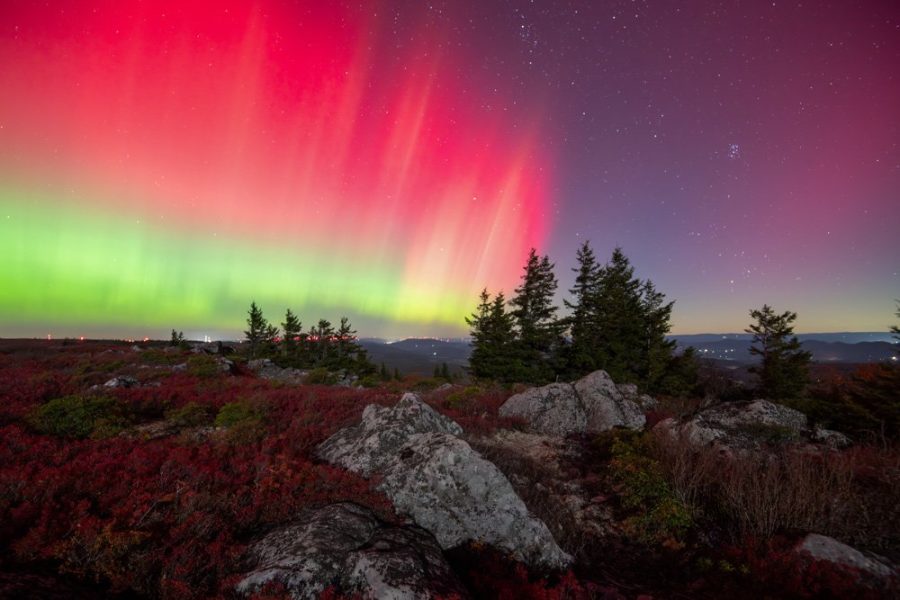
On October 10, 2024, I got a text from a friend asking if I was going to watch the Northern Lights that night. Supposedly, the internet was abuzz with chatter of a severe geomagnetic storm, which was forecast to set the sky aglow across the Mountain State.
I felt a brief pang of excitement, immediately followed by skepticism. Growing up in West Virginia, I remember reports on the evening news (which is how people learned of things before the days of social media) discussing the possibility of witnessing the aurora borealis. But they never panned out for me. It was either during some wee hour of the morning, or the phenomenon simply wasn’t visible. At best, some professional astrophotographer with a fancy camera rig would capture a hint of red in the sky, barely perceptible to the advanced optics of a DSLR camera, and certainly not visible to the naked eye.
Nevertheless, I’m a self-described nerd when it comes to weather and astronomy—even more so when dealing with the niche topic of space weather. As such, I let the excitement build while trying to moderate it with premeditated disappointment. Starting at dusk, I continually went outside my home in the middle of Davis to stare intensely at the sky with hopes of seeing something extraordinary. At one point, I looked to the northeast and saw what appeared to be a pinkish glow. Not letting myself get too excited, I figured my eyes were playing tricks on me, or that the hue was from light pollution.
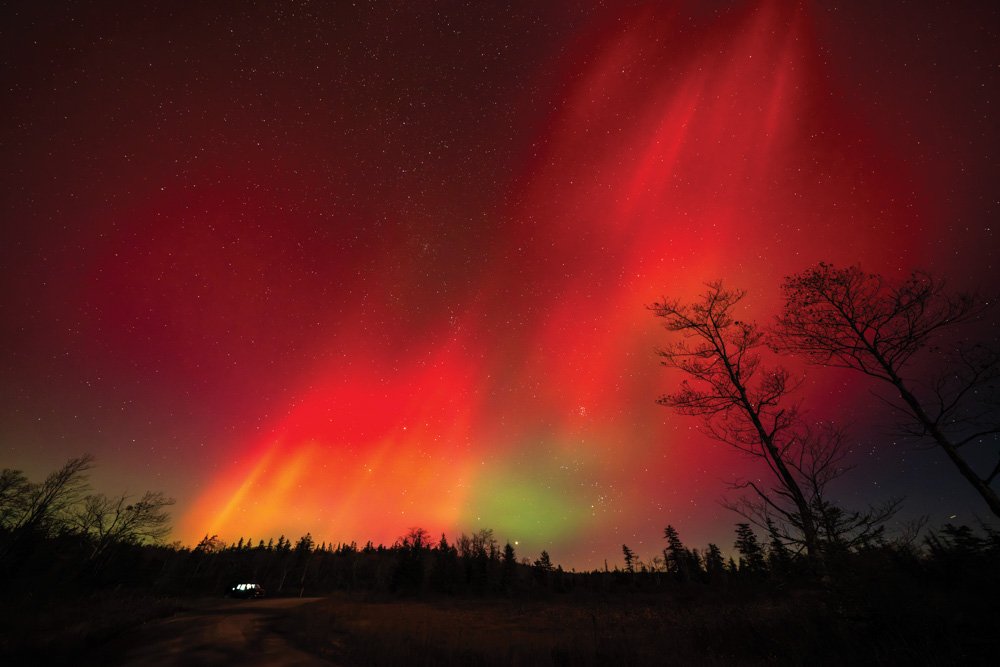
An array of red, yellow, and green pillars over a bog near Canaan Valley, photo by Dylan Jones
To double check, I got out my fancy camera and took a long exposure shot and freaked out as the camera confirmed what my naked eyes had seen. The sky was a solid dome of pink, with purple and blue hues to the north. Finally, the Northern Lights were happening in West Virginia, and I could actually see the cosmic show.
Show Time
On October 9, 2024, the NASA Solar Dynamics Observatory reported a strong solar flare—a powerful burst of electromagnetic radiation from our sun’s atmosphere—that peaked at 11:47 a.m. Eastern time. This X-class solar flare, the highest level of intensity, triggered a coronal mass ejection (CME), which is a magnetized cloud of plasma, that barreled toward Earth.
Some 30 hours later, the CME reached our home planet’s magnetosphere, causing a geomagnetic storm that unleashed a stunning display of lights across the Northern Hemisphere. Skywatchers and astrophotographers across the country, including folks as far south as Texas and Florida, were treated to an unforgettable show.
I ran inside, shouted to my wife, Nikki, that it was go-time, and scrambled to throw my camera gear in a backpack. We hopped in the car and sped to the top of the nearest mountain to post up in a spot free from light pollution and with a wide-open view of the cosmos.
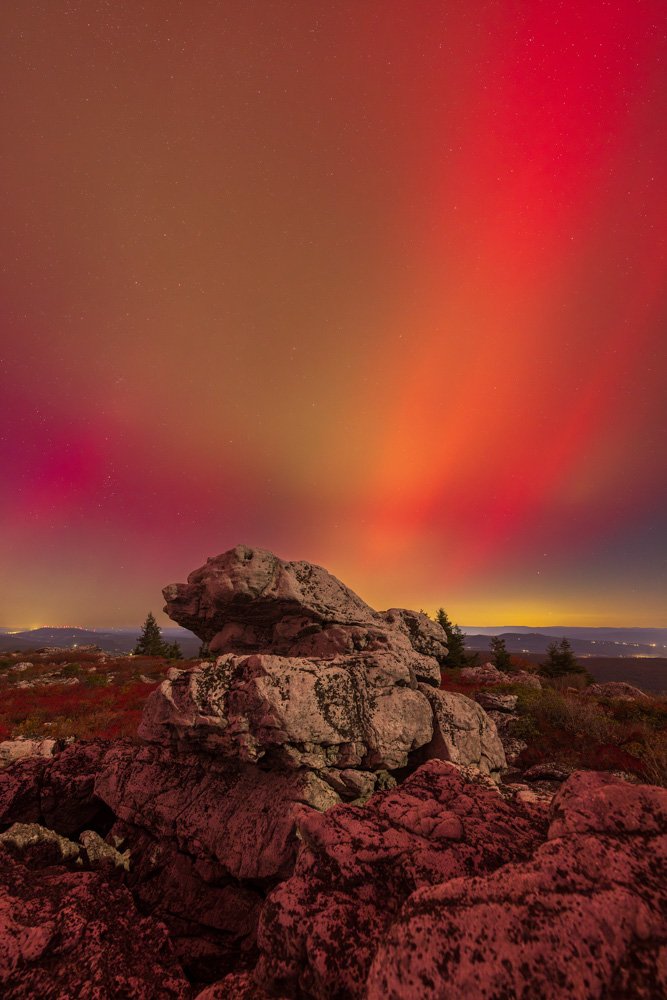
Anvil Rock in the Dolly Sods Scenic Area is illuminated by a glow from the aurora borealis. Photo by David Johnston
I figured we’d enjoy the novelty of seeing the faint glow with our naked eyes and be stunned by the images on the camera. But as I set up the tripod, the northern sky lit up in green and yellow tones as if a massive stadium was just over the ridge. The dome of light pulsated, fluctuating in color tones reminiscent of a Rastafarian flag.
The pictures on the camera screen were even more mind-blowing, but that didn’t matter, because the show we were watching with our own eyes left us speechless. A substorm, which occurs when charged particles transfer their energy from Earth’s magnetosphere into the ionosphere, further ignited the scene with dancing magenta waves speared with bright yellow light pillars. Nikki and I shouted all the expletives you’d expect to hear from two awe-struck humans.
Fifty-Fifty Chance
David Johnston, a photographer based in Randolph County, was prepared. He’s been photographing the night sky for over a decade and monitors space weather websites and apps to stay up to date for events like the aurora borealis. “I’ve gone out on nights where there was a good possibility, and nothing happened; you never really know for sure,” Johnston said.
Auroral displays are notoriously difficult to forecast. The complex interactions between charged particles in the magnetosphere are tricky to model. We have a hard enough time predicting weather here on Earth, even more so with space weather emanating from the sun some 93 million miles away. “Detecting the characteristics of an approaching CME, like how strong it is and its north-south orientation, which factor into whether or not there will be a visible aurora, involves a lot of uncertainty,” Johnston said.
But the severe alert from the X-class solar flare had Johnston and many others ready to head for the hills. “It became increasingly apparent that the possibility of auroras being visible down here in West Virginia was real and not just a pipe dream,” he said.
Johnston was joined by Nathaniel Peck, a photographer based in Maryland, who frequents the Allegheny Mountains for his shots. “I went up there thinking it would be a fifty-fifty chance, but I wasn’t gonna miss it,” Peck said.
The pair met up at the Dolly Sods Scenic Area and hiked out to one of their favorite spots along the spine of the Allegheny Front, away from the more popular cliffs of the Bear Rocks Preserve. Johnston and Peck shot sunset photos and then bundled up to wait for the sky to darken. At twilight, they both noticed a pinkish glow in the east, but Johnston, like me, figured the hue was from light pollution. He pointed his camera eastward and snapped a long exposure. “Lo and behold, the same deep pink appeared in the picture,” Johnston said. “It’s already happening, and it’s not trivial. The patterns and colors in the sky could change, not just minute to minute, but in some cases, over a matter of a few seconds.”
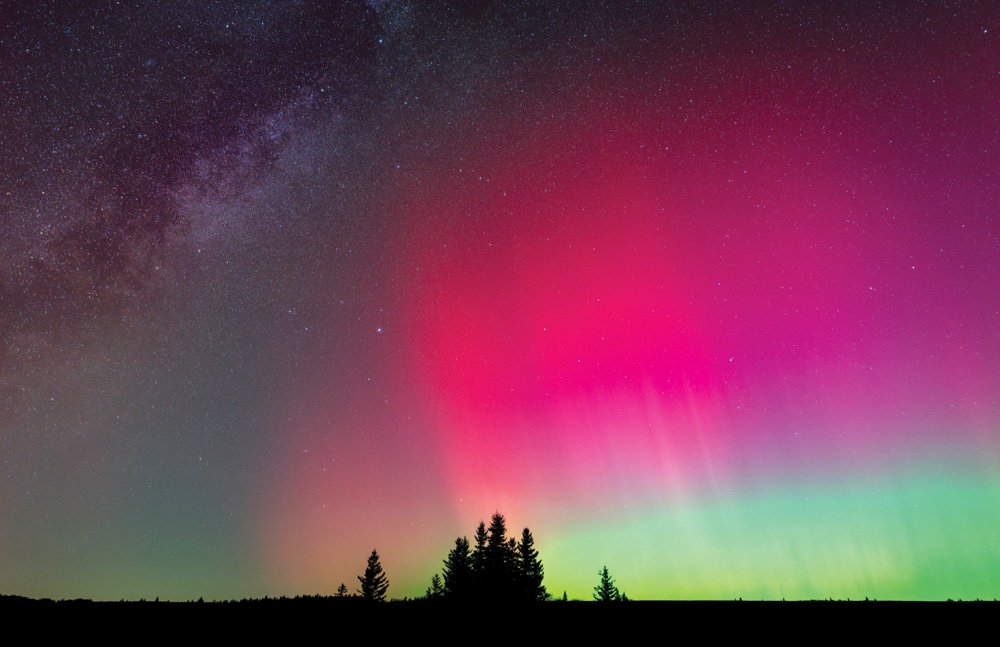
After the moon dipped below the horizon, the Milky Way made an appearance, adding another cosmic dimension to the scene. Photo by Matthew Grahovac
Peck set his camera up with a remote shutter so he could take a constant stream of photos while being able to experience the event himself. “It just got better and better as the night went on,” he said. “I did not dress warm, and it was so miserably cold and windy up there, but then the substorm started and I could actually see the pillars. I just sat down on a rock and stared up, speechless.”
Matthew Grahovac, an amateur photographer from Northern Virginia, also made the trek up to Dolly Sods with his wife to catch the show. Grahovac had his auroral interest stoked in the fall of 2024 while on a backpacking trip in the Upper Peninsula (UP) of Michigan. Up yonder in the UP, the Northern Lights aren’t as much of a rarity, and an event was forecast to be visible during his trip, so he downloaded a space weather app and started paying attention. Much to his disappointment, the aurora wasn’t visible that night, but his interest was piqued.
Grahovac received the notification of the October 10 storm and rushed to his car. “My wife and I discussed going to Shenandoah National Park because it’s closer, but we figured it would be crowded and it has more light pollution than Dolly Sods,” Grahovac said. “Every time I’ve gone to Dolly Sods, it was clear, and I remember seeing the Milky Way brighter than I’d ever seen it in the East. I told my wife that we probably won’t end up seeing anything, but it’ll be an adventure regardless.”
While heading west on the highway, Grahovac noticed a pink glow to the north. He pulled off the highway to make sure he wasn’t losing his mind. “I’ll never forget that drive, it was like nothing I’d ever seen before,” he said.
They were even more stunned to arrive at Bear Rocks Preserve and see the peak red foliage of the berry shrubs reflecting the brilliant reds of the aurora. Once the moon dipped below the horizon, the Milky Way became visible, setting up some surreal shots. They stayed into the early hours of the morning then drove home, logging just two hours of sleep before work. But Grahovac said the sleep deprivation was worth it to witness something he won’t soon forget. “It was a very cool moment that I got to experience with the person I love,” he said.
Bridge to the Stars
Huntington-based photographer Jesse Thornton has been focusing on the night sky as his primary subject for a decade. When he got the alert of the October geomagnetic storm, he hurried east into the ancient chasm of the New River Gorge for a chance at a unique shot.
It’s worth mentioning that there was an auroral display visible in West Virginia in May of 2024, but with a faint glow that wasn’t visible to the naked eye, it paled in comparison to the October event. “I shot the May event along the Ohio River, and the image has a little patch of pink in the sky you can barely tell is there, and I thought it was the greatest thing ever,” Thornton said.
When he set up in the bottom of the New River Gorge, he was able to see the glow with his own two eyes. “It appeared as a very ominous, dark, reddish glow cast over the entire scene,” he said. “I’m amazed that the surface of the river was reflective of the color.”
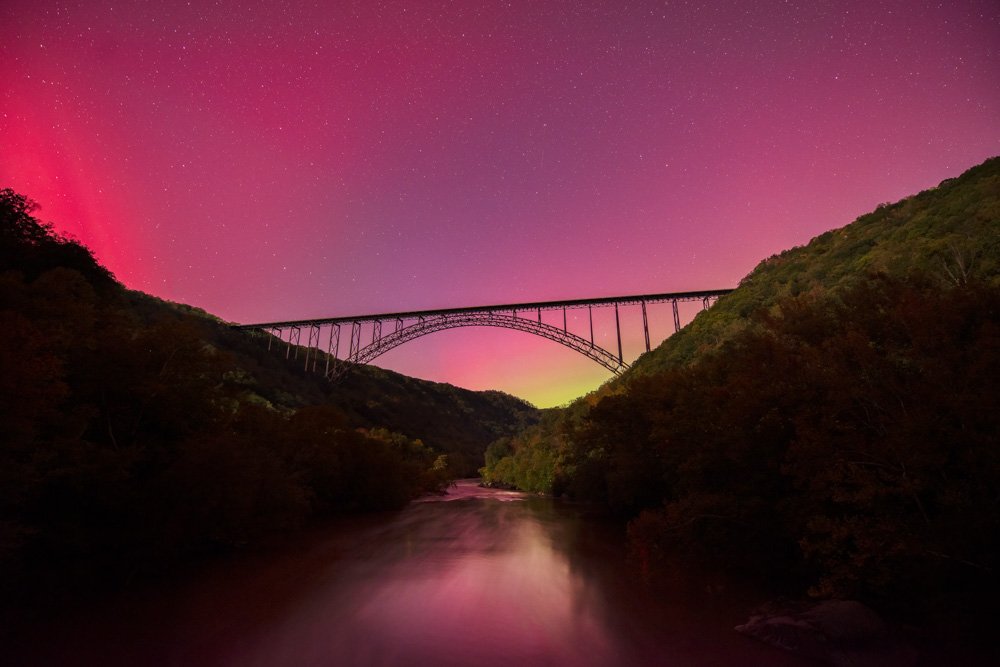
The iconic New River Gorge bridge looks especially stunning under the Northern Lights. Photo by Jesse Thornton
Having only a sliver of sky visible meant missing some of the pillars that appeared for viewers, like those in the Allegheny highlands, who were perched above their surroundings. “Essentially I sacrificed what would have been a better light show to get the bridge shot,” Thornton said.
For Thornton, seeing one of the state’s iconic structures spanning one of the planet’s oldest rivers to the backdrop of a rare cosmic event is something he won’t ever forget. “As somebody that does wide-angle astrophotography, it was kind of the pinnacle of what’s possible here,” he said. “I was just ecstatic. It felt like a culmination of all the time and effort of the last decade put into one night.”
By the end of the cosmic light show, I experienced a heavy dose of what I like to call sublime insignificance—letting trivial troubles melt away while feeling part of something truly grand, regardless of how unfathomable the scale may be. Although I didn’t want it to end, the intensity of the substorm had clearly faded, and my hands were going numb. All good things must come to a close, and it was time to head home. Fortunately, the shared sense of awe and camaraderie from that magical evening lives on through the art of photography. The collective body of shots from that evening serve as a friendly reminder that, sometimes, the stars (and complex interplay of space weather) really do align. After decades of letdowns, I finally got to experience the Northern Lights, something I’ve dreamed of seeing since I was a kid, right here in the Mountain State.