




Written by Amanda Smith
Locals say Trey Swartz embodies the Appalachian creator archetype. Eager to live his dream of climbing and creating in the New River Gorge, Swartz quit his blue-collar career in heating, ventilation, and air conditioning and moved to Fayetteville in February of 2021 to start his journey in jewelry making as the Southern Pillar Jeweler.
Like many West Virginia transplants, Swartz found community, creativity, and freedom in the hills. Swartz’s father grew up in Saltville, Virginia, an old salt mining town, then moved to the suburban sprawl of Northern Virginia to raise his family. “I didn’t really know anything about Appalachia until I moved here and started climbing,” Swartz says. “Since then, I’ve learned so much about my family’s extensive Appalachian roots. I’m pretty much the first generation of my family to not grow up in the mountains, but they drew me back in and feel like home.”
He came to Fayetteville for rock climbing but soon discovered his love for crafting jewelry using raw materials that are found throughout the region. Now, he spends hours foraging for these treasures along the banks of the New River and high up along the cliffline that rims the Gorge, seeking out special objects to set in custom-sculpted bevels.
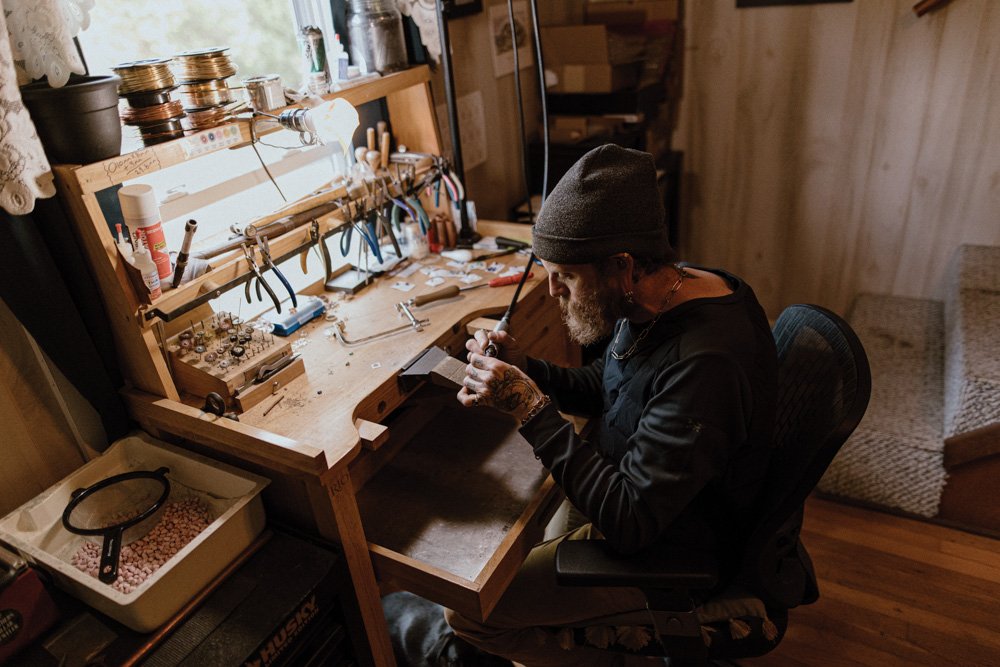
Swartz working in his home workshop. Photo by Braiden Maddox
One day while Swartz was out climbing at Hawks Nest Dam, he spotted a blue rock embedded in the trail—a stark contrast to the grays and oranges of the region’s classic iron-rich sandstone. “The rock looked almost glass-like,” he said. Unsure of its composition, Swartz took the mineral home to begin his work of setting it in silver. Later that week, he got to talking to a local at the hardware store who told him the mineral was not a mineral at all, it was slag. Or, as the man described it, trash.
Elemental Relics of the Past
The New River cut through rock layers that date back over 300 million years, creating one of the planet’s oldest gorges. The erosion-resistant Nuttall sandstone that forms the dramatic hundred-foot cliffs is popular with rock climbers, while the surrounding shales and coal beds below provide geologic evidence of the ancient swamps and river deltas that once characterized the region.
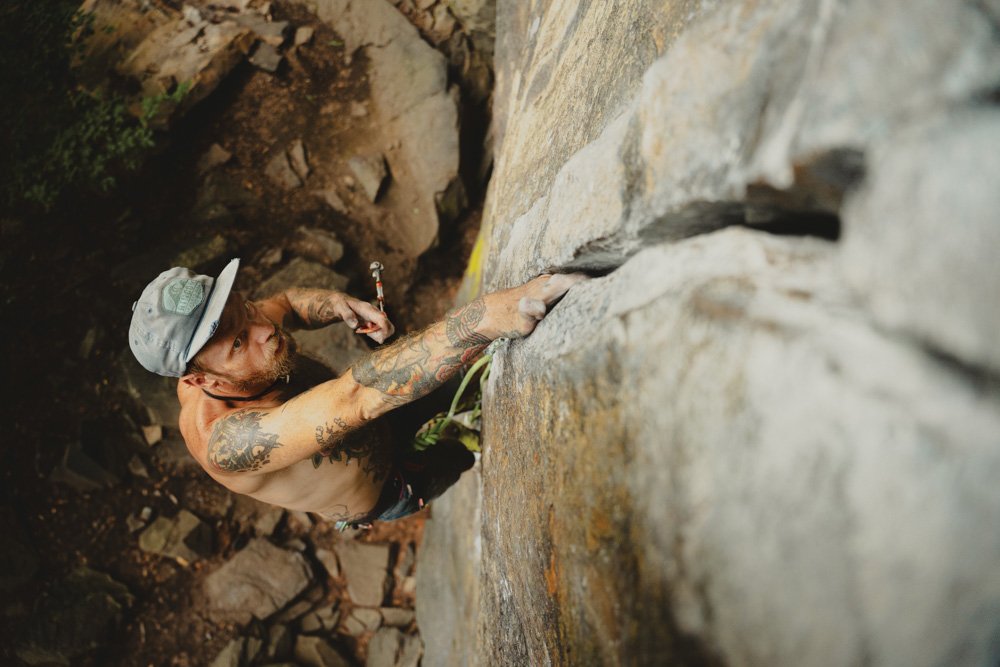
Trey Swartz climbing High Times (5.10+) at the Bridge Buttress in the New River Gorge. Photo by Karen Lane
Along the banks of the New River and its tributaries, one can find more than sandstone cliffs and seasonal wildflowers. Mixed among the cobbles are pieces of slag, rock formed as a by-product of smelting ore that now dot the landscape as relics of West Virginia’s industrial past.
Coal slag is the most common variety of slag found in the New River Gorge. It’s visually similar to volcanic rock in that it’s lightweight, filled with small holes, and often black or dark brown. This slag forms when waste rock layers, such as shale or sandstone, are burned along with coal. The intense heat melts and partially recrystallizes the minerals, creating a porous, brittle stone. Coal slag had multiple industrial uses after production—crushed for use as an abrasive, incorporated into road surfacing, or used as fill material. It’s often found along Appalachia’s rugged riverbanks, redistributed by floods. It can even be seen floating in the water due to its porous nature.
Iron slag, though less common, can also be found along certain stretches of the New River and its tributaries. This material originated in blast furnaces that processed iron ore in the 19th and early 20th centuries. During smelting, impurities in the ore, along with silica, alumina, and other elemental oxides, floated to the top of the molten iron. Workers skimmed off this molten waste, which then cooled into solid, glassy fragments.
Swartz finds immense beauty in these waste products, overlooked by most who spend time on the riverbanks. Coal slag can be blue, green, or rust-red, depending on the mineral content of the original ore and furnace conditions. “Every once in a while, you’ll come across one with blue and green stripes, or even tiny specks of embedded metal and opal-looking sparkles,” he says.
From Slag to Sleek
Swartz is a self-taught artist with a love for scavenging materials. He began his jewelry making career with river glass and chunks of coal. “The first time I used river glass was a few years ago, over the winter when I was out of cabochons [highly polished, unfaceted gemstones] I had bought before I was cutting my own. I saw a piece of glass and wondered if I could use it, and it worked perfectly,” Swartz says.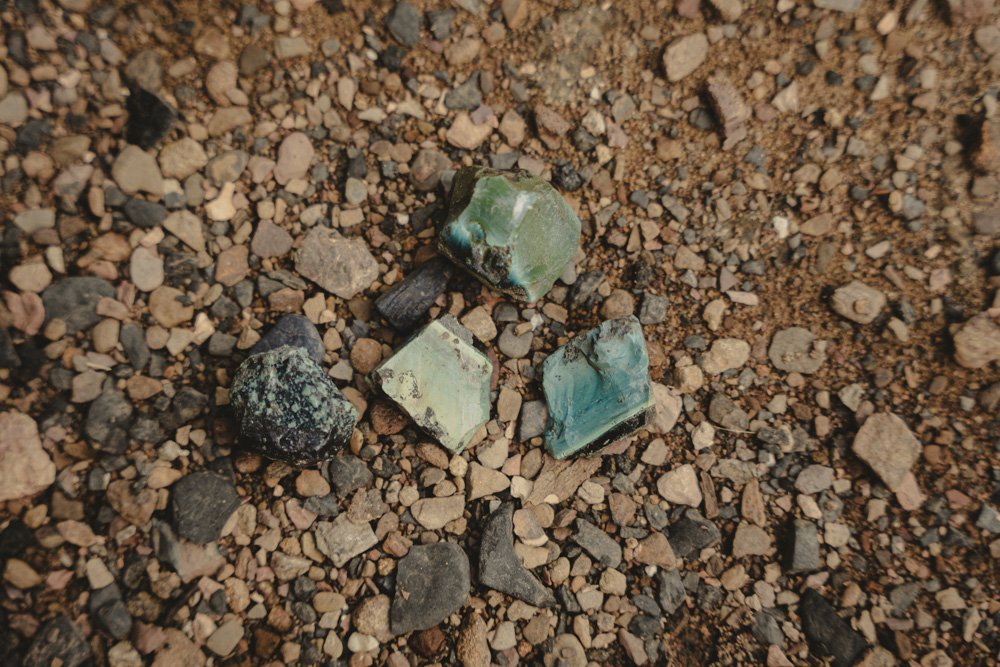
Rings with polished chunks of coal came next. “I watched a friend make a ring and then he let me use his bench to make one,” Swartz says. “I learned the craft by watching online videos and playing with metals in my shed during the pandemic, then taking more extensive classes over the years.”
After dialing in his craft, Swartz entered and won a business plan competition and used the winnings to purchase lapidary equipment—a set of tools and machines that shape, grind, cut, and polish stones. One of his most “professional” tools is a cabbing machine, which has six diamond-coated wheels used to grind, shape, and polish gemstones. These essential tools allowed Swartz to transmute the raw chunks of slag and quartz into the beautiful treasures he now sells.
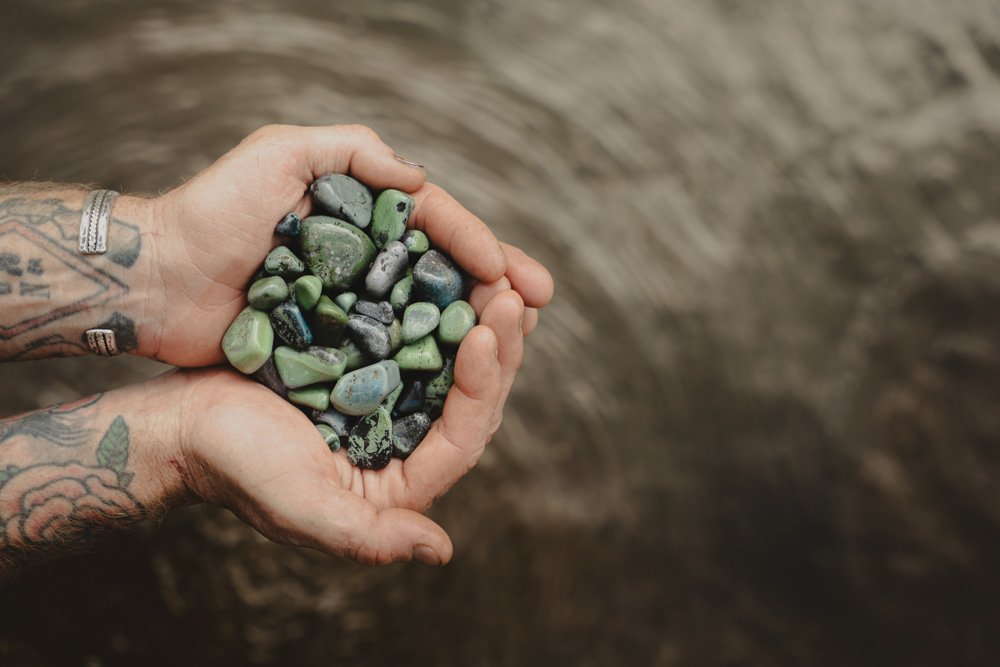
Top: Chunks of slag. Bottom: Polished pieces of slag. Photos by Karen Lane
Once Swartz has his slag cabochon ready, he uses his smithing skills to shape silver pieces with hand tools like pliers, files, and hammers. “I use a torch to solder them together to create the ring. Each piece is made one of a kind to fit each stone,” he says.
Swartz loves the hunt for slag, which allows him to spend time outside and scavenge for unique materials most people would overlook. While spending time outside is a perk of the craft, Swartz must balance that with time spent inside his workshop. A basic ring takes about an hour or two for Swartz to complete, with more complex designs taking upwards of four hours per piece. “I’ve gotten very quick and efficient over the years,” he says. “I like making several at once in batches of similar styles and may spend up to ten hours in one day working on a set.”
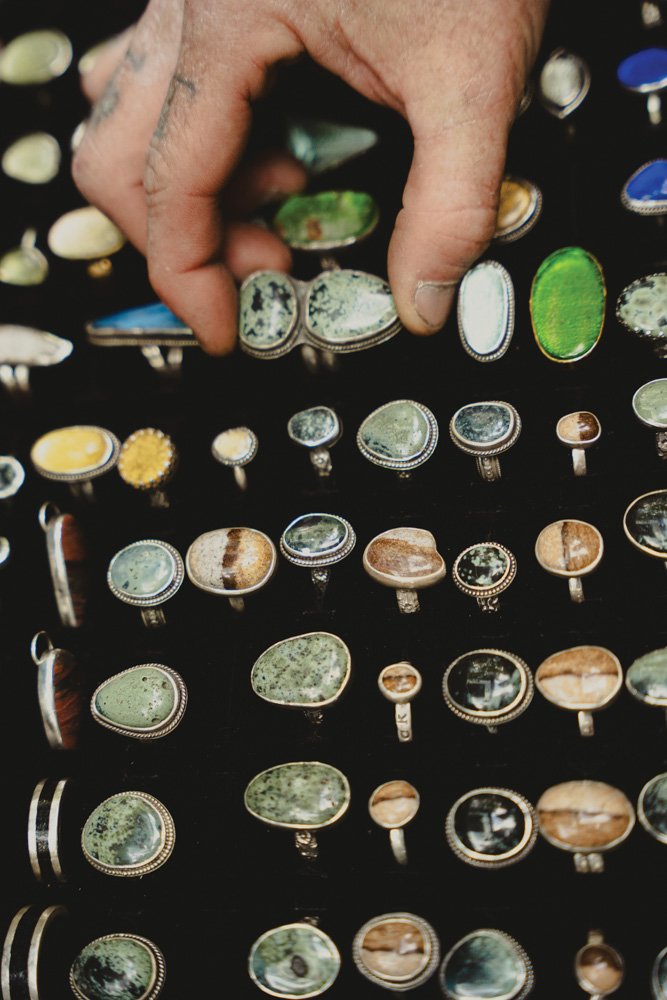
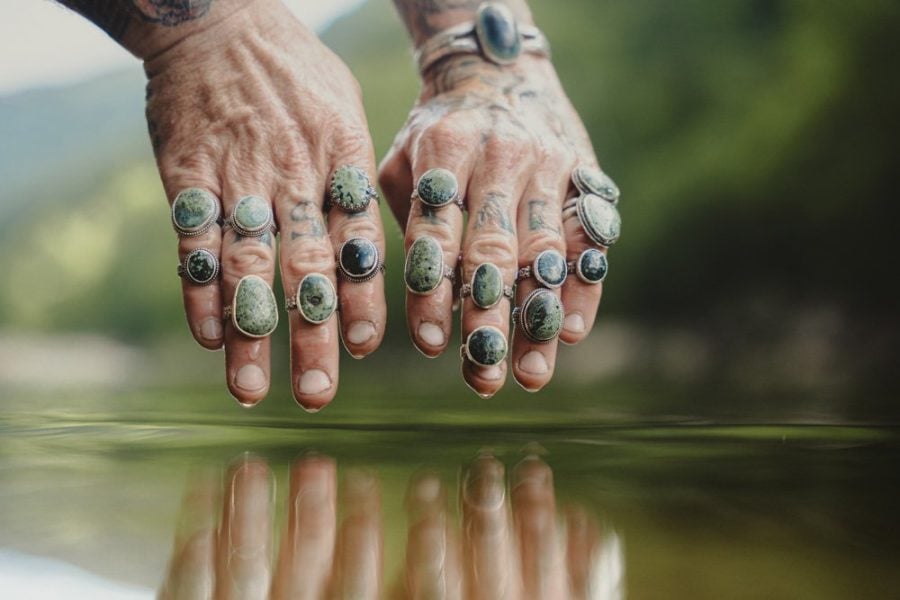
An array of Trey Swartz’s rings. Photo by Karen Lane
From Trash to Treasure
To Swartz, slag is far more than a waste product—it’s a record of the industrial methods, labor, and economic history of the Appalachian region. Swartz says found objects are far more inspiring to him than the sorts of precious stones that are easy to order online. He gets creative satisfaction from making jewelry out of these forgotten materials. Or, as he puts it, “I like trash.”
Alongside his slag rings and pendants, some of his favorite materials to work with are river glass, sandstone, and coal. These works are created and sold back to people who have an interest in owning a piece of West Virginia’s history. “Once their trash, now their treasure,” he says.
You can find Swartz in the Wild Kind Artisan Boutique, his shop in Fayetteville, where he teaches ring-making courses in collaboration with another jeweler. When he’s not turning trash into treasure, he’s out climbing with his dog, Coal, in tow.
Karen Lane is a climber and photographer living and working in Fayetteville. Her work showcases the landscape and rock climbing scene of the New River Gorge to bring East Coast representation to outdoor media.
Amanda Smith is a climber and geologist living and working in Fayetteville. She works with local organizations to keep climbing areas safe and to educate climbers about best environmental practices on the wall.