


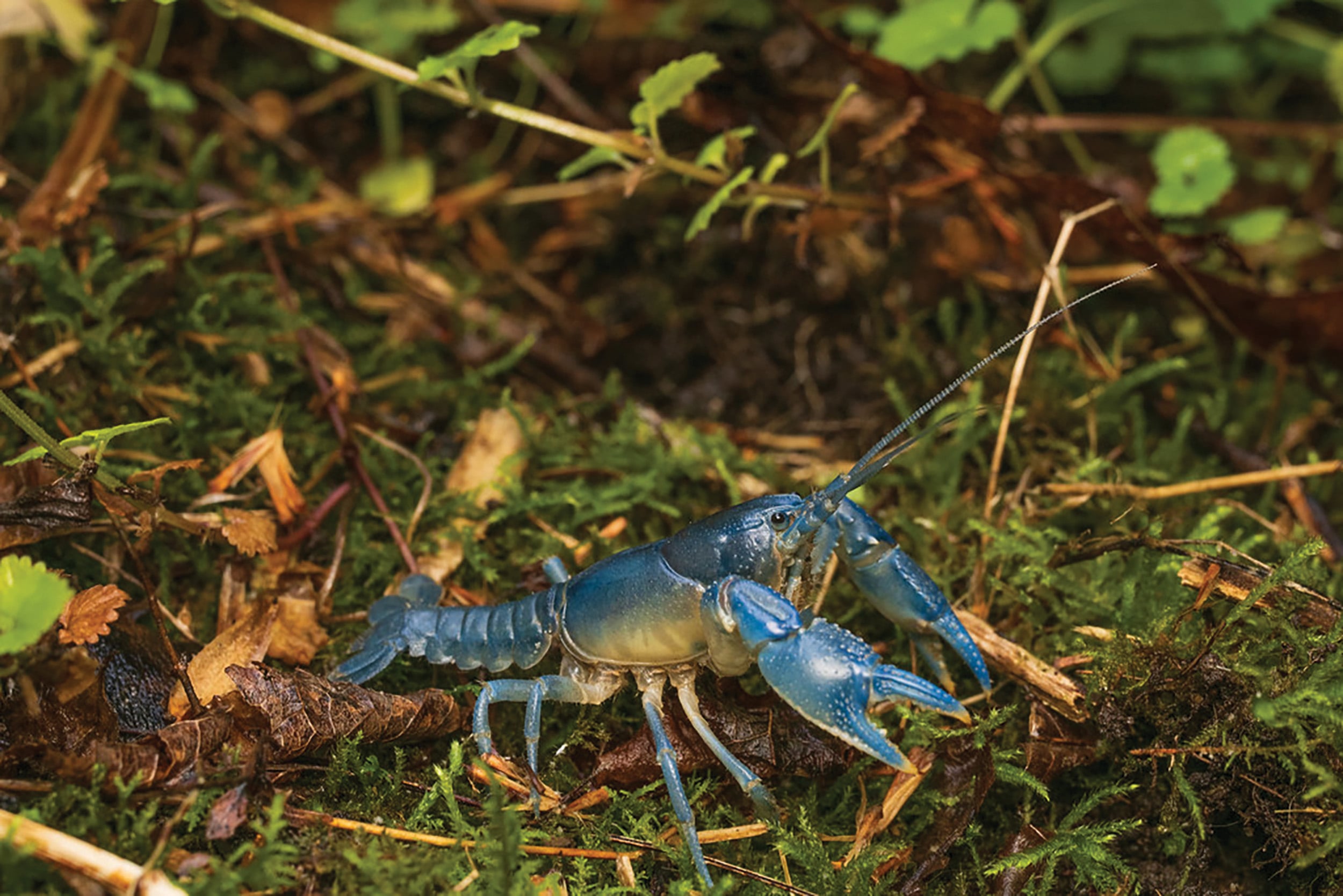
The Big Sandy River’s tributaries—including the Tug and Levisa forks—wind through southern West Virginia, southwest Virginia, and eastern Kentucky. In these creeks and streams lives one of Appalachia’s rarest residents— the brightly colored Big Sandy crayfish (Cambarus callainus), named for the watershed to which they are endemic. Wade into these streams long enough, and you’ll probably also encounter the scientists fighting to save them from extinction.
Until 2009, the Big Sandy crayfish was thought to have gone the way of the dodo. It hadn’t been seen in West Virginia since 1989. Then, one of those scientists—Zachary Loughman, a West Liberty University biologist—found three in one day. As a result, since 2016, it’s been under federal protection by the U.S. Fish and Wildlife Service as a threatened species.
The Big Sandy crayfish is one of 28 species of crayfish currently found in West Virginia. The olive-brown body, called a carapace, grows to about two inches long. These crayfish know how to accessorize—their claws and legs come in a variety of blues, from cobalt to shimmering shades of teal. They also sport two crimson antennae, with matching ridges on the shell that covers their head, like a helmet with racing stripes. Big Sandy crayfish are thought to live for five to seven years but do not start reproducing until they are around 3 years old.
Propagating the species
Loughman says crayfish are “ecosystem engineers.” They shred leaves and dead things in the sediment, releasing organic material that provides nutrients to other aquatic residents. Fish use abandoned crayfish burrows as safe places to lay eggs. Snakes, salamanders, and even mice move into previously occupied burrows, calling dibs on ready-to-move-in domiciles. Crayfish get eaten by a lot of other animals, making them an important part of the food web. They also serve as little clawed barometers of overall stream health, helping scientists like Loughman understand the pressures on the ecosystem—fewer crayfish are an early warning sign that a waterway might be in trouble.
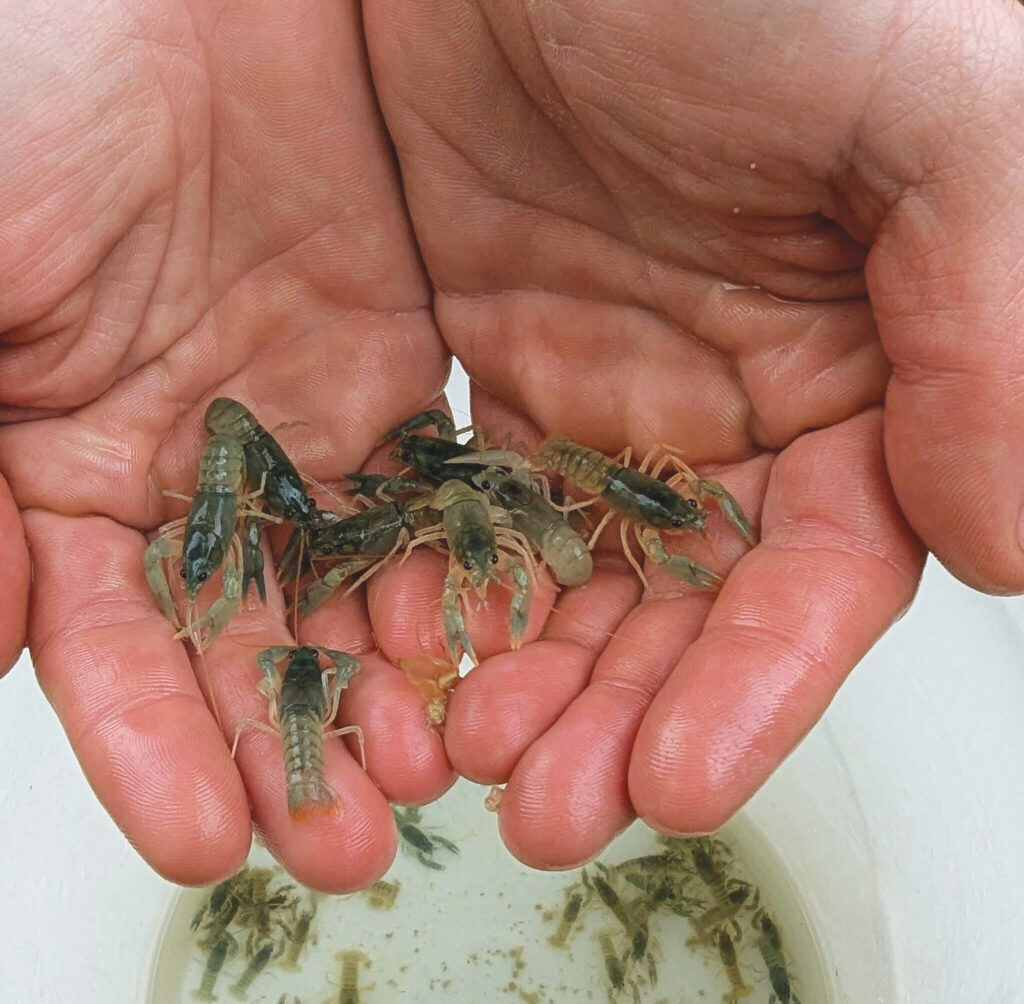
The Big Sandy River crayfish was once thought to be extinct. Now, thanks to a group of hard-working scientists, the species is returning to its home range. Photographed by Andrew Phipps
Loughman has worked with Andrew Phipps, a biologist at the White Sulphur Springs National Fish Hatchery, and Brian Watson of the Virginia Department of Wildlife Resources to support crayfish repopulation in the Big Sandy watershed. To propagate them, eggs are brought to the fish hatchery, and the crayfish are raised in captivity until they reach sexual maturity. Crayfish in the wild eat clay to help take up the nutrients they don’t get from other food sources, according to Phipps. But in captivity, the animals’ diet provides plenty of protein and fat and also supplements the micronutrients they need to grow new shells after molting. Molting supports accelerating growth and is critical for survival, so by developing a specialized diet that shortens the time it takes for Big Sandy crayfish to reach adult size, Phipps and his team are giving them their best chance once they’re re-released into the wild.
Releasing propagated crayfish is just one of the steps required to support repopulation of the species in native streams and creeks. It’s also important to know how many of those grown in captivity are surviving, in addition to the few already living in the watershed. This way, enough resources can be allocated to boost the population and move the Big Sandy crayfish off the threatened species list.
Each crayfish grown in captivity receives an elastomer tag in its abdomen that will remain in place even when it molts its shell. This allows the same ones to be tracked as they grow and age. Annual surveys are conducted to see how many are in the area, and understanding where and how crayfish move is critical to this effort. “When you’ve got a mobile critter, it adds a level of complexity to that monitoring effort,” says Watson.
On the move
Loughman and his students have also used tiny tracking devices to capture the movements of a different endangered West Virginia crayfish species, the Guyandotte River crayfish (Cambarus veteranus), not only to better understand when and how they move and where they go, but also to identify their preferred habitat to better inform conservation efforts. This tracking method is called radiotelemetry.
“We should definitely be doing all kinds of habitat work,” says Phipps, a point on which he, Loughman, and Watson all agree. Each of them notes that some level of habitat restoration is needed for repopulation to be successful. One reason there may be a limited number of Big Sandy crayfish in the Levisa Fork, according to Watson, is related to habitat availability. These crayfish prefer to inhabit “big, flat slab rocks that have gaps underneath them,” he says. Changes to the Levisa Fork over time, including flooding, have removed some of this habitat, meaning there are fewer places for these crayfish to live.
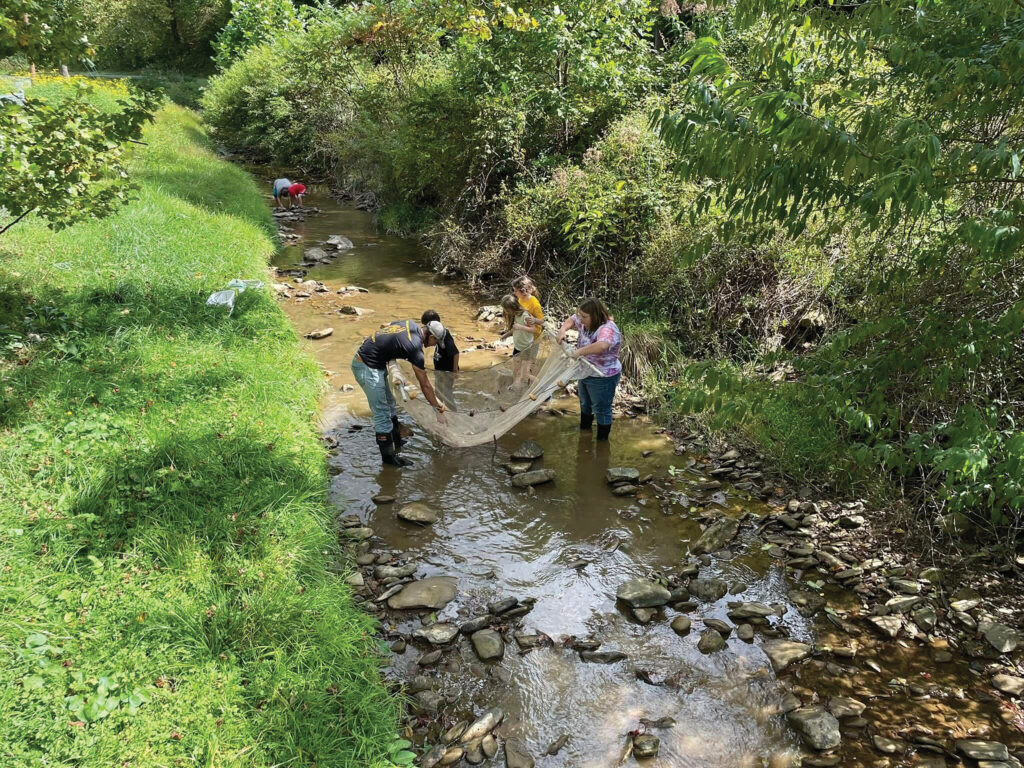
Raising and releasing the crayfish is only part of the process. Using a variety of techniques, researchers monitor the movements of the animals in hopes of steering future conservation efforts in the right direction. Photographed by Zachary Loughman
The combined use of radiotelemetry with accelerated propagation and habitat restoration efforts has the potential to speed up the Big Sandy crayfish’s recovery. This multi-pronged approach could also be applied to other endangered crayfish species in West Virginia and beyond.
Going home
While the work to boost the Big Sandy crayfish’s numbers continues, two of these scientists share a sense of nostalgia when they think back on their childhoods. Many Appalachians grew up playing with crayfish, and Phipps and Loughman were no different.
In May of 2024, Phipps returned home to southwest Virginia for a Big Sandy crayfish release “into the McClure River, which is actually darn near my front yard. I had Big Sandy crayfish in the creek at home when I was a kid.”
Loughman is a West Virginia native and the director of West Liberty University’s Appalachian Aquatic Conservation Center. It’s one of only two such facilities in the country. He has also had an all-blue crayfish named after him—Cambarus loughmani, found in the Teays River Valley. In talking about why he works so hard to conserve crayfish like the Big Sandy, Loughman thinks back over the years. “I played with those when I was a kid,” he says. “It’s part of an Appalachian childhood, if you’re doing it right.”
Why so Blue?
Crayfish, crawdads, crawfish, mudbugs, or even crawdaddies—call them what you’d like (though we might look at you sideways for that last one), but don’t call them boring. Crayfish are known for their stylish inclinations.
These dirt-dwellers don shades of minimalist olive brown, elegant emerald, chic cobalt, electric turquoise, and avant-garde shades of orange and purple.
Most animals with bright coloration evolved that way to attract or repel, like a male bird shaking his tail feathers or a poisonous amphibian with a built-in hazard label. But not crayfish.
So what evolutionary forces are behind all this crustacean couture? Diet, genetics, and habitat, to name a few.
Some shades allow for camouflage in the brown–red–blue hues of foliage, leaf litter, silt, and stones in and around streams, while others come from water chemistry or pigments in food sources. That’s why the same individual may change color over time.
But no matter what natural selection has to say on the subject, we’re sure even evolutionary biologists would agree that these stream-dwellers are just divas with great taste and attitude problems.