

From Private to Priceless
When the B&O Railroad crossed the Appalachian Mountains in Maryland and West Virginia in the mid-1800s, it opened the breezy, beautiful highlands to vacationing Easterners. Brookside Resort in Aurora, West Virginia, not far from the B&O station at Oakland, Maryland, was one of their summer retreats.
The railroad made other things possible, too—like clear-cut timbering. Brookside had a big, peaceful stand of hemlock where guests hiked and rode horseback. When the rich started driving cars in the 1910s and resort attendance dropped off, longtime resort caretaker Branson Haas bought Brookside Woods to keep it intact. And 20 years later, he sold it to the state of West Virginia on the condition that it never be cut—to protect it from the “galdarned timberman,” as one chronicler documented.
Today, it’s the 133-acre Cathedral State Park: the state’s largest stand of old-growth forest, with trees 350 and even 400 years old. Its 3 miles of hiking trails wind among 100-foot giants, and a riot of ferns, mosses, and wildflowers thrives in their shade, 170 plant species in all. Haas died in 1955. But he gave all who came after the chance to experience this one spot on the planet in a relatively undisturbed state. In 1966, it was designated a National Natural Landmark, a rare example of pre-colonial mixed eastern hemlock–hardwood forest.
People who lived through that age of clear-cutting saw a singular, fast-moving threat to wild places, and a rare few had the foresight and the means to draw hard boundaries against it. Today, the threats are slow and diffuse: creeping development, mainly. But happily for all of us, the impulse to preserve lives on. Some of the most distinctive and restorative places we can visit were set aside for us by forward-thinking landowners.
Yankauer Nature Preserve
When Dr. Alfred Yankauer served as an adviser at the World Health Organization in Washington, D.C., in the early 1960s, he and his wife, Marian, bought a 104-acre getaway on a high bluff overlooking the Potomac River in Berkeley County, West Virginia.

The mile-long Kingfisher Loop trail in the Yankauer Nature Preserve is known for abundant wildflowers, excellent birding, and stunning views of the Potomac River.
Courtesy of West Virginia Land Trust
The land once grazed cattle but, by the 1960s, it was reverting to nature. The Yankauers camped there as often as they could, and it became a real refuge for them. So when they moved to Boston in 1966, they donated it to The Nature Conservancy (TNC) to preserve it in its natural state.

Preserves like the ones managed by the Potomac Valley Audubon Society are increasingly important as development diminishes safe refuge for migrating species like the monarch butterfly.
Courtesy of West Virginia Land Trust
TNC is a giant conservation organization today, protecting more than 125 million acres on six continents. But in the 1960s, it was just getting started. It protected its first 60 acres, at the Mianus River Gorge in New York, in 1954, and only hired its first full-time president in 1965. The Yankauer donation was an early one.
The property wasn’t fully open to the public until the Potomac Valley Audubon Society (PVAS) agreed in the mid-1980s to co-manage it. It’s matured since the Yankauers camped there. “The Yankauer Nature Preserve has been allowed to regenerate,” says PVAS Executive Director Kristin Alexander. “So what was a cedar grove, those are getting older, and it’s now an interesting mix of older cedar forest and oak–hickory forest, with gigantic sycamores along the river.” There are a couple miles of hiking trails, with more than 100 bird species and almost 200 species of flora. “We do wildflower walks—they’re spectacular there in mid-April.”
PVAS has since taken on other properties in West Virginia’s Eastern Panhandle. In 2006, the organization became co-manager of the ridgetop Eidolon Nature Preserve, donated to TNC by longtime owner Marguerite Zapoleon. In 2011, Stauffer and Elinor Miller donated their wetland directly to PVAS. Stauffer’s Marsh, once filled in as farmland, was placed under a conservation easement in the 1990s—that’s a legal agreement that permanently limits the uses of the land—and restored by the U.S. Department of Agriculture.
And in 2016, Linda Case and her arts and sustainability nonprofit CraftWorks donated 13 acres to PVAS. That became the nucleus, through Case’s ongoing generosity, of what is now 74 acres. In an area that’s under intense development pressure, it’s all soon to be protected under conservation easement by the West Virginia Land Trust—more on the WVLT below.
A couple miles of trails there pass through a variety of habitats. “Cool Spring Preserve is everything from a pollinator meadow to big oak trees to an old orchard,” Alexander says. There’s also Cool Spring Marsh, the only example in West Virginia of rare Shenandoah Wet Prairie. And in the former CraftWorks studio, PVAS operates the Case Nature Center, which hosts guided walks, natural history workshops with animal ambassadors, and summer camps.
Thanks to Case, the Millers, Zapoleon, and the Yankauers, PVAS now manages nearly 600 acres of distinctive protected lands for public enjoyment. Alexander mentions a young summer camper who later became a camp counselor, then camp director, and he’s now a geology major in college—just one of many such stories. “The generosity of these landowners has allowed thousands of summer campers, school children, families, and just community members every year to learn about and appreciate the natural world and hopefully gain some sense of the value of preserving green spaces.”
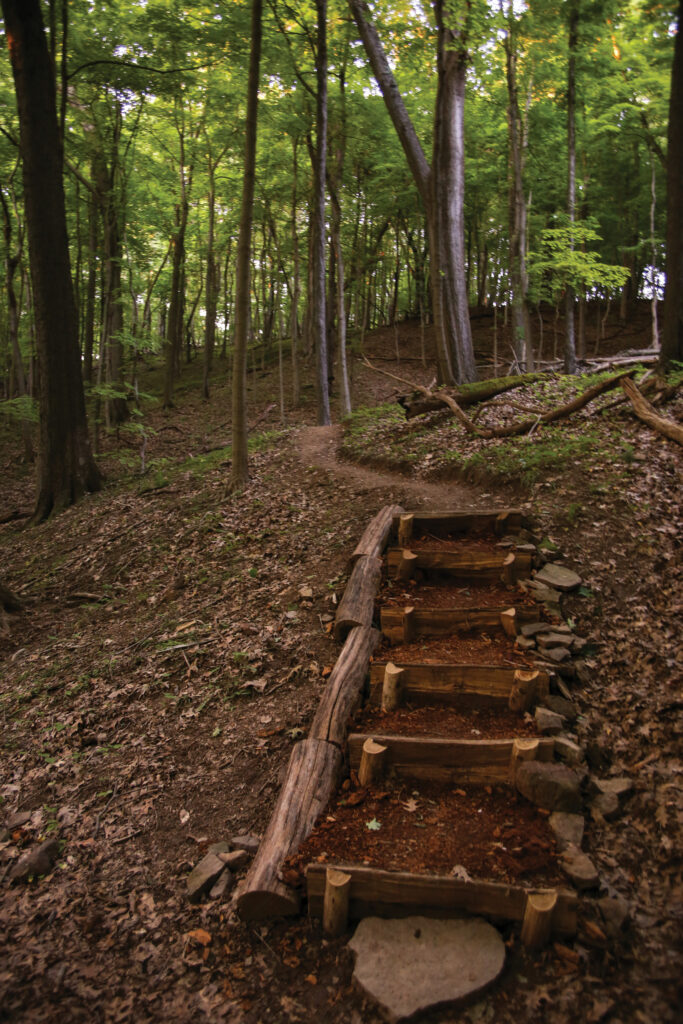
The high canopy and clear understory of Elizabeth‘s Woods at the West Virginia Land Trust‘s Toms Run Preserve has the serene, sacred feel that is distinctive to old-growth forests. Volunteers have created trails and trail structures at Toms Run that are in harmony with the surroundings.
Courtesy of Forks of Coal Foundation
Elizabeth’s Woods / Toms Run Preserve
In the mid-1990s, Elizabeth Zimmermann donated 84 wooded acres just south of Morgantown, West Virginia, to the West Virginia Land Trust. The WVLT is known today for its hand in conserving more than 60,000 acres of extraordinary properties in every part of the Mountain State. But in 1994, there was no WVLT. Zimmermann’s bequest was the founding property—the catalyst for the organization’s formation.
Zimmermann’s vision was for her mature woods to serve as a nature preserve and a place for recreation and education. The WVLT held Elizabeth’s Woods passively until about a decade ago. Two adjacent tracts came available, and the organization enlarged its holdings and created public access.
The WVLT calls its now-320-acre oasis beside the Monongahela River Toms Run Preserve. It’s mostly mature forest on gentle slopes, with sharper drop-offs closer to the river. In one steep and bouldery reach, Toms Run cascades as Little Falls. Rhododendrons grow tall there, alongside beech trees and maples. On the ridges, oaks and hickories dominate.
Migratory birds in great numbers stop at the preserve in spring and fall. The forest is part of the national Old Growth Forest Network, highlighting its impressive closed-canopy stands. Its slopes filter rainwater that flows into Toms Run, a tributary of the Mon River, sending cleaner water to Morgantown’s drinking water intake.
Toms Run Preserve is big enough that shy creatures feel at home. Black bears raid neighbors’ bird feeders from there. Fishers, a weasel relative the size of a house cat, live there, too. The preserve is also big enough that its 2-plus miles of trails feel far from the sights and sounds of civilization.
Not all land trusts develop public access—their core function is often to hold development rights to preserve properties in a natural or undeveloped state in perpetuity. But the WVLT goes beyond that. “When people talk about moving to Morgantown, they want to know, ‘What can you do there?’” says Executive Director Brent Bailey. “We play a really important role here, as in other communities around West Virginia, in preserving places that protect the outdoors and give people recreational opportunities.”
Forks of Coal State Natural Area
It’s still possible to go the Branson Haas route and work directly with a state agency. Jack Workman did it a decade ago, and we have the Forks of Coal State Natural Area to show for it.

he Forks of Coal State Natural Area preserves a large swath of wilderness at the place where the Little Coal and Big Coal rivers meet to form the Coal River. Courtesy of Forks of Coal Foundation
Jack and Claudia Workman were chemical engineers. The success of plastics they engineered for the mining industry allowed them to buy a large tract in Boone County, West Virginia, between the Little Coal and Big Coal rivers: the Forks of Coal.
“Jack and Claudia never had children, but they loved children and wanted them to learn about nature,” says Forks of Coal Foundation President Kathy Hill, who knew the Workmans. When his wife passed on in 2014, Jack Workman negotiated an agreement with the West Virginia Division of Natural Resources: About 100 acres of their land would be transferred to the WVDNR to become the Forks of Coal State Natural Area. And on it, the agency would create the Claudia L. Workman Wildlife Education Center.
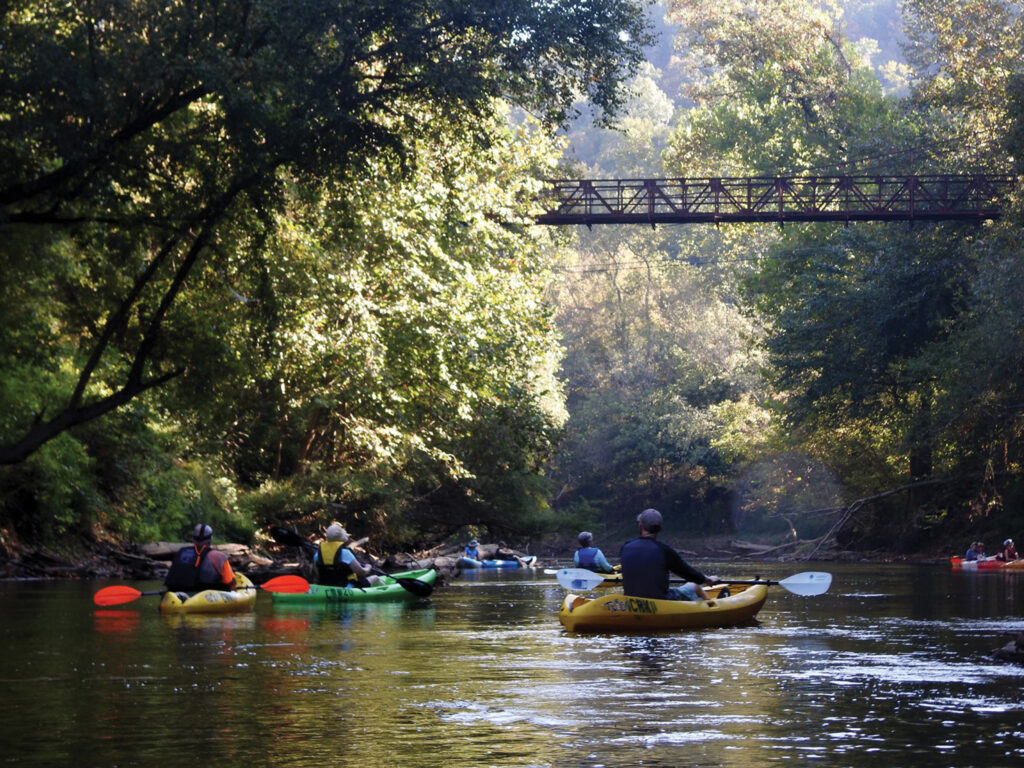
The Coal rivers are popular paddling destinations, and the Forks of Coal Foundation leads an occasional nature tour on the water. Courtesy of Forks of Coal Foundation
Opened in 2022, the education center holds engaging displays about local wildlife. There’s a 1,500-gallon freshwater aquarium, an indoor beehive with a pipe to the outdoors, and pull-out drawers where kids can touch animal furs. Center staff offer nature workshops year ’round.
And surrounding the center is 100 acres right at the confluence of the rivers, with 6 miles of hiking trails through forest and meadow. It’s full of wildlife—owls and eagles, fish and beavers, snakes and the occasional bear. Interpretive signs highlight features like old punch coal mines and a cliff formation known as Roof Rock.
About 3,000 people visit Forks of Coal State Natural Area each year. Following a provision in Workman’s will, once the education center became operational, an additional tract of about 200 acres transferred to the WVDNR. “Jack was a very smart businessman,” Hill laughs. She expects trails in the new section to open in 2027.
“The Workmans could have sold this property and made some big housing development, but they didn’t,” she says. “They really wanted it to be used in the best way it could be used, in their minds: to conserve nature and for education. I personally have a very strong commitment to seeing it done the way they wanted it.”