

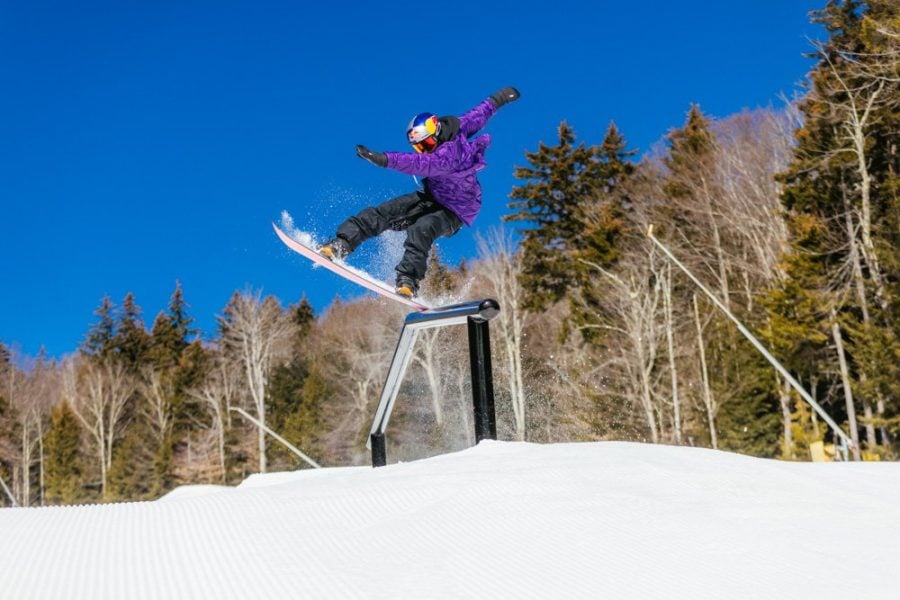
Young phenom LJ Henriquez, a sponsored rider hailing from NYC, shows off
his steez on an rail in Snowshoe’s Evolution park during a 2022 visit.
Photo by Kurtis Schachner
West Virginia skiing is known for many things: gladed runs, occasional powder, eccentric locals, and shredding no matter the weather, whether it be rain, shine, or that classic East Coast ice. It’s also known for a robust terrain park scene, because when your mountains just aren’t that big, you’ve got to go big in other ways. Over the decades, the rails, boxes, and jumps of the Mountain State’s terrain parks have produced everything from legendary locals and beloved brands to sponsored skiers and Olympic contenders.
For the uninitiated, the terrain park is that cordoned-off zone of the mountain filled with shaped boxes, arched rails, and jumps of all sizes. It’s a place of risk and reward where (mostly) young people with plenty of cartilage and still-developing prefrontal cortices throw themselves in the air with reckless abandon to pull off tricks like grabs, spins, flips, and slides. Beyond being a locus for aerials and acrobatics, the park is a cultural hub where style is expressed, friendships are cemented, and lifelong memories are made. From gargantuan half-pipes at Snowshoe and a half-buried car that was made into a rideable feature at Canaan Valley Ski Resort to the birth of the Skier Trash brand at Winterplace, West Virginia’s terrain park history is ripe with legend.
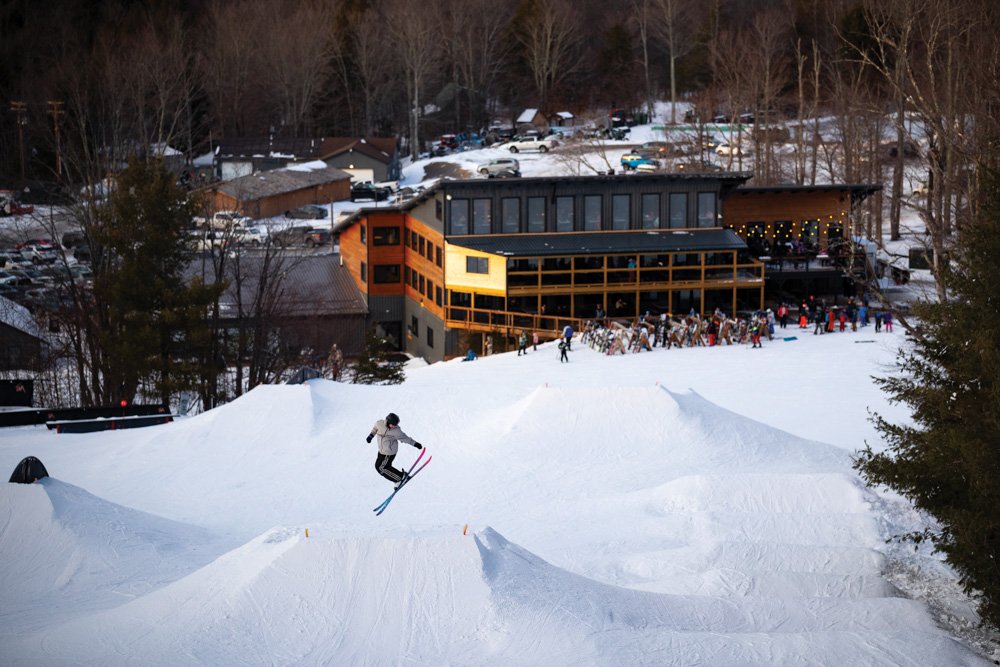
A skier throws a trick off a tabletop jump in the Thunder Snow terrain park at Timberline. Photo by Sean Snyder
As we head into the best time of year (ski season, duh) and West Virginia’s storied ski resorts continue to pump more capital investment into their respective mountains, their terrain parks continue to pump out up-and-coming shredders—talented locals and visitors alike that make these powdery playgrounds their outdoor hangs during the depths of winter.
Build it and They Will Come
While the park scene has evolved across various resorts over the decades, nowadays the best terrain parks can be found at Snowshoe Mountain Resort on Cheat Mountain in Pocahontas County, Timberline Mountain in Tucker County’s Canaan Valley, and Winterplace Ski Resort on Flat Top Mountain in Raleigh County.
All those boxes, rails, and giant jumps with perfectly angled lips don’t build themselves. It takes a dedicated crew to turn piles of snow and jumbles of steel into a proper terrain park. And it all starts with the snowmaking team. While the high-elevation mountains of the Alleghenies get well over 100 inches of natural snow per season, it’s still not enough to craft the large jumps and features that dot the slopes, and the parks don’t take shape until the snowmaking crew can build up some serious piles.
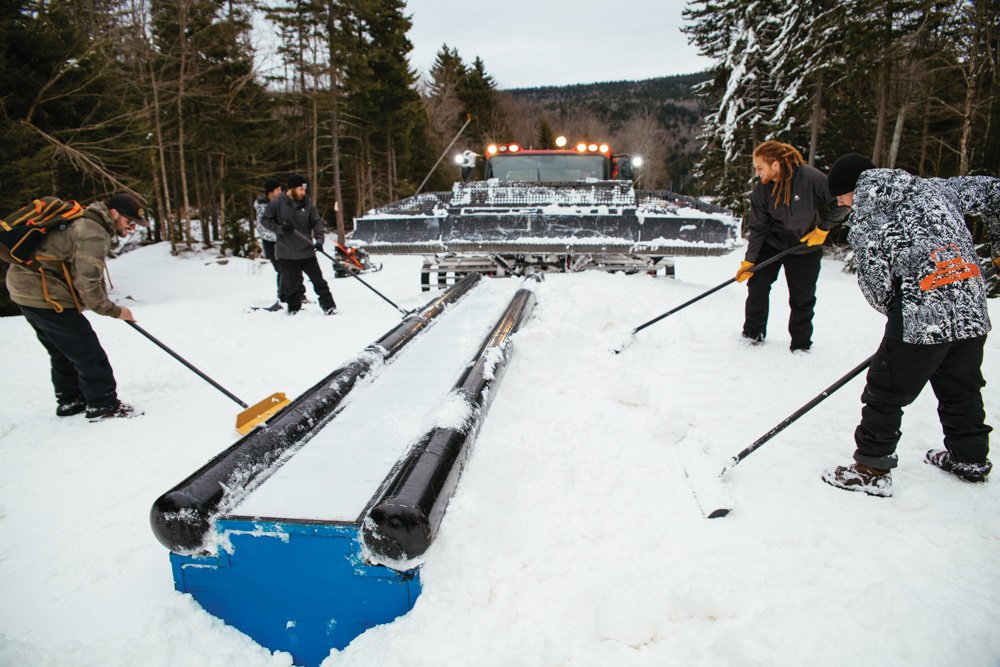
The Snowshoe terrain park crew rakes around “The Pontoon,” a custom-built double-rail–box feature in the Progression park. Photo by Kurtis Schachner
“It’s a huge collaborative effort,” says Critter Carter, a terrain park builder at Timberline. “It all begins with the guys that are out there putting in the work and asking us where we want snow. People are always like, ‘Oh, thank you so much for building this park,’ and I tell them that it took so many people to make it happen.”
Carter’s been snowboarding since the age of nine and started riding park at age 13, following the encouragement of friends who were building features in their backyards. One friend pushed him to enter a rail jam in those early years, which Carter ended up winning to his surprise. He was hooked. “It was easy to find friends and make family inside the terrain park,” he says.
Once the classic “whaleback” piles of snow are in place, highly skilled snowcat operators must move these mini-mountains into shapes that can be further finessed by the builders. “You’re like a kid in a sandbox getting to build pretty much whatever you want,” says Grant Reeves, the terrain park manager at Snowshoe.
A veteran snowboarder who’s been working at Snowshoe since 2012, Reeves now oversees the staffing, construction, and maintenance of Snowshoe’s four terrain parks, which have features from beginner-friendly, ground-level rails to massive 45-foot tabletop booters. He still shows up every day filled with stoke to go out and create. “You always draw a plan or have an idea in your head or with your crew, and then you get out there and your plan usually changes immediately.”
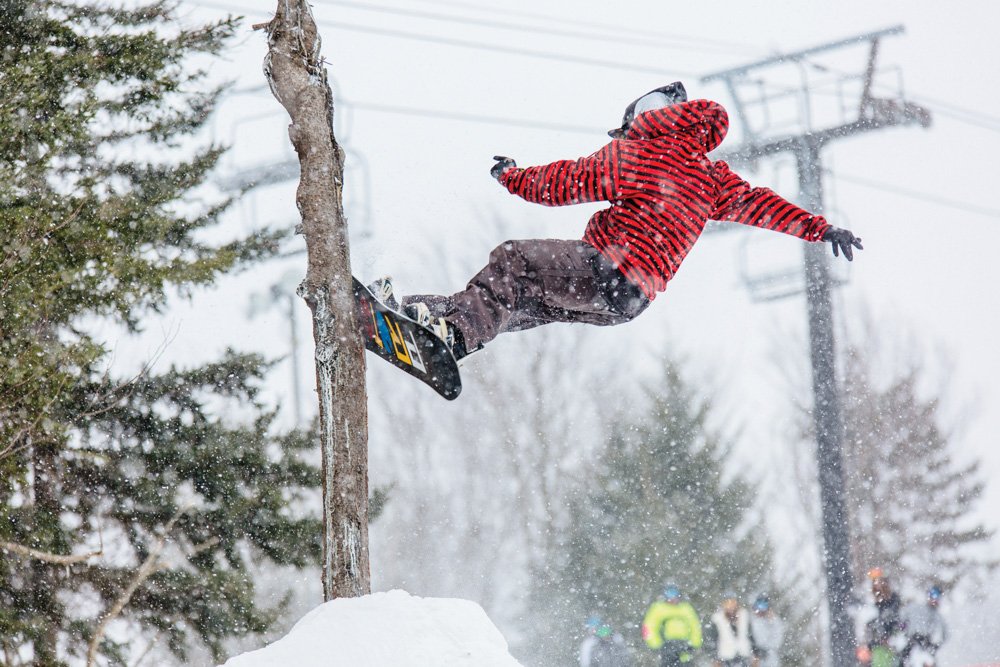
Snowshoe staple Grayson Neff taps the “tree bonk” in the Timberjack park at Silver Creek, part of Snowshoe Mountain. Photo by Kurtis Schachner
Reeves runs a snowcat and says sculpting jumps with the high-tech grooming machine is his favorite part of the process. “Those machines are just incredible,” he says. “It’s insane what they can do. Plus, they have a killer sound system, it makes the time go by pretty quick.”
That time comes in the form of grueling 10-hour shifts. It’s a good thing the race car-style bucket seats are comfortable, because despite being seated, running a cat is a mental and physical feat. “You definitely get jarred around a bit, and just sitting down in any position for that long is tough,” Reeves says. “You get certain weather conditions where the snow doesn’t do what you want it to do, so you’re sitting there pulling your hair out, trying to wrap your head around what you’re going to do. At the end of a shift, you’re mentally drained.”
After the whales are shaped by the snowcats, the park crew comes out and sets the rails and boxes. Using rakes, shovels, and good ol’ elbow grease, builders like Carter craft features and put the finishing touches on the ramps that send skiers and boarders up in the air and onto the rails. “The rake work is some of the most satisfying stuff you can do,” says Carter. “The end result should look like a piece of art, like a snow sculpture. But my favorite part is riding it, because of course we have to test it after we build it.”
Depending on who you ask, bringing the vision of a park to life is part art, part science. Reeves, who says he tends to “go with the flow” when the initial build occurs, leans into the creative side. “There’s some science that goes into building the structure of the features, but then once you’re out there, I think it’s more of an art,” he says. “It really just comes down to the operator and the crew’s creativity.”
Maintaining the Flow
If building a park is a collaborative effort, keeping it in tip-top shape is a team labor of love. The West Virginia ski season, which typically runs from early December to late March these days, is full of unpredictable atmospheric ups and down.
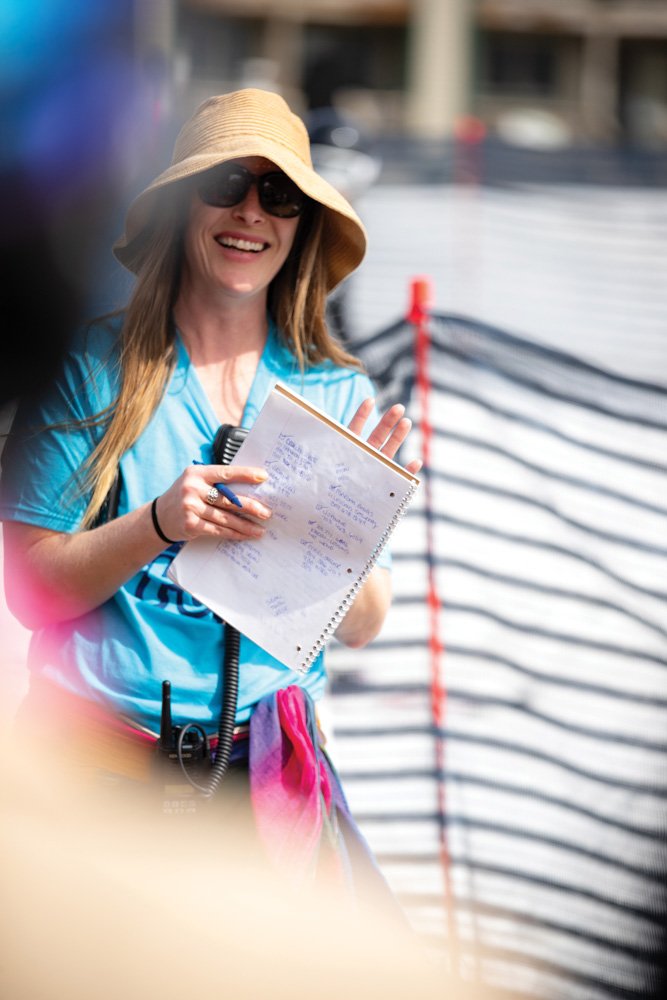
Liz Moore on emcee duty during the rail jam at Timberline’s annual end-of-season Pool Party event. Photo by Sean Snyder
“A huge challenge in this region is the maintenance of the parks, because you get such drastic temperature swings,” says Liz Moore, who is manager of the ski school as well as the two terrain parks at Timberline. “It’s easy to have a beautiful park somewhere it stays cold all the time and you have perfect snow, but when things melt out and refreeze, you’re constantly needing to either rebuild or shuffle things around.”
Crucial shapes of features like the lips of jumps and landing zones need to be meticulously maintained not only for looks, but also for safety. If you catch an edge upon landing after launching 20 feet in the air, you’re not gonna have a good time. “Sometimes keeping things riding good can be as easy as raking it flat and maintaining the surface,” says Carter. “Just getting rid of those divots and fixing the ruts at the bottom of the feature.”
But it’s not always a walk in the park. When the snow guns turn on, which happens pretty much any time the mercury dips below freezing, fresh snow piles up on the features. “Some days you’re out when they’re blowing snow, getting blasted while shoveling tons of snow off the features just to get them back to their original shapes,” Carter says.
And with Snowshoe, Timberline, and Winterplace all offering night skiing on some terrain, the parks must be looked over well after dark. “We usually have three park groomers out around the mountain pretty much every day in peak season,” says Reeves, who doesn’t hesitate to grab a rake and help out when he’s not in the snowcat. “We rotate two shifts, one from seven to five and one from noon to around nine thirty.”
Progression Session
While running laps on the slopes is about perfecting turns and going fast, running laps in the park is all about the art of the session. Sessioning is the act of playing around on a feature over and over again, often with the goal of attempting a specific trick until landing it. “You can see a slower pace in the park, and a little bit more of a community vibe in it,” says Moore, who started teaching snowboarding at Timberline in 2000 to get more time on the snow and become immersed in the scene. She gravitated toward defying gravity in the park and says she immediately fell in love with it. “I still love a good session. You’ve got people hanging out and encouraging each other. It’s almost like they’re having a cookout, except that what they’re cooking up is their newest trick.”
Sessioning, naturally, leads skiers and riders to progress in skill, and good park builders take progression into account when deciding how big features should be, as well as how they will change throughout a season. The Progression Park in Snowshoe’s Basin territory is created with beginners in mind, offering “rollable jumps and mellow jibs” so park-curious riders can get the feel for freestyle without having to commit to huge hucks. “You want something that can be rideable to a few different skill levels,” says Reeves. “You don’t want something that’s so extreme that it pushes the beginners out of the way. Evolution is our bigger park, which has all kinds of rails, stair sets, and 30- to 40-foot jumps to get creative with.”
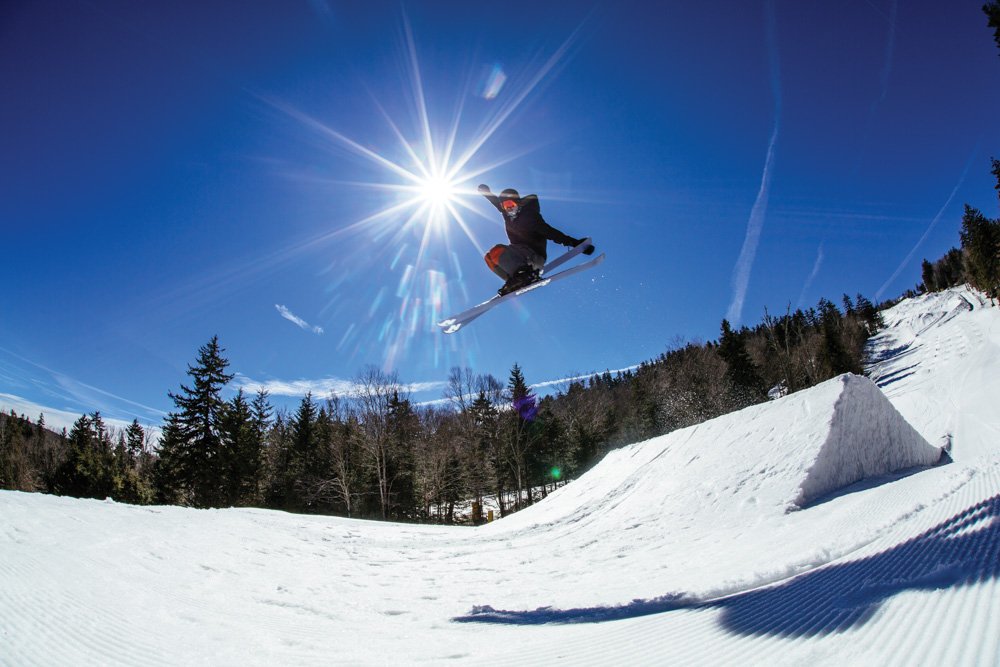
A skier nabs some air and a tail grab off a booter at the bottom of the banked slalom course, an annual event held at the end of the season at Snowshoe. Photo by Kurtis Schachner
Last year, Timberline held progression sessions during night skiing, which Carter helped make happen. “It was such a vibe,” he says. “We were playing music and everyone was hiking the hill together like a big family. Once you start getting into that progression, it really unlocks so much more potential for your riding everywhere.”
Counterculture
The park offers a blank canvas for personal expression. It’s the gathering place for nonconformists, the punk rock answer to the snootier side of alpine skiing. “It’s crazy to see how much the park scene has grown over the years,” Reeves says. “Twenty years ago, it was just getting started, so it’s definitely neat to see everyone want to hit the park these days. You see parents with their little kids, the punk kids, and even those older guys still getting out there.”
Tucker County native Joseph Lewandoski came of age in the park just over a decade ago. He started skiing at just three years old and ventured into the park at the age of 13. For Lewandowski, who was also a skateboarder at the time, the transition into the communal scene of the terrain park felt natural. “It had a very similar vibe to it with everybody trying new things and pushing each other to be creative and look at things differently, giving each other kudos when you do land something,” he says. “I can roll up to a park most anywhere and if there are people sending it, they’ll be friendly and open to hang out. It’s just like a big melting pot for people who love skiing and snowboarding.”
In 2015, he and few of his buddies formed the Ski Goons crew. They learned how to shred and film, capturing each other ripping it up and posting their edits on YouTube. The drive to get good footage pushed them to improve, and when scouring the Ski Goons archives, you can clearly see the progression over the years.
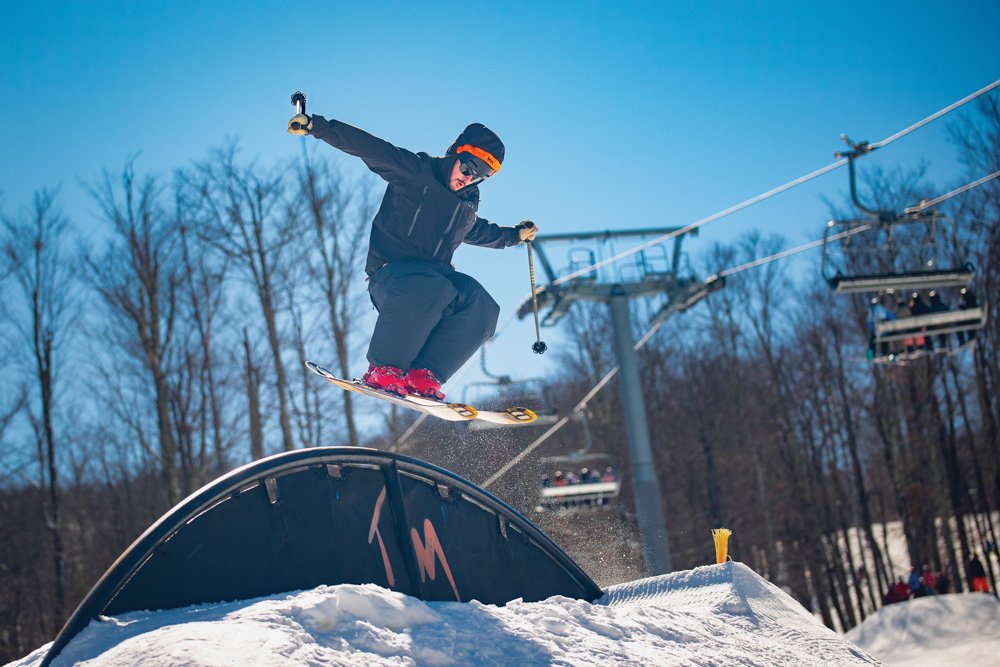
Tucker County local Joseph Lewandowski shows some style as he pops onto a rainbow rail in Timberline’s Thunder Snow park. Photos by Sean Snyder
Although Lewandowski and the Goons make it look effortless when they’re throwing tricks in the park and getting big air off the side-hits that dot groomed trails across the Mountain State, the casual nature with which they shred is the result of countless hours of practice.
Lewandowski, who has a plethora of tricks in his quiver, says that throwing a backside 270-degree spin off a rail was one of the most challenging. First, he had to get the frontside spin down, which involves landing sideways on a rail, then spinning 270 degrees on the exit to land facing switch, or backwards. The backside variation involves spinning 270 off the rail to land facing regular, or downhill. “It’s not the hardest trick to learn, but it definitely took me the longest to figure out,” he says. “I learned how to go frontside, but when trying to go backside, I got stuck mentally with it for a while. I typically like to learn how to do things one way, then I had to figure out how to do it the other way. That was a battle for me.”
Mission Critical
Moore views having a good park as critical to the success of a ski resort these days. “Although it can be hard to see the return on a terrain park because you put a lot of money and time into it, it’s just such a fun part of the sport that people really enjoy doing. It’s a key part of the playful side of a mountain.”
“I would say it’s almost as important as having a bunny slope,” Lewandowski says. “When I roll up to a resort, one of the first things I’m going to do is look at their park and critique the rest of the mountain based on that. It shows they actually care about the mountain. Parks don’t make resorts a lot of money, but they put a lot of smiles on people’s faces.”
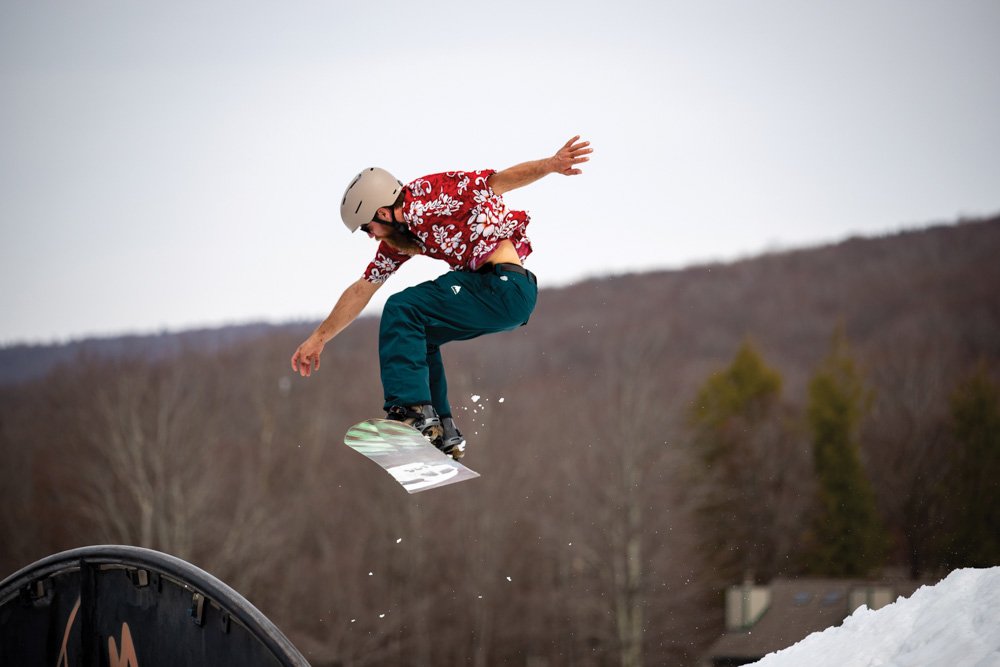
Canaan Valley resident Max Withrow gets some amplitude during a rail jam competition at Timberline Mountain. Photo by Sean Snyder
Timberline is upping its park scene with a new rope tow that will make park laps more convenient. “I think it’s really going to increase that whole community cookout vibe even more because now you’re going to have a lot more energy from not having to hike it every time,” says Moore. “I think we’re going to see people throwing down bigger and better tricks.”
Up on Cheat Mountain, Snowshoe is bringing back the West Virginia Open after a six-year hiatus. Reeves says the big-air, slope-style event used to be one of the biggest terrain park events in the state. “We’re really excited to bring it back,” Reeves said.
If you’ve still got supple knees and an appetite for air, consider dipping into the park this year for a delectable dose of West Virginia park culture. At minimum, you’ll get to enjoy some big spills, bigger tricks, and a giant smile on your frozen face. Who knows, maybe you’ll get the bug, start sessioning on the reg, and surprise yourself. They say go big or go home, but the best is when you go big and go home.