


Written by Gene Kistler
Captain’s Log: 6 a.m., Friday, May 17. I get up slowly as my bones and muscles complain loudly until strong, hot coffee convinces them that everything is OK.
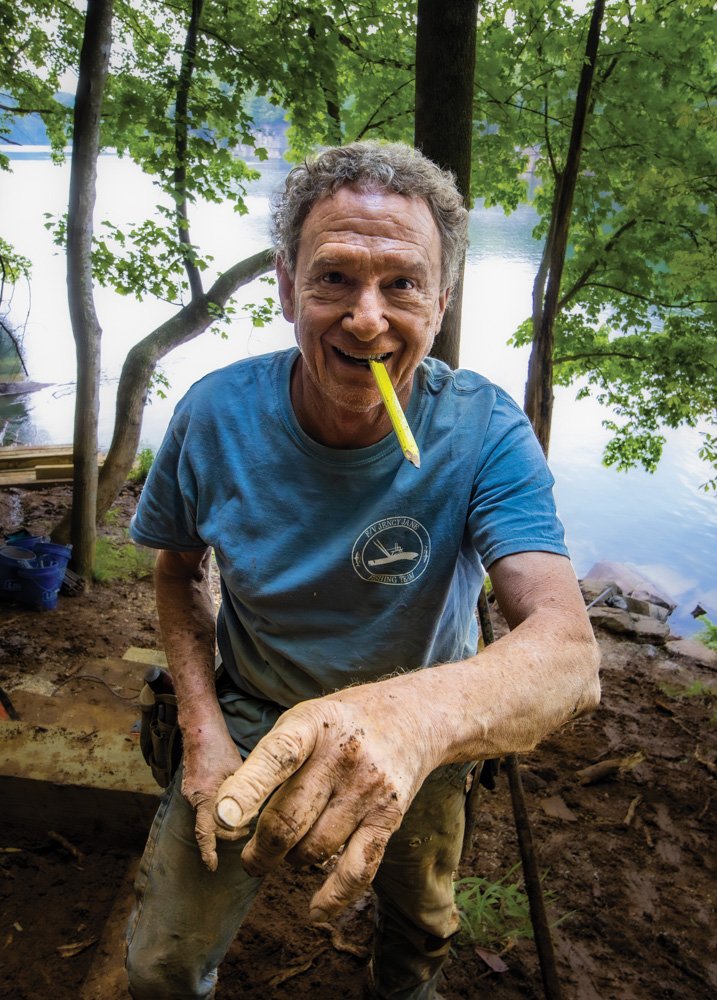
The man, the myth, the legend, the author: Gene Kistler. Photo by Jay Young
At 7:30 a.m., I drive across US Route 19 to the Burnwood Campground on the rim of the New River Gorge. These are hallowed grounds where many glorious times have been enjoyed over the years by rock climbers from around the world. I park and wander into a slow-moving crowd of climbers-turned-volunteers, some from as far away as Toronto, who are gathered here today to get dirty and sweaty. They’re still waking up; I hear the cross-chatter of quiet conversations as they sit drinking coffee while assembling simple breakfasts and lunches. It’s day seven of (Not) Work Week (NWW), our annual eight-day volunteer shindig where we do a whole lot of hard work that isn’t really work after all… or is it?
As the caffeine kicks in, some folks start examining the free items on the registration table and fill out tickets for the evening raffle. Who doesn’t love a raffle? Today’s prizes are a 70-meter rope and a set of quickdraws—tools of the trade for climbing the New River Gorge’s legendary cliffs. Above the table hangs a banner with the letters NRAC, short for New River Alliance of Climbers—our local advocacy group responsible for making climbing safe and sustainable in the gorge. Underneath the logo is the phrase “Be Informed—Get Involved—Stay Connected.” I feel so connected here today. I look around as more folks rise. I recognize almost every sleepy face, some returning every year to (not) work with us. The coffee keeps flowing; the conversations follow suit, growing louder and louder. Laughter starts popping through the chatter. Another day is winding up and the familiar, clear energy of NWW is coalescing once again.
At the center of this frenetic swirl is Brittany Chaber, my organizational partner for this annual “work” party, the calm eye in the middle of the storm. Every morning, Brittany arrives early at Burnwood and sets the positive vibe for the day. She is ultra-organized. She lays out the breakfast and lunch fixins and staffs the registration table, greeting sleepy climbers and registering new arrivals. There are rolled up T-shirts for each volunteer, the fruits of her labor that starts in the winter.
Over the years, Brittany has developed a proven formula: she raises around $4,000 every year from eastern climbing gyms to pay for NWW shirts and feed 200 volunteers for eight days. She works with outdoor brands to collect excellent raffle prizes. She sets up the online registration, sends out the recruitment fliers to schools and gyms, and writes the press releases—all of this as a volunteer. “In 2015, I attended the first NWW. Nine years later, I’m still trying to figure out what makes it so special,” Chaber says. “I love welcoming new people and seeing the volunteers who continue to return year after year. We’re so lucky to have the opportunity to give back in such a way that makes us feel that we belong.”
It’s now 8:30 a.m. and the morning mist rising out of the ancient gorge has finally burned off. A few morning announcements are made and now it’s time to go to (not) work. However, this morning is different—everyone is getting geared up and going rock climbing, because the work is done!
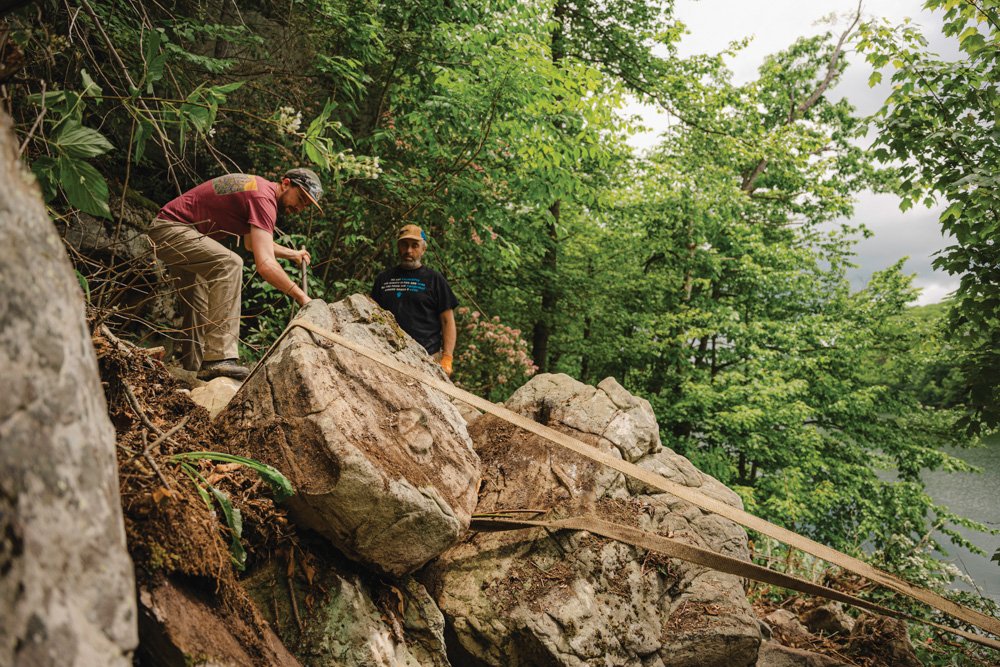
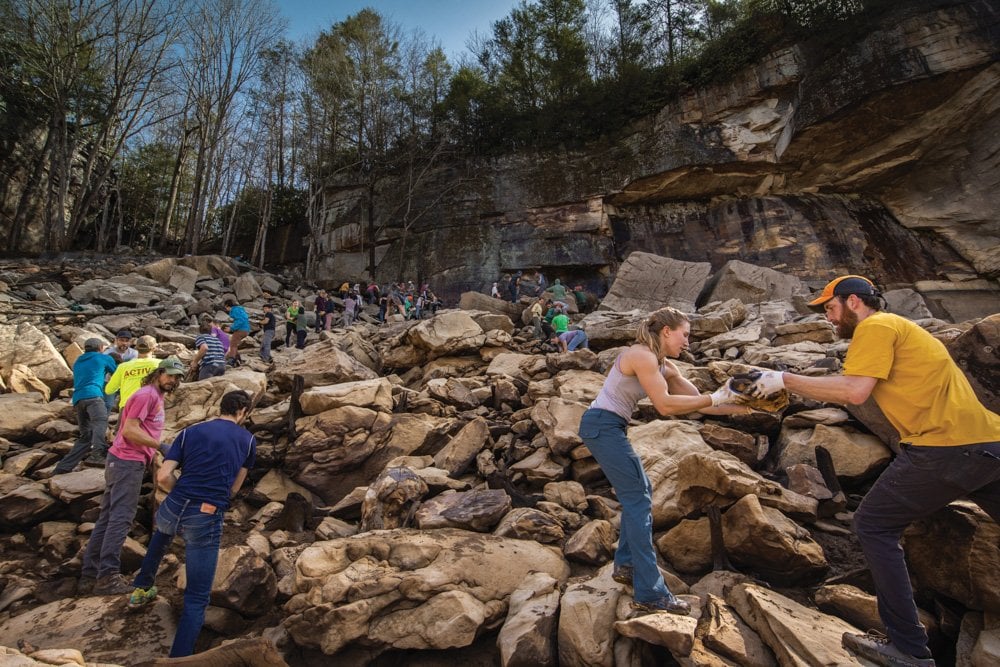
Volunteers use a “come along” winch to move massive rocks. Photo by Karen Lane
We had an ambitious scope of work slated for our eight-day NWW. But with around 30 volunteers a day, we completed the massive list of trail work and site improvements in just six days. This year’s accomplishments resulted in transformational improvements at the Whippoorwill and Summersville crags at Summersville Lake, including the installation of split rail fencing to protect the hillside from further erosion, creation of a revegetation plan, construction of stairs, clearing of brush, and improvements to existing trail tread. We also did some brush clearing and major rock work on the North Bridge Trail. Looking back on our accomplishments, we’re all a bit mystified. I hear the familiar clinking of carabiners accompany the chatter. The excitement is palpable. It feels like summer camp. As I watch folks gather their kits and depart Burnwood for the crags, I stop and reflect on the decades. How did I get here?
We moved to Fayetteville in 1991. Back then, Fayetteville wasn’t the vibrant town it is today. Only a few of us climbers had made the tough decision to uproot and move here. We had to figure out how to make it all work. But as we developed more climbing routes, a steadily growing number of climbers from the surrounding states and beyond continued showing up every weekend. By the late 90s, folks were climbing thousands of routes on the towering cliffs rimming the New, Meadow, and Gauley river gorges, and hanging above the turquoise waters of Summersville Lake.
All of our world-class climbing takes place on public lands. The three river gorges are managed by the National Park System (NPS), and every national park in the country that had rock climbing at that time was tasked with developing and enforcing a climbing management plan. Summersville Lake is owned and operated by the U.S. Army Corps of Engineers (USACE), which manages the dam and lake that just happens to be surrounded by awesome cliffs. At the same time, the Access Fund, a national climbing advocacy nonprofit, was encouraging climbing communities across the country to organize and develop relationships with land managers. In 1997, we gathered to form NRAC as local climbing advocacy took root around the country. We approached the NPS and USACE as one and hoped that, in time, we could all work together.
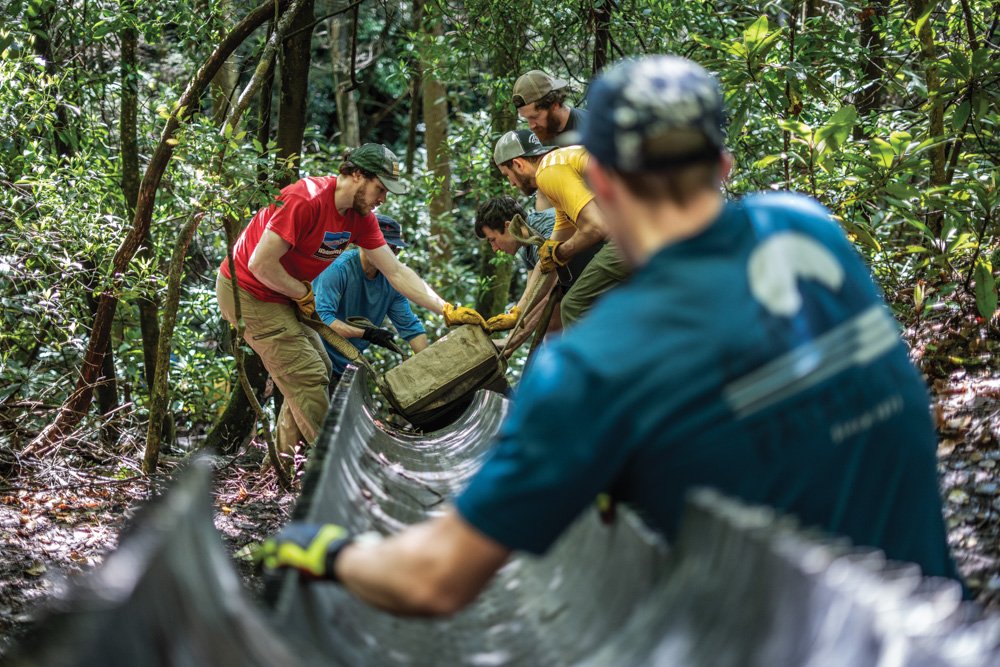
(Not) workers slide a 400-lb paver stone down a slide. Photo by Jay Young
Before the days of NRAC, there was Rick “Rico” Thompson. Rico planted the volunteer seed. He was part of a Pittsburgh posse of funhogs that explored and climbed all over this place. In the 80s, the bases of the cliffs lining the New River Gorge were littered with a century’s worth of trash piled below any place folks had cliff-top access. Climbers hiked by it routinely to the point where seeing it became normal. But Rico saw things differently and began organizing climber cleanups by word of mouth (this was long before the days of email). For the first time, different groups of climbers started coalescing to haul tons of garbage from the depths. That was the beginning of the rock-solid climbing community that we have today, built on discovering how much fun it was to hang out, shoot the breeze, make this place better, get a (not) work out, and entertain the local TV news reporters. That seed Rico planted in the eighties still grows and bears fruit some 30 years later.
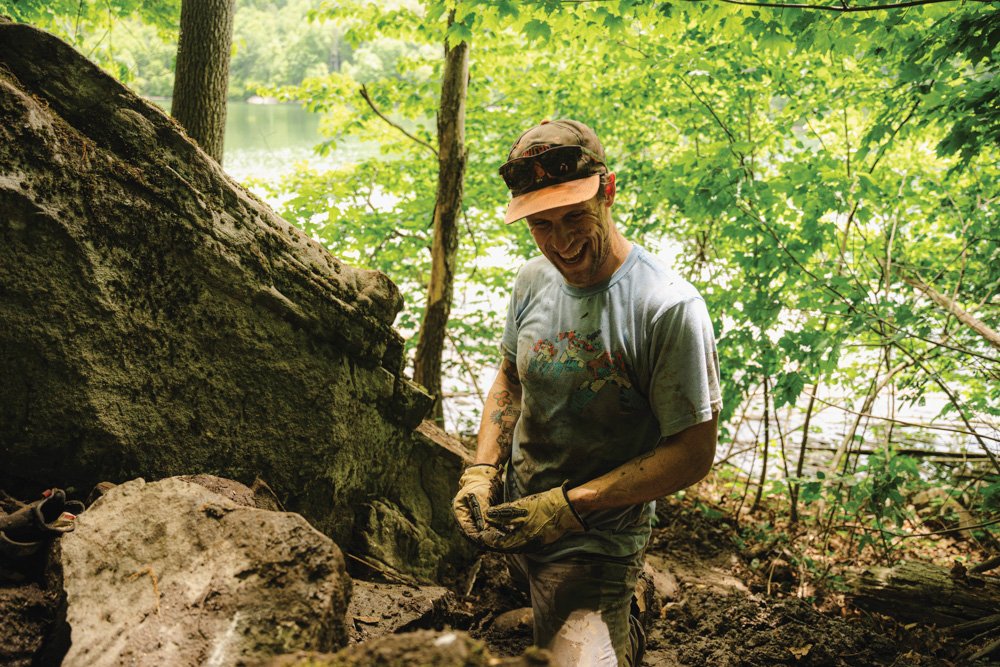
Craig Reger, all smiles and hardly working. Photo by Karen Lane
But by the time we established NRAC, everyone was tired of hauling garbage. Luckily, most of the garbage was gone. Our broader goal was to make climbing sustainable and that meant mitigating climbers’ impacts. A climbing trail plan was needed. We won a grant from the Access Fund that brought in trail building expert Jim Angel. He struck the trail work spark that still burns today.
Trail building and maintenance was way more fun than hauling garbage. We began to organize trail days, which expanded into trail weekends. Over the next fifteen years, we established proper trails in the New River Gorge and Summersville Lake. We worked hand-in-hand with the NPS and USACE. The community volunteer framework proved resilient and the grassroots grew. From 2003 to 2013, we held an annual, wildly successful climbing celebration called the New River Rendezvous. We continued to pound the volunteer drum.
But such work is never finished. We needed something new to grow our capacity, to spend more time together, to build on our sense of accomplishment. I learned about the Yosemite Facelift, which is two whole weeks of volunteer stewardship deep in the crucible of American rock climbing. We realized that the weekend paradigm no longer satisfied the urge—we wanted more. Let’s do a week, we said. No, make it eight days! Let’s make sure that we take our time, have fun, and not get hurt. We formulated the equation to serve as the foundation: work + fun = (not) work! Let’s raise money to feed everyone, provide free camping, and treat volunteers like celebrities. The workday would be from 9 to 3, then you go climbing, and then you end the day with dinner at Burnwood, a local restaurant, or someone’s house. The broader community response was huge. Businesses in and around Fayetteville loved it. The first NWW was held in 2015, and it’s been a resounding success ever since.
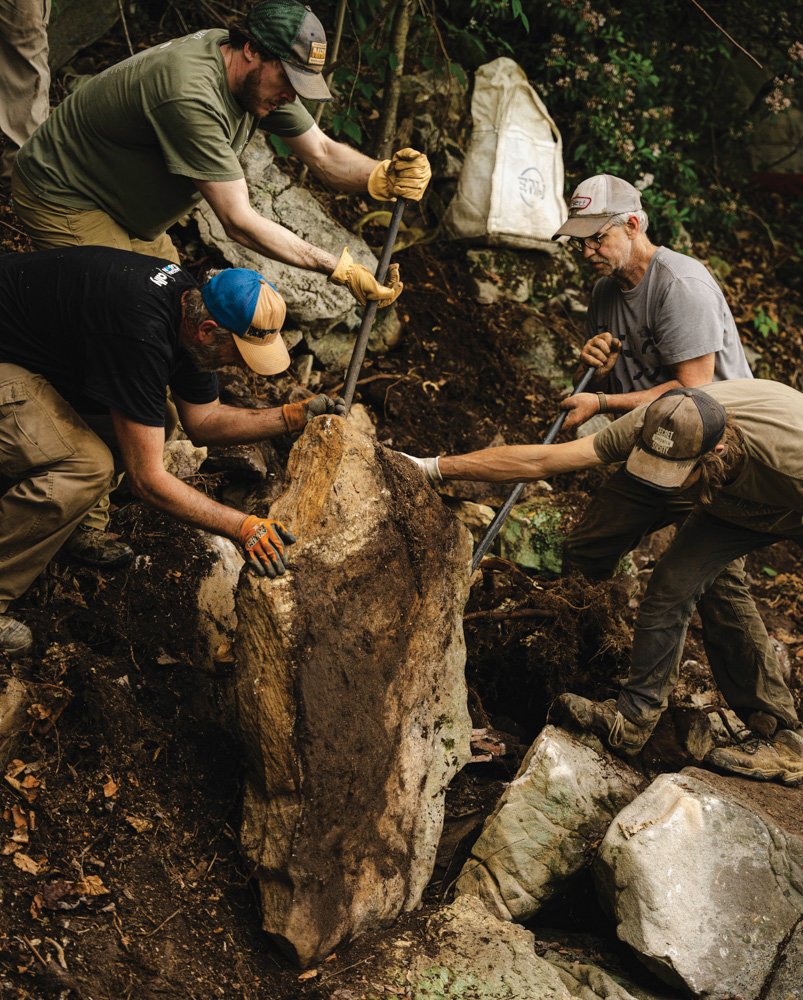
Volunteers use rock bars to put boulders in place to create new trail tread. Photo by Karen Lane
Looking back on a decade of NWW, we realized that this year was the ninth rendition (of course, there was no NWW held in 2020). And we’ve been wondering why do people keep coming back for more? I think the answer to that burning question is best addressed by third-year NWW alumna Ashlei Selden. “To sum it up, this kind of thing is what humans crave, even if they don’t know that it’s what they need,” she says. “It’s in our blood. It’s the gift our ancestors gave us—the gift of being able to find rhythm in problem-solving with kindred minds, working the land with our hands, feeling that sweet sun on our skin. The key ingredients to life are as old as time: community and connection to the ground you stand upon.”
Ultimately, we are all volunteers. That’s how we roll here at NRAC. Together, we’ve learned how communities grow, gain fiber, and get strong—much like a rope. We’ve had so much fun (not) working. We’ve formed unbreakable bonds over our collective admiration for this amazing place and the privilege to climb these gorges.
Gene Kistler is a shaker, doer, and maker of subversive positive change who lives in Fayetteville on the rim of the New River Gorge.