
Appalachia’s visitors, wanderers, and athletes come in all shapes and sizes. There’s no limit to the kinds of adventures that unfold in the mountains, and this is just as true for those with disabilities. There’s something for everyone, here—and as the recreational world expands to include those with physical and cognitive challenges, so do their remarkable stories.
Access for all
Eric Thompson’s great loves are rivers and mountains. He grew up active—when he wasn’t paddling, he was skiing. The Tucker County native couldn’t seem to stay indoors, and he had no reason to do so. He worked around the country as a whitewater guide and commercial raft leader. In the winter, he was a ski patroller and went on to become a Wilderness EMT, racking up miles in states like Alaska, Oregon, Colorado, and Wyoming. He saw the country and lived his dream. Nothing held him back.
Then on November 12, 2012, Thompson’s car spun off the road. He sustained a spinal cord injury that left him paralyzed from the chest down, and everything changed. However, his return to outdoor recreation didn’t thwart him—the relentless West Virginia adventurer found his way back to the rivers and slopes with specialized equipment. Instead, his biggest challenges came from everyday life. It was the towns and businesses around him that became inaccessible because they lacked infrastructure like ramps.
“I couldn’t get across the curb, couldn’t get into a restaurant, couldn’t get into a bathroom,” he recalls. “Going down Front Street in Thomas, I couldn’t get in to get a haircut, because there were steps there.”
He encountered the same problem again and again in West Virginia. Access was a nightmare, and he realized he wasn’t alone. “One in four Americans have at least one disability, and 80% of those are acquired during life,” Thompson says. “We’re all just one bad step in the shower away from joining that group. And in West Virginia, it’s one in three.”
In fact, accessibility in Appalachia as a whole is lacking. With this in mind, Thompson created Access on the Go, and through the organization, he’s working to improve accessibility throughout the region. It’s not simply about helping businesses and towns install ramps or ADA-compliant bathrooms—it’s about creating communities where people with disabilities can fully participate in everyday life, recreation, and tourism.
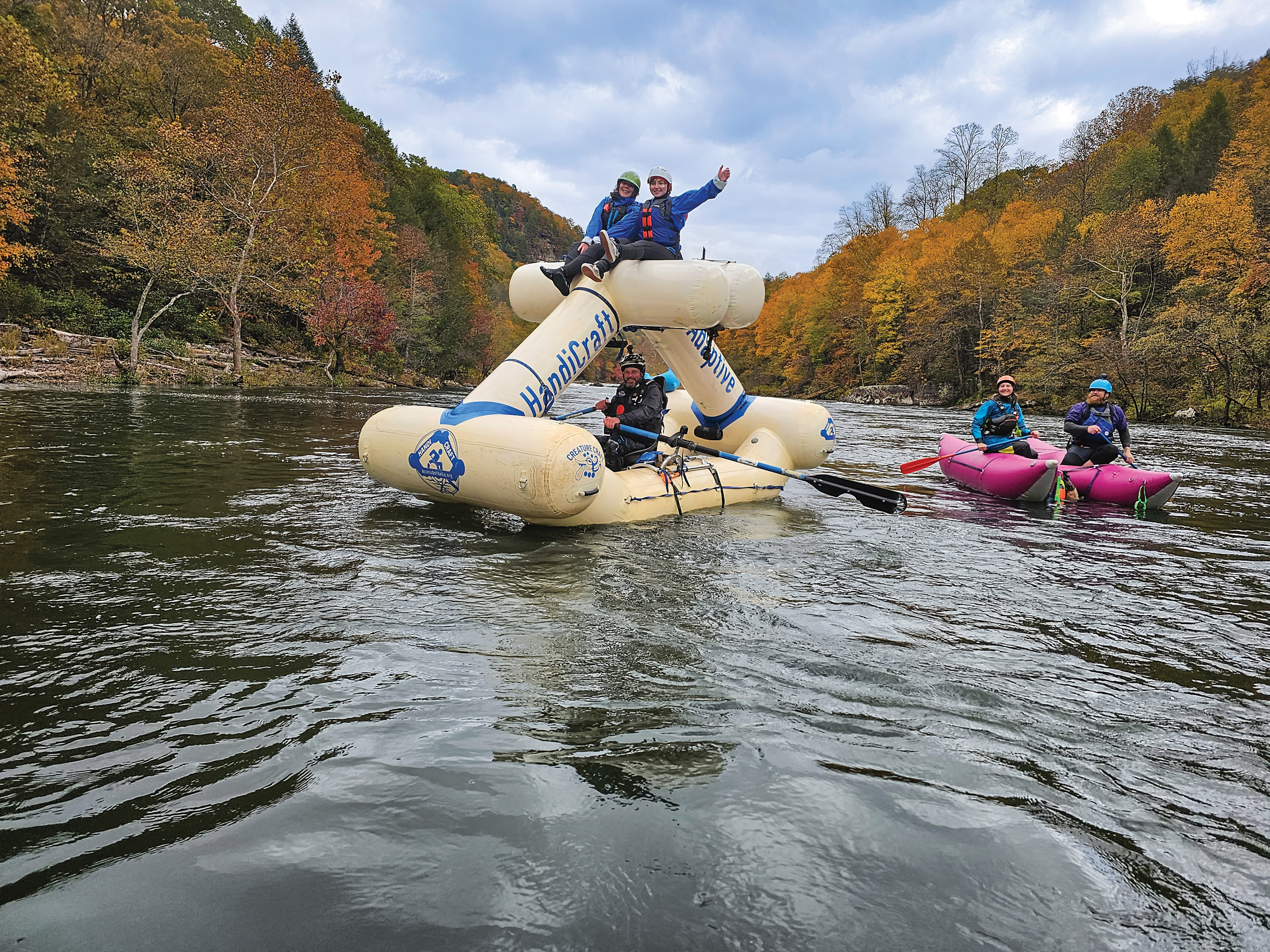
While Eric Thompson’s adaptive equipment has allowed him to continue adventuring, he works to ensure Appalachians with disabilities have the access they need, on and off the river. Image courtesy of Eric Thompson
Much of what he does is hands-on work—he’s shown groups how to create different types of adaptive trail systems and kayak launches. He also helps to evaluate infrastructure, identify accessibility barriers, and work with communities to improve public access. For example, an adaptive ski program may be up and running, but skiers need to be able to park their vehicles in a proper location and have access to things like lockers, restrooms, and restaurants.
In many cases, these barriers can be removed through relatively modest improvements when communities are willing to prioritize inclusion. Thompson especially wants to help businesses reach their one-in-four customers who cannot physically get in the door. “I tell them, ‘It’s not that there’s a lack of users that need your amenities. You’re just not allowing your customers to come inside, so let’s get you some new business.” Thus, he’s created a free Accessibility Improvement Tool Kit, available on his website.
“It’ll walk you through a self assessment to identify where you have readily removable barriers that are preventing equal access to goods and services and your profitability.” I also indicate where there’s ADA IRS tax incentives.” The goal, he says, is two-fold: removing barriers to access promotes participation, independence, and belonging. It also brings new business to Appalachia.
“It’s a big place,” he says. “I’m going to keep going.”
World class wheels
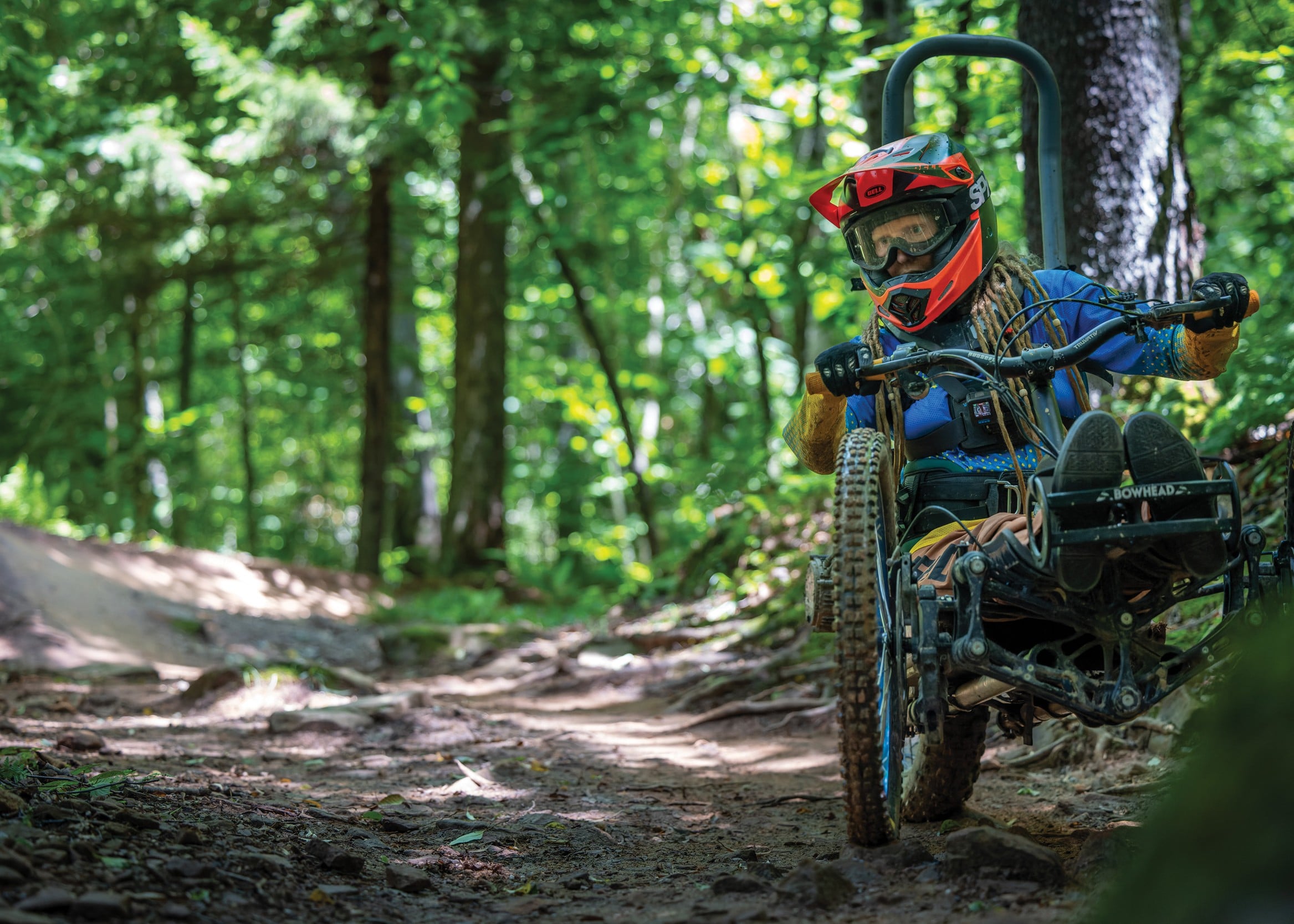
Like all mountain bikers, when Challenged Athletes of West Virginia’s mountain bikers are on the move, the goal is speed, adventure, and above all, fun. The equipment looks a little different, but the athletes at the helm fly down the mountain at Snowshoe, in Pocahontas County, West Virginia, so fast that you may not get a long look.
Challenged Athletes of West Virginia has been providing adaptive winter ski opportunities on the mountain since 1996. Now, the nonprofit is taking advantage of Snowshoe’s world-renowned reputation as a mountain biking mecca. “We’re world-class, here,” says director Carol Woody. “We need to make sure it’s accessible for our athletes and participants.”
The program offers specialized adaptive equipment, and many athletes with disabilities also bring their own. In such cases, instruction specifically tailored to them and their needs can go a long way towards making the experience a great one. “We have several instructors with an adaptive-specific certification, so we have the tools needed in order to work with people with special needs, whether it be a cognitive or physical disability or combination of both,” Woody says.
That doesn’t mean everyone has to go hurtling down the mountain. Some riders may enjoy a more level experience in the woods with an instructor’s help. Others want steep, technical trails in the mountain bike park. Woody’s goal is to provide options to people of all ages.
For athletes who need more support, the program now offers an all-terrain, pilot-driven cycle called a Cimgo. A rider can sit, secured in a comfortable position, while the instructor controls and steers the bike.
“There are all different kinds of tandem bicycles for special needs riders,” Woody explains. “This is different in that it can handle the steepest, most technical terrain—even our World Cup trail at the park at Snowshoe. They get to experience the thrill of true downhill mountain biking.” The Cimgo is designed to be transported on the chair lift, just as mountain bikes are, while the rider stays seated.
Pilots have to be certified before a program can purchase a Cimgo. Snowshoe is currently the only organization in North America using the bikes, and as other adaptive centers start their own programs, they’ll come to West Virginia to receive specialized training.
Challenged Athletes of West Virginia has made the state a destination for athletes looking for mountain adventure—from young kids to seniors—with warm and welcoming support. “So many people don’t even realize that adaptive mountain biking is something that’s even available to them,” Woody says. “But riders have been planning their whole summer around coming here, from all over. We can offer a little helping hand and celebrate the wins, even if they’re small.”
Ride the Rails
Rail biking for all.
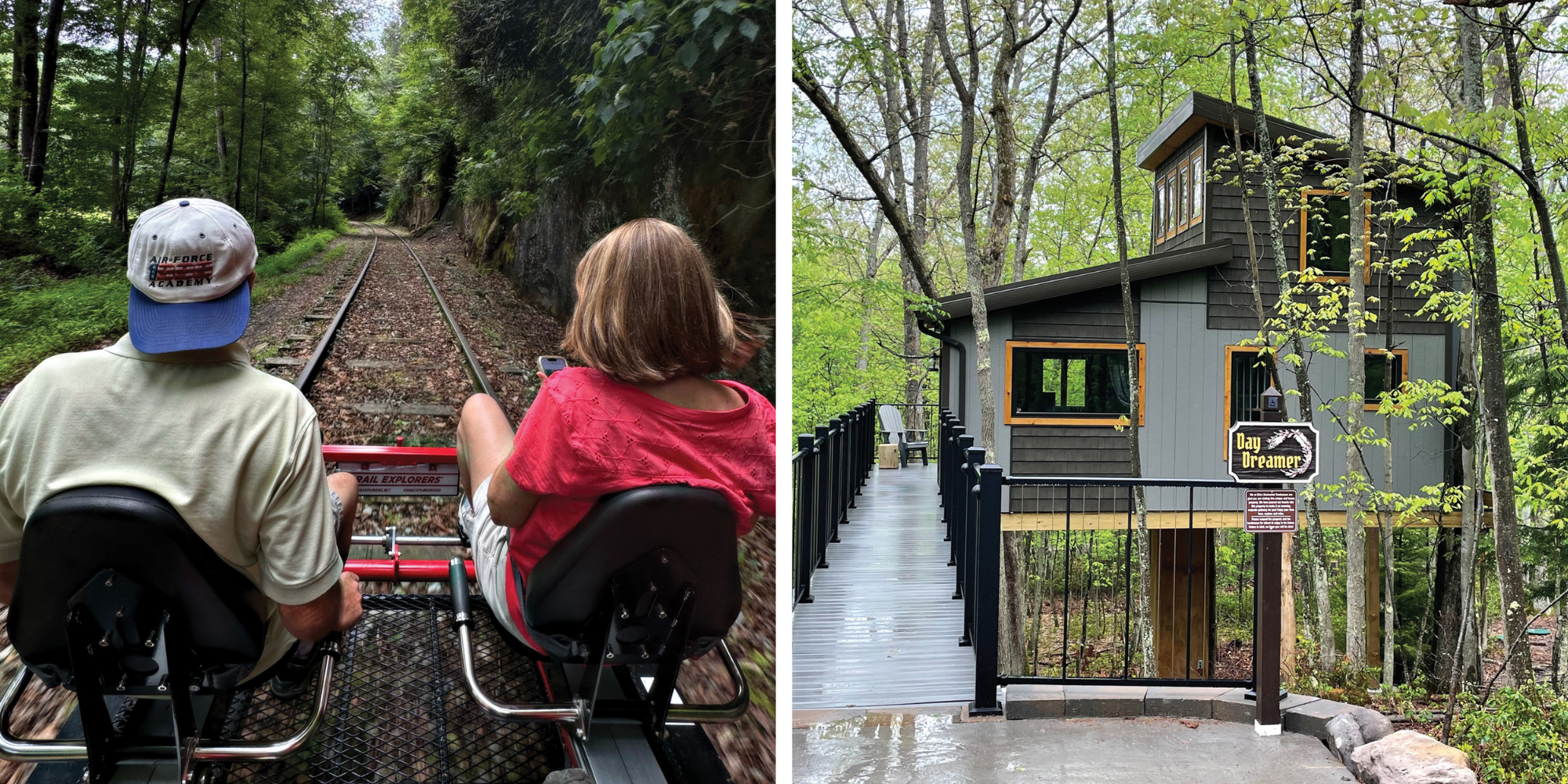
One of West Virginia’s most unique and accessible outdoor adventures can be found in Clay, West Virginia. Elk River Rail Explorers offers visitors the chance to pedal electric-assisted railbikes along a breathtaking 12-mile stretch of the former Buffalo Creek & Gauley Railroad through dense forest, beside crystal-clear water, waterfalls, cliffs, and historic railroad remnants—and the experience is designed so almost anyone can participate.
“One thing we take pride in is the accessibility—anyone can ride,” says Elk River Division Manager Trey Corwell. The company offers child harnesses for younger riders and adaptive harnesses for adults with disabilities. Corwell recalls one memorable tour involving a wheelchair user with multiple sclerosis. “She was able to experience the outdoors in a way that she hadn’t been able to on her own,” he says. “We want anyone to ride, no matter their age, size, or ability.”
Left: Photographed by Nikki Bowman Mills | Right: Photographed by Stacie Griffith
Ella’s Enchanted Treehouses
Taking accessibility to new heights.
The DayDreamer Treehouse near the Savage River State Forest in Garrett County, Maryland, is an ADA-accessible treetop retreat that sleeps six. Guests have a concrete parking area, a level, dusk-to-dawn-lit ramp, and a wide deck supported by a 150-plus-year-old, hand-hewn beam overlooking the forest. Inside, open spaces ensure wheelchair clearance, kitchen fixtures are ADA-compliant, and the master bedroom has an ADA bathroom with a 48-inch transfer shower and fold-down seat.
The house is the largest of four, all located close to Deep Creek Lake and Wisp Ski Resort. Owner Stacie Griffith says, “The ambience is incredible. There are rocks everywhere. They’re covered in this green, bright moss that makes you feel like you’re in an enchanted forest.”
What we love: Everything. It’s a treehouse.
Family travels
Jennifer Allen, of Lancaster, Pennsylvania, is the author and founder of Wonders Within Reach, a travel blog about her experience roaming the world with her family, which includes three children—one with a rare kidney disease and one who has spina bifida and uses a wheelchair. Her family’s unique travel challenges offer a new perspective for those in similar situations.
“All travel should begin with research,” she says. “Small Town, USA, is generally not accessible.” She suggests determining whether your destination is wheelchair accessible and what accommodations might be in place. Before they went to Yellowstone, Allen says her son searched for “accessible things to do in Yellowstone” and found helpful answers.
“A lot of destinations now are putting accessibility tabs on their website,” she adds. “You might go to a resort’s site and look for an ‘accessibility’ tab. They’ll have itineraries or locations that are accessible so you can plan around those. There’s a lot that has been made accessible, and there are a lot of things that we can do. The biggest issue is just finding it. I think a lot of families like ours are still stuck making phone calls.”
On a West Virginia trip, some digging led her family to the Potomac Eagle Scenic Railroad in Hampshire County, one of the few wheelchair-accessible historic railroads in the country, and to Blenko Glass Company in Milton, which has made the bulk of its tour wheelchair-friendly.
Allen says it’s always helpful to have a plan in place when traveling with anyone with special needs. Bring a first aid kit specific to the travels, including tools to repair a wheelchair or orthotics. Also, know what hospitals are in the area, what specialist you might use, and who is in your network if there’s an emergency. Likewise, a host of resources exist for autistic and sensory-sensitive individuals as well, and this information is often available under an establishment’s ‘accessibility’ tab.
Sometimes, Allen’s family finds a simple activity to be one of the best travel experiences, and rail-trails often fit that bill. During a visit to West Virginia’s Greenbrier Valley, they explored the Greenbrier River Trail, which follows the old C&O railroad line for 78 miles at no more than a 1% grade and offers views of mountains, towns, bridges, and tunnels. “The Greenbrier River Trail is awesome,” she says. “As a family with disabilities, when we were trying to figure out how to get back to living a normal life, the first thing I came up with was rail-trails. Hiking is one of those things that you can always do.”
Waterfall Watching
Check out these wheelchair-accessible cascades.
Blackwater Falls, Blackwater Falls State Park, Davis, West Virginia Fully wheelchair accessible via Gentle Trail, which leads to an overlook of the 62-foot falls.
Sandstone Falls, New River Gorge National Park & Preserve, Hinton, West Virginia Fully wheelchair accessible. A boardwalk leads to the 1,200-foot-wide, 15-foot drop in the New River.
Muddy Creek Falls, Swallow Falls State Park, Oakland, Maryland Fully wheelchair accessible. An accessible parking lot leads to a boardwalk overlooking the 53-foot falls.
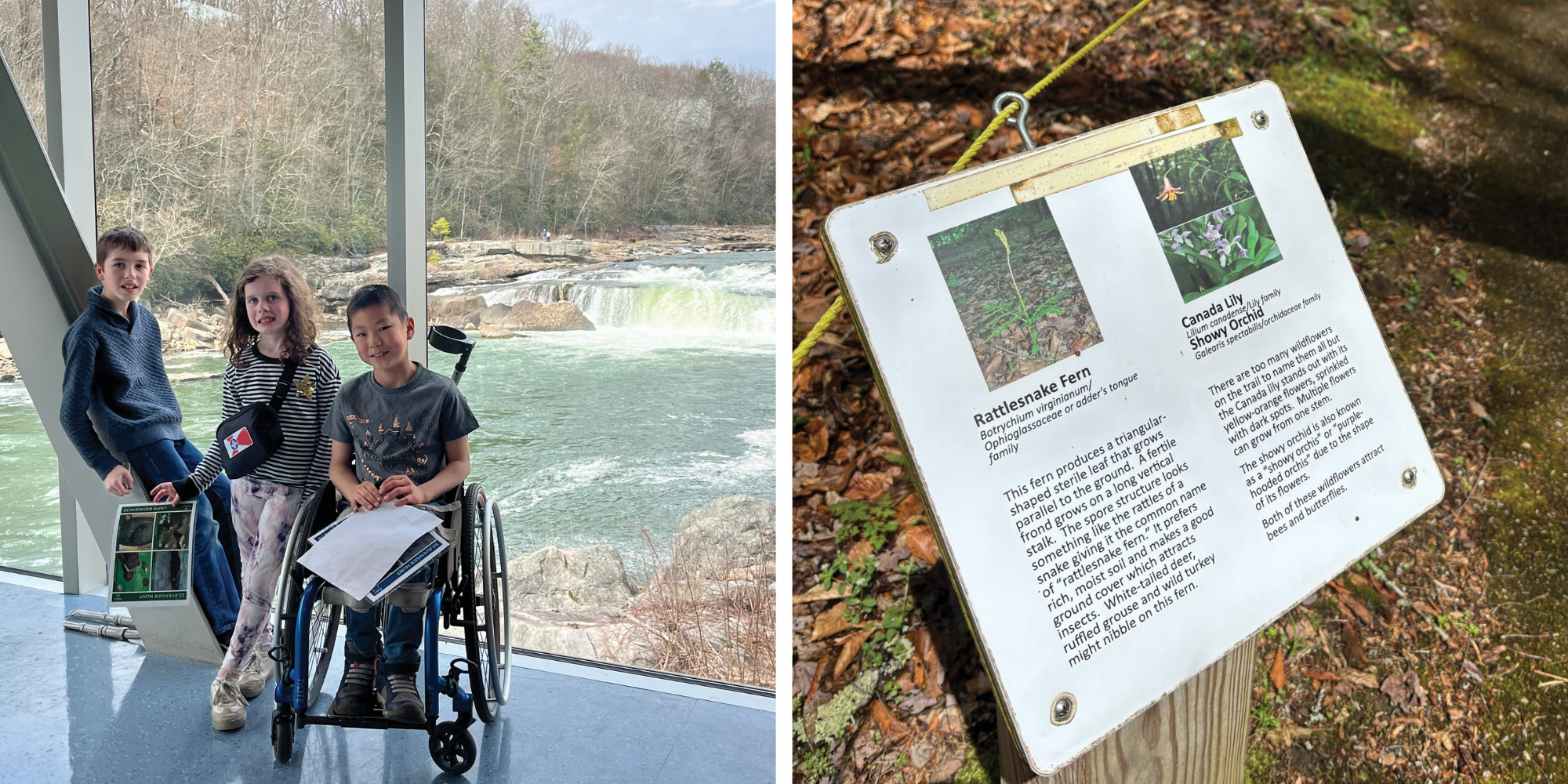
Ohiopyle Falls, Ohiopyle State Park, Pennsylvania Fully wheelchair accessible, as is the visitor’s center. The Youghiogheny River plunges 20 feet into the beginning of the popular whitewater section known as the Lower Yough.
Left: Photographed by Jennifer Allen | Right: Photographed by Laura Jackson
Braille Trail
Hikers with visual and physical challenges should visit these places.
The Spotted Salamander Trail, Kanawha State Forest, Charleston, West Virginia Fully accessible nature trail equipped with guide ropes. Interpretive signs for both sighted and blind guests point out critical stream habitat and wildflowers. The parking lot is paved, and an adaptive playground and restroom are on-site.
Cook Forest Sensory Trail, Cook Forest State Park, Leeper, Pennsylvania One-quarter-mile ADA-accessible paved trail with cable for the blind and interpretive signs in braille and raised printed letters. The walk is designed to feel grounding for autistic and sensory-sensitive visitors as well. There are wheelchair-accessible picnic tables at the entrance.