



Written by Julia Kastner
It was the spring of 2008, and I was a new mountain bike racer. After competing in the Big Ring Challenge in Texas’s Sam Houston National Forest, I relaxed at the team tent with Susan Stormer, a bit of a local legend. She and her then-husband Ryan had worked for the International Mountain Biking Association before starting their own professional trailbuilding company. She asked me, the newbie, “Are you putting in your trailwork hours?” “No,” I told her. I worked at a bike shop at the time, and the schedule made it hard. “If you have time for this,” she replied, “you need to make time for that.”
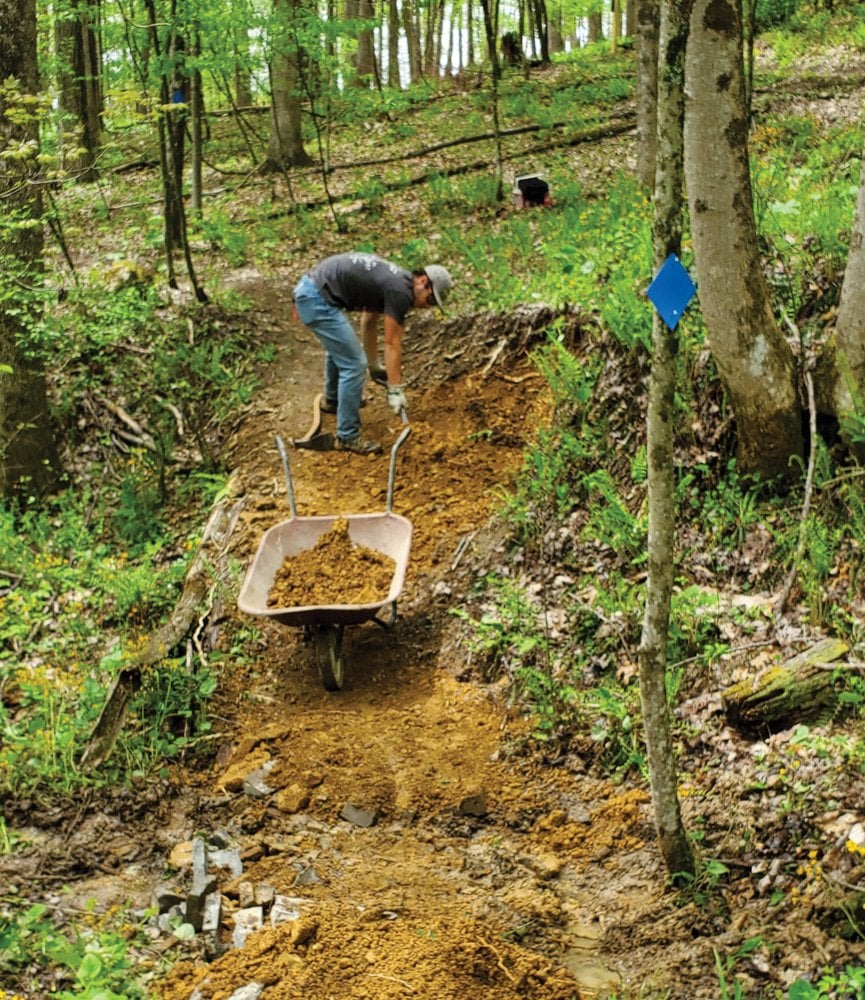
A volunteer digs up fresh loam at the Upshur County Trails. Photo by John Weber
She was pleasant but firm in her assertion. Within the next few weeks, I found a weeknight trailwork party that fit my schedule. We mostly lopped small limbs and shaved a little dirt for drainage, but it was the start of something new for me: a hobby unto itself. A passion.
I spent my remaining years in Texas putting in my hours. It was rewarding work. The more I worked, the more I learned about trail design and the negative impact of riding off-trail, like erosion and the creation of multiple lines. I became a more thoughtful rider. I led some trailwork parties myself. My local, heavily trafficked, urban park didn’t allow volunteers to run power tools or build anything new without going through layers of bureaucratic permissions—trimming and drainage mitigation were the limit. I took a weekend-long course from Susan and Ryan, where I got my first taste of design-and-build concepts: how to use an inclinometer, place features, and assess grades for sustainability.
When I rolled into West Virginia more than 10 years later, I’d lived and traveled through a couple dozen states. The urban experience—lots of oversight, limited use of volunteers—would often repeat itself. As a brand-new and, I thought, temporary resident of Upshur County, I planned to teach a couple of semesters at the local college, get back in my van, and move on. I soon discovered the local trails and made a few friends. I found a lot to love here, including the riding and the people, but the element that really captured my attention was the freedom enjoyed by the local trail group to install features and grow the trail system. Before I knew it, I’d sold my ancient van and gone full brick-and-mortar as a resident. The privilege of putting a berm wherever my friends and I wanted one was too much to walk away from.
A few summers later, on a cross-country drive, I rolled in to a random hotel outside a small town in Montana and was excited to find a trailhead right out the back door. For the price of a beer, the bartender agreed to dogsit my pup the next morning so I could get out and ride. It was an outstanding outing, much needed after four days of driving. “Those trails were so fun!” I gushed. “Who built them?”
“Built them?” The bartender cocked his head. He was a mountain biker. We’d already talked gear, and he’d described the ride I’d find: switchbacked climbs to rolling, flowing, whooping-fun descents. But it seemed as if he’d never considered the question of how these trails got here—trails that were an undeniable benefit to the hotel’s business. Did he think they’d sprouted there under the big sky?
I’ve long adopted Susan’s ethic: if I have time to make mountain biking (let alone racing) an important part of my life, I need to make time to give back to the places in which I play. Trails don’t grow on their own, and once built, they don’t maintain themselves. The way vegetation thrives in these lush hills, even a beautifully designed and constructed system will close itself right up if not used and maintained. It feels self-evident to me that trail users should contribute, even if only in small doses. Take the odd walk and kick sticks off the tread. Carry a folding saw; pull it out when a limb blocks the trail. Join your local volunteer group’s trailwork party, even just once a year. Trim back branches, clear downed trees, weed-eat and brush-hog, pick up trash, clear drains, add dirt to refresh eroding berms and table-tops.
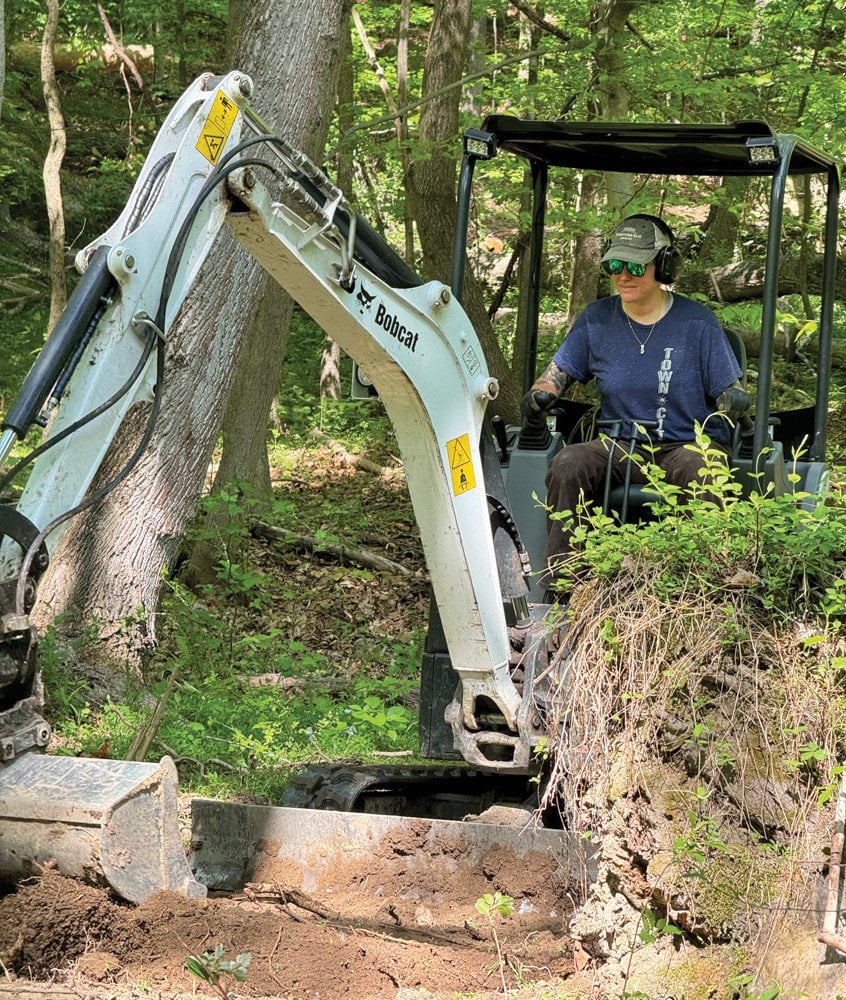
The author using an excavator to carve out a fresh mountain bike trail. Photo by Tracy Toler
If your musculature is getting a little bike-specific, try shoveling dirt and hauling wheelbarrows for a few hours: it’s outstanding cross-training. If you think it’s fun to roll down a fresh trail with your friends, whooping along the way, just wait till you try it on a trail you helped design and build. “One of the most exciting things for me is to blaze new trail. It’s like if you were a painter and you had a blank canvas on the easel,” said Scott Creak of Upshur County Trails (UCT), my home trail system in Buckhannon. “You look at the terrain, you walk through the woods, and you think about how you want to use this particular section. It’s dirt painting. It’s my form of art.”
With UCT, I’ve made the kinds of friends who take me to the ER when I crash my bike and bring me home again at midnight with a quesadilla from Sheetz. My trailwork buddies help me out with home repairs, provide carpools to bike races, and send me postcards. “The Upshur County Trails all started as a couple of miles for a couple of locals to ride, but our core group became pretty great friends, getting together every couple of weekends to dig in the dirt,” Creak said. “Today, there’s 10 miles out there. A bunch of people who didn’t know each other, from different backgrounds, all working together—that’s pretty unique.”
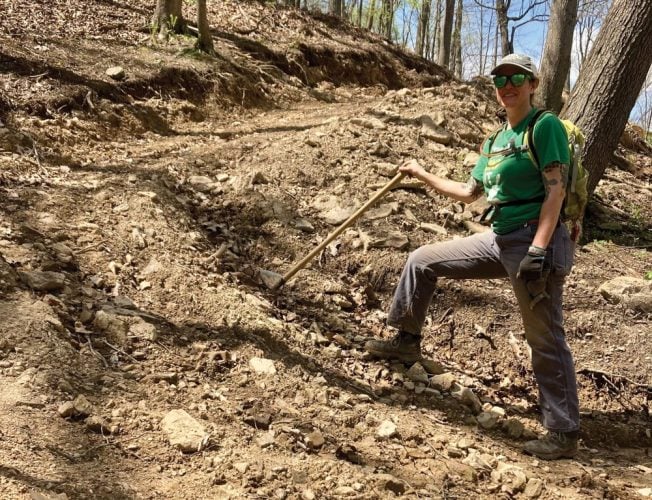
The first time I visited the Baileys Trail System in Athens, Ohio, I think I alarmed my riding buddy when I squealed and hopped off the bike to take a picture of a pitch drain. I am always thrilled to find good dirt—just the right loamy mix of sand and clay with that golden color. These days, I get stoked about running a small excavator on a professional crew. I never thought I’d care for heavy machinery, but it’s just like handwork, only on a grander scale. Bigger is not always better, but moving more dirt, in this line of work, is generally a boon.
I’ve found it rewarding, not only to build berms and then ride them, but to help build community with trailwork parties of college students who marvel at every rock and root. “Do you ever see wildlife out here?” “Why haven’t we seen any deer?” they ask. “Well, it would help if you turned off the music on your phone, but it’s always possible,” I’ll respond. After moving dirt all morning, I’ll hear things like: “That was actually really fun. Next time I’ll try and bring some guys from the frat house.”
Tracy Toler, owner-operator of Adventure Trail Systems (and my boss), also works with young people. “We get kids to come out, and sometimes they don’t know how to hold a shovel or dig a hole,” Toler said. “A lot of it is just teaching them how. It’s hard work, which gives them a better appreciation for hand labor and blue-collar work. Once people get a little taste of that, get their hands a little dirty, maybe get some blisters, it’s addictive.”
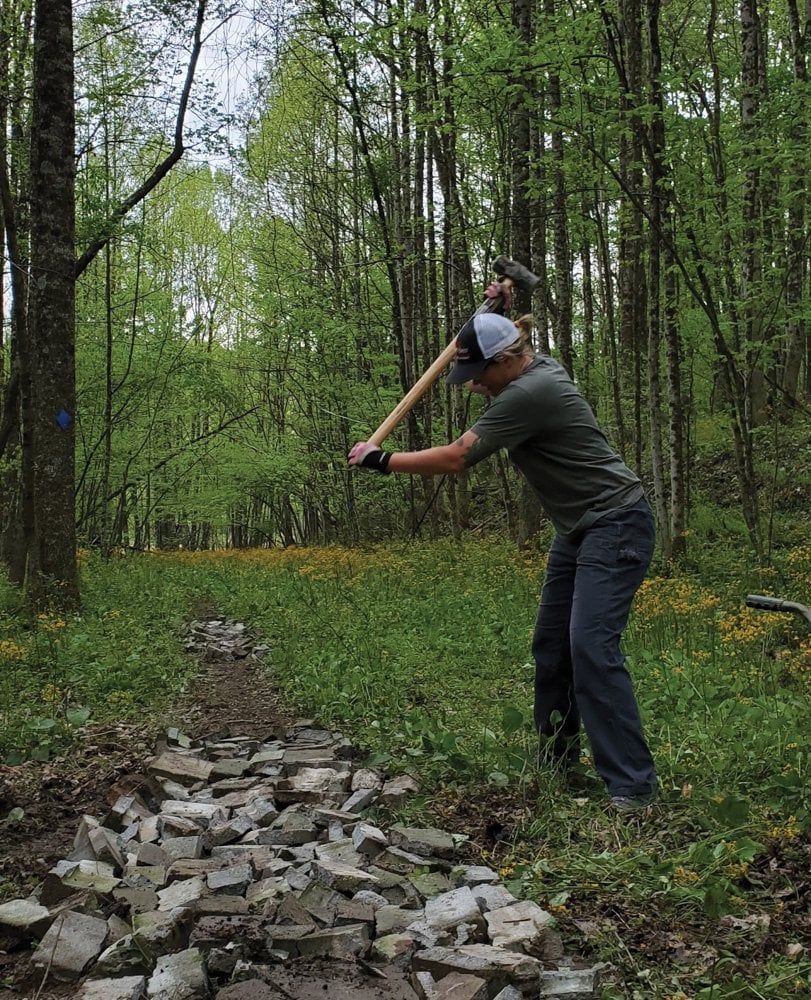
Julia Kastner smashing concrete at the Upshur County trail system. Photo by John Weber
There are still days I sit down on a log and pull out a pepperoni roll for my lunch and tear up, grateful that I get to be right here. Not everyone would get this giddy about shovels and blisters, but I think that if you enjoy that low whir of knobby tires in dirt, if you appreciate a perfectly angled turn, if you’re glad to have access to such experiences—you just might like being a part of the build.
West Virginians have a solid work ethic, and proof of this can be found in the volunteer efforts that created the mighty Meeks Mountain Trails in Hurricane. The dedicated and tight-knight crew built 33 miles of purpose-built trails entirely with volunteer labor in just six years. “It’s an exercise that allows people to detach from the mundane, and put some sweat equity into this thing,” said Brandon Doerner of the Meeks Mountain Trail Alliance (MMTA). “They’re able to see what their labor has produced in a short time, and that’s rewarding. That’s why we hike out on what we just built, so they can see the reward.”
I’m extremely proud of the work done by our UCT crew, folks with whom I’ve shed blood, sweat, and tears over the years. I’ve had the privilege of visiting with avid and hardworking trail groups throughout West Virginia in the Ohio River Valley, Kanawha State Forest, Hurricane, Morgantown, Harrison County, Canaan Valley, and beyond.
This sport that I love only works because there are trails, and trails are built by human effort and investments of time, money, energy, and passion. I’m constantly honored to be a part of it all. I believe a home is not four walls, or a van, but a network of human connections. And I wouldn’t have the home I’ve found here in West Virginia if it weren’t for shoveling dirt.
So if you love a good berm, if you wish that turn worked a little differently, if you appreciate having trails in your backyard or wish you had trails in your backyard, if you’re wishing for a little more upper body work outside of the weight room, consider putting in the hours. Consider the grubber hoe. Consider the humble shovel. And to all of those who dig, trim, or pick up trash: thank you. I’ll see you out there.
Julia Kastner is a book reviewer, trailbuilder, mountain biker, and lover of trees and mushrooms. She’s surprised and pleased to find herself in West Virginia, behind the sticks of a Bobcat E20 excavator.