



Written by Jess Daddio
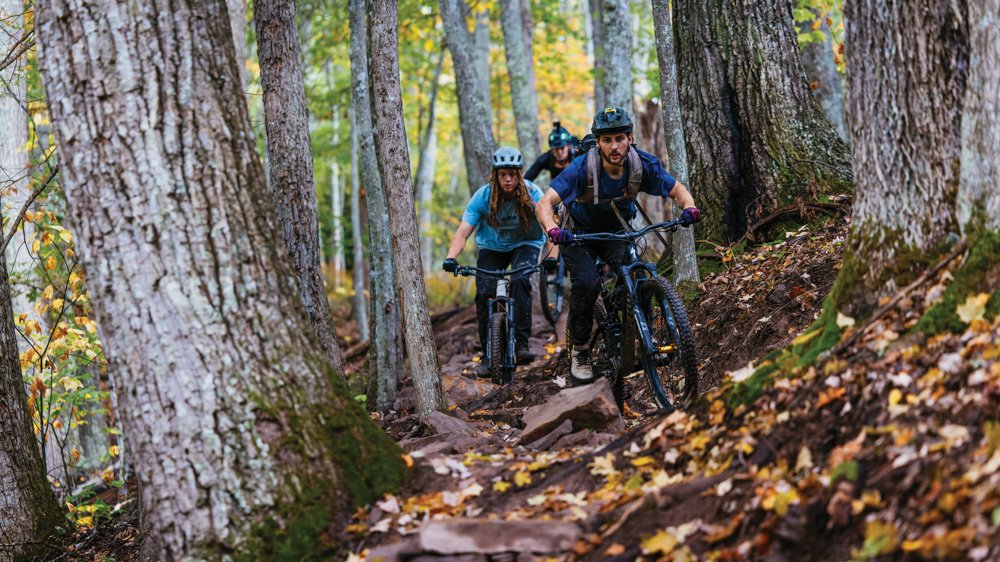
On May 17, mountain bikers in the Mountain State will officially be able to ride the Monday Lick Trail System, a purpose-built network of mountain bike trails in the Monongahela National Forest (known as the Mon) just outside the rural town of Marlinton. Winding for 27 miles between the top of Buckley Mountain and the Greenbrier River, the Monday Lick system is the largest purpose-built mountain bike trail network in the Mon, a national forest which has historically been known for old-school rake-and-rides and rugged backcountry singletrack. For many in the region, Monday Lick represents more than just another cool place to ride in Pocahontas County; it’s the newest poster child for the Snowshoe Highlands Area Recreation Collaborative (SHARC). It’s also a major step toward achieving the group’s collective dream of securing a gold-level ride center designation from the International Mountain Bicycling Association (IMBA).
In 2019, IMBA designated the Snowshoe Highlands as a bronze-level ride center, making it West Virginia’s first and only IMBA ride center. Although centered around Pocahontas County, the Snowshoe Highlands Ride Center also includes bits of Randolph, Nicholas, and Webster counties. Just one year later in 2020, following a flurry of activity by SHARC to improve the ride center’s status, IMBA bumped up the ride center’s designation to silver. IMBA ride centers are categorized by bronze, silver, and gold levels based on the density and diversity of trails, mountain bike-specific amenities, and clear trail signage and mapping. To date, there are only four gold-level ride centers in the country, none of which are on the East Coast. SHARC wants to change that. For the past six years, the collaborative has been laser-focused on establishing the Snowshoe Highlands as the first gold-level IMBA ride center in the East. With over 400 miles (and counting) of singletrack in the Snowshoe Highlands, the completion of the Monday Lick system may just be enough to bring home the gold.
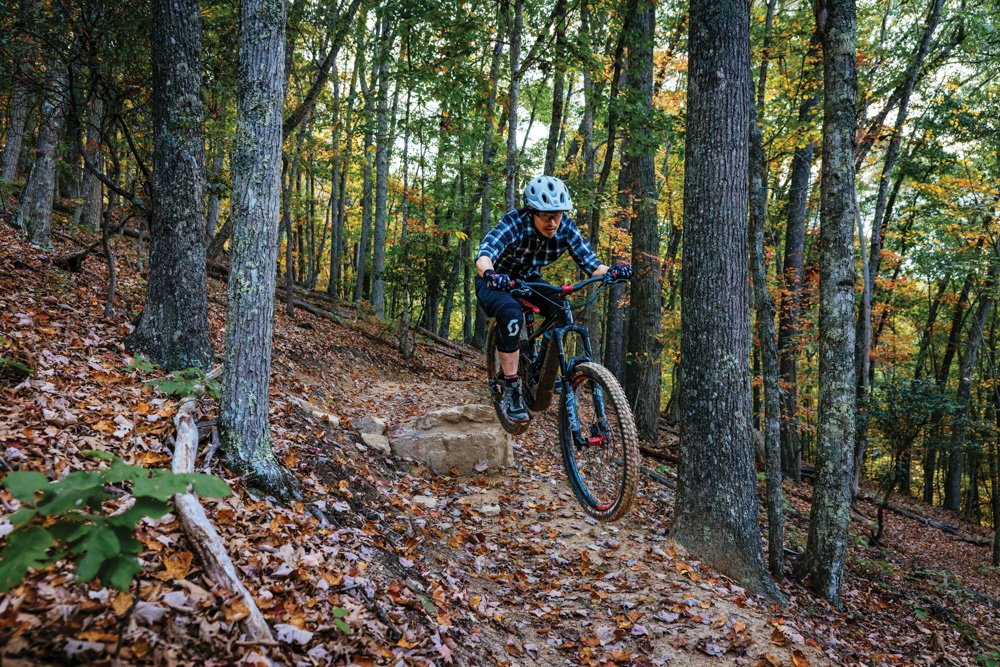
Felix Chuang catches mad air off a gnarly booter. Photo by Kurt Schachner
SHARC trail crew lead CJ Peterson first heard about the Monday Lick trails sometime around 2019. Back then, Peterson was working for Snowshoe Mountain Resort’s bike park in the summers and its terrain park during the winters. He remembers listening to the old guard of local riders talk around the campfire about a proposed trail system they called Monday Lick, which was then a mostly undeveloped 4,000-acre wildlife-designated tract in the Marlinton Ranger District of the Mon. “At the time it didn’t even seem real or feasible,” says Peterson. “There were so many stakeholders at play.”
Snowshoe Mountain Resort, the Pocahontas County Convention & Visitors Bureau (CVB), and even Mayor Sam Felton of Marlinton have all been heavily invested in not just the Monday Lick project but in SHARC’s larger ride center initiative. That many cooks in the kitchen can be hard to manage. Big trail construction projects are notoriously time-consuming and cumbersome. Between environmental impact studies and land manager cooperation, there are always obstacles to overcome. And then there’s the matter of finding funding—and lots of it. According to IMBA, construction for one mile of natural surface trail can cost anywhere between $15,000 and $40,000.
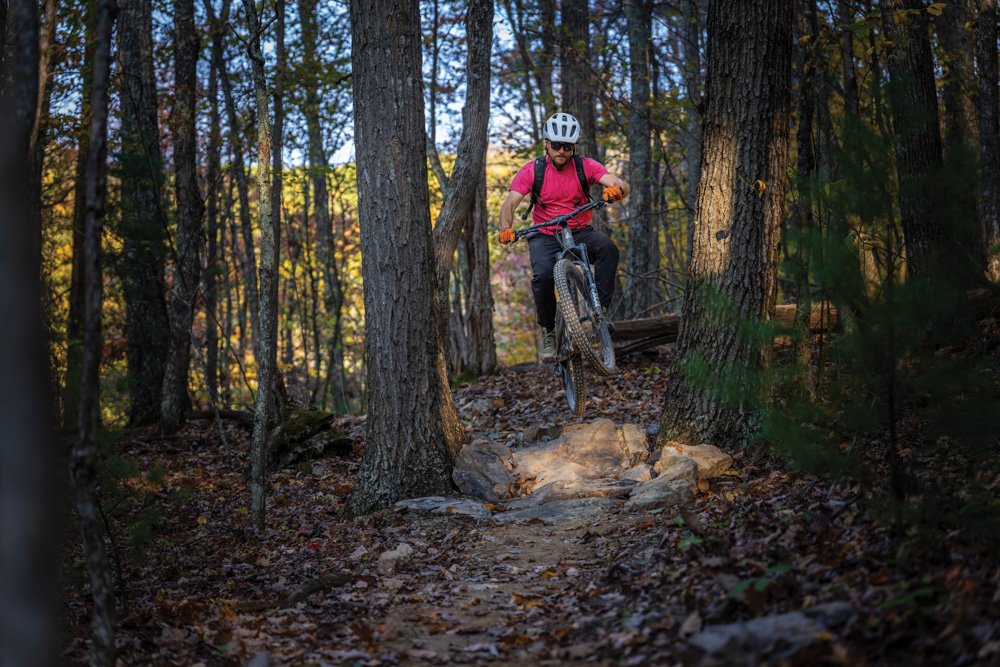
Charles Evans pops off a perfectly angled rock. Photo by Kurt Schachner
But the stars seemed to align for SHARC and the Monday Lick project. In 2022, SHARC received a $1.5 million grant from the Appalachian Regional Commission Partnerships for Opportunity and Workforce and Economic Revitalization (ARC POWER) Initiative. The grant was significant not only for SHARC, but for ARC as well. Prior to the Monday Lick project, ARC had only funded portions of trail projects, but never a trail system in its entirety.
After the grant announcement, progress on Monday Lick moved quickly. Between the summers of 2023 and 2024, two trail building companies constructed the initial 24 miles, which are slated to open this May. The final three miles of trail will be constructed in late spring this year, with the goal to have the entire network completed and open by summer.
“It’s been an incredible pace for securing the funding, getting the work on the ground, and the implementation,” says Jason Hattersley, forest service District Ranger for the Marlinton-White Sulphur Springs Ranger District. “It exceeded all expectations. I think that speaks to the passion of everyone involved.”
“We call it Cheat Mountain magic,” says SHARC trails coordinator Charles Evans. “Timing is everything, right? When there was that opportunity to seize the moment, there was already a plan in place. SHARC knew what they wanted to do and made it happen.”
As a grassroots collaborative, SHARC has prioritized not only the development of new trail systems like Monday Lick, but also the creation of new trail-related jobs. In 2023, Evans became SHARC’s first full-time employee. Since then, SHARC has expanded its trail staff to include two full-time crew leads, like CJ Peterson, as well as four other seasonal positions. These jobs are mostly funded through a cost-share agreement between the forest service and the CVB via the Great American Outdoors Act. The Benedum Foundation, Snowshoe Mountain Resort, and SHARC itself have also chipped in to support Evans and his team. Together, the crew is responsible for maintaining over 400 miles of trail throughout the ride center and hosting mountain bike races, including the inaugural Monday Lick Enduro, which is slated for the weekend of June 20.
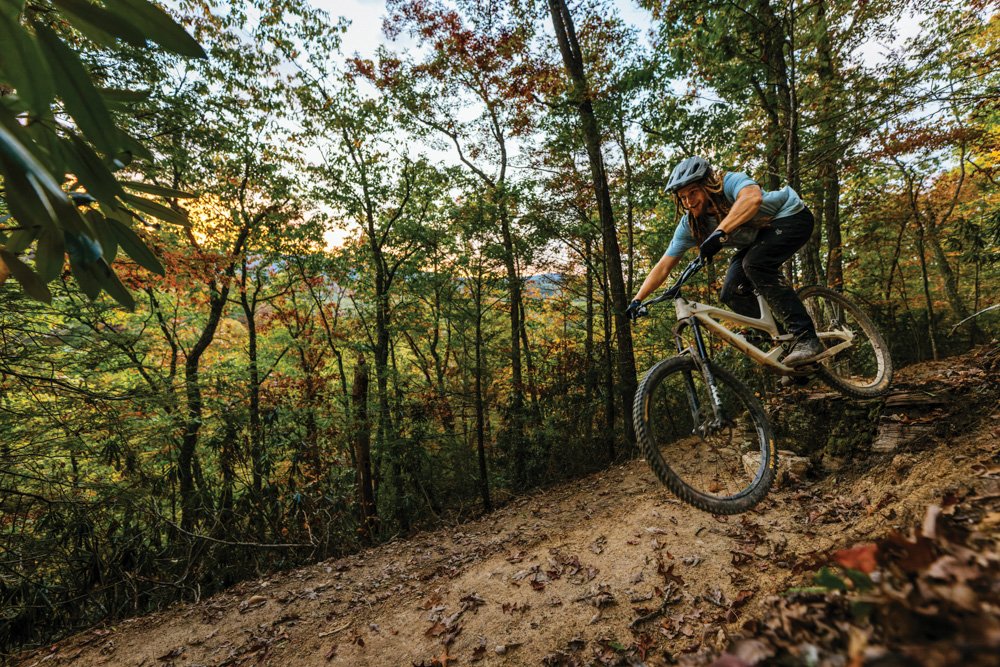
Zen Clements having a hoot on the new trails. Photo by Kurt Schachner
“It’s impressive that [SHARC] has that level of dedication,” says Appalachian Dirt owner-operator Zach Adams, who was one of two trail builders on the Monday Lick system. “You can’t just drop almost 30 miles of new trail on a community that only has 1,000 people. It’s going to take a lot of love and care to keep Monday Lick in good shape, especially if it gets a lot of use, so it’s cool that SHARC already has that maintenance in place.”
Mountain bikers have been riding through Pocahontas County’s dank, spruce-studded forests since the inception of the sport, but until recently, they’ve only had two flavors of riding to choose from: lift-assisted downhill at Snowshoe or tight and boggy root-tech in the Mon. Now, the trails at Monday Lick will offer a third flavor: flow trail à la rocks. The system’s high point on Buckley Mountain sits at 3,200 feet, where the long-distance Allegheny Trail runs high and dry along a predominantly oak- and hickory-canopied ridge. From there, veins of trails course through the Monday and Sunday Lick drainages, threading along cliff faces and diving some 1,200 feet down the mountain into moss-soaked loam and rhododendron corridors. The trails undulate between fast flow and bike-optimized rock-tech, with a few features thrown in to level-up the fun. Greenbrier Bikes owner Scott Guyette says the Monday Lick trails are unique in that they manage both to pay homage to Pocahontas County’s riding roots while serving to contemporize the county’s overall ride experience.
“We’ve always had a reputation of being a gnarly, rocky, rooty place to ride,” says Guyette. “Monday Lick still delivers on that in sections, especially with its namesake trail. But the trails are unlike anything else in Pocahontas County. They’re a little more modern and well thought-out, not just a deer path in the woods that got beat in over time.”
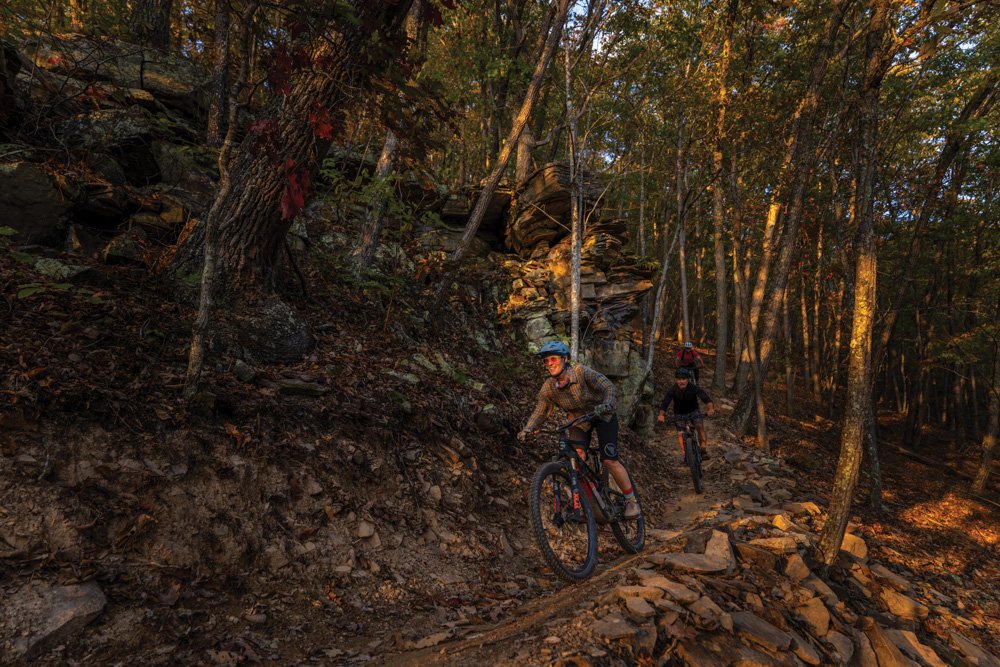
Jan Cios, Chris Cios, and Charles Evans ride beneath one of many rock outcroppings in the steep terrain of the Monday Lick drainage. Photo by Kurt Schachner
Although technically a bi-directional backcountry trail system, Monday Lick definitely “rides better downhill,” says Adams, whose crew built about half of the mileage. That fact, combined with the two gravel Forest Service roads that bisect the network, make the Monday Lick system ideally suited for shuttle laps. Guyette is currently in the process of securing a shuttle permit from the Forest Service. Downtown Marlinton and Guyette’s bike shop are only two miles from the entrance to Monday Lick. Although mountain bikers could just as easily pedal up the Greenbrier River Trail to connect to the trail system, Guyette is excited about the shuttle potential and the new demographic of riders that kind of ride experience will bring.
“From a business perspective, I do think we’re going to see an uptick in visitation,” he says. “I hope there’s a little crossover from the Snowshoe people who come for the weekend and ride a day at the resort then do a day at Monday Lick.”
As for the IMBA ride center designation, it’s unclear whether or not the addition of the Monday Lick trails will finally elevate the Snowshoe Highlands to the coveted gold status. IMBA is planning on releasing new criteria for ride center designations later this year. But for Pocahontas Trails president and co-founder Eric Lindberg, SHARC’s quest for gold goes well beyond securing IMBA’s stamp of approval. SHARC has numerous other projects in the works, including updated trail signage, new construction on another 20-25 miles of singletrack at the Mower Tract, and planning and design for trail systems at Halfway Run and the Green Bank Observatory.
That so many people from such a remote part of West Virginia can come together, decide to do something positive for their community, and then make it happen is the real beauty, and Monday Lick is just the tip of the iceberg. “If we don’t get [the gold-level ride center designation], we’ve still built an awesome place to live and ride,” says Lindberg. “That’s the bigger deal. Getting the ticket punched is really cool, but it’s not the end game.”
Jess Daddio is a freelance writer, filmmaker, and West Virginia wannabe who resides in the Virginia mountains. When she is not plotting her imminent move to WV, Jess enjoys bikepacking and nature nerdery.