



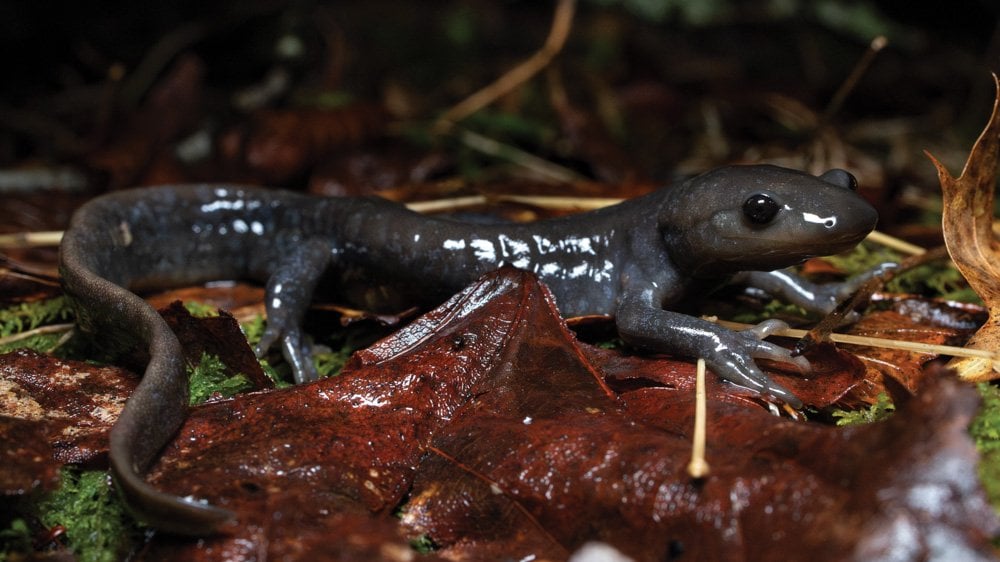
At two in the morning on a cold, rainy night, Frank Gebhard and his fiancé, Shannon, went scrambling across a shale outcrop along the New River in search of an extremely rare salamander. For years, Gebhard attempted to observe the yellow-spotted woodland salamander (Plethodon pauleyi), but every time, he was defeated. The first time he trekked from his home in Davis down to the New River Gorge region was during the middle of a dry, 95-degree day. “There was no chance I was going to find one,” recalls Gebhard.
As a kid growing up in Bel Air, Maryland, Gebhard frequently ventured to local ponds and streams to catch bullfrogs and other amphibians. Over time, he became more interested in salamanders, in part because they were so difficult to find. “They were kind of like my white whale,” he says. Then one day he came across an eastern red-backed salamander (Plethodon cinereus) beneath a log, one of the most common salamander species in the eastern U.S. “Now, I’m just continually chasing that feeling,” Gebhard says.
Over the years, Gebhard learned more about salamanders and their habitats, increasing his odds of finding them whenever he ventured into the wild. On this trip, he was feeling hopeful. He had scouted the area for suitable habitats during the day and identified several spots that seemed fitting for the yellow-spotted woodland salamander. The duo returned in the middle of the night, when salamanders are most active, and began their search. “We started hiking straight down into this gorge. It was one of the steepest hikes that I’ve done to this day,” he says.
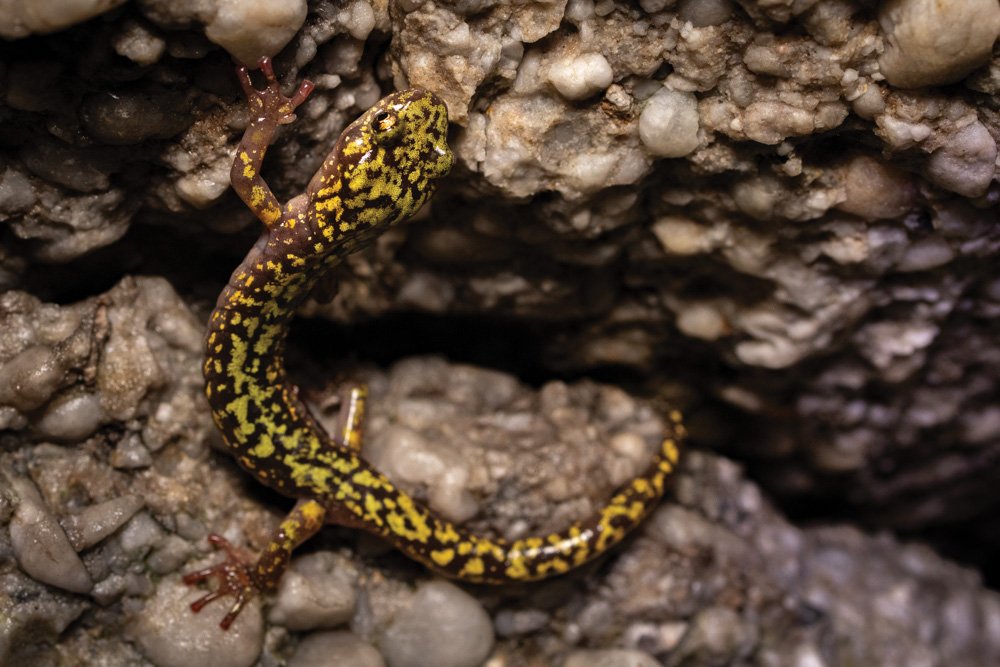
The green salamander (Aneides aeneus) has a flat body and wide feet that help it climb trees and rocks. Photo by Frank Gebhard
After making it down to the river, Gebhard and Shannon sat down on a rock to rest. After some time had passed, a juvenile yellow-spotted woodland salamander wriggled out of the rock crevice and into the crisp autumn night. Gebhard was thrilled but not quite satisfied, for his goal was to see and photograph a full-grown adult. At 3 a.m., they decided to continue their search, moving gently along the exposed and fragile rock. By the end of the night, they found five large adults, and Gebhard captured several photos of the elusive salamander in its natural habitat. According to Gebhard, perhaps only 100 people have ever seen this species. “It was 5 a.m. before I got to bed. It was a killer night. I still live off of the energy that I got from it.”
The yellow-spotted woodland salamander is one of three salamander species that have been discovered in West Virginia in the last six years. It was first described in May 2019 and named after Thomas Pauley, an emeritus professor of biology at Marshall University and the co-author of the first book on amphibians and reptiles in the state. In 2022, researchers discovered, based on DNA sequencing, that the black-bellied salamander (Desmognathus quadramaculatus) was actually five separate species, three of which were new to science. One of these species was the Kanawha black-bellied salamander, which can be found in swift streams south of Gauley Bridge in Fayette County. The third new species to the state was discovered in 2023, when researchers reported a disjunct population of the shovel-nosed salamander in the New River Gorge. Because this species was thought to only occur south of West Virginia, it was likely introduced as fishing bait.
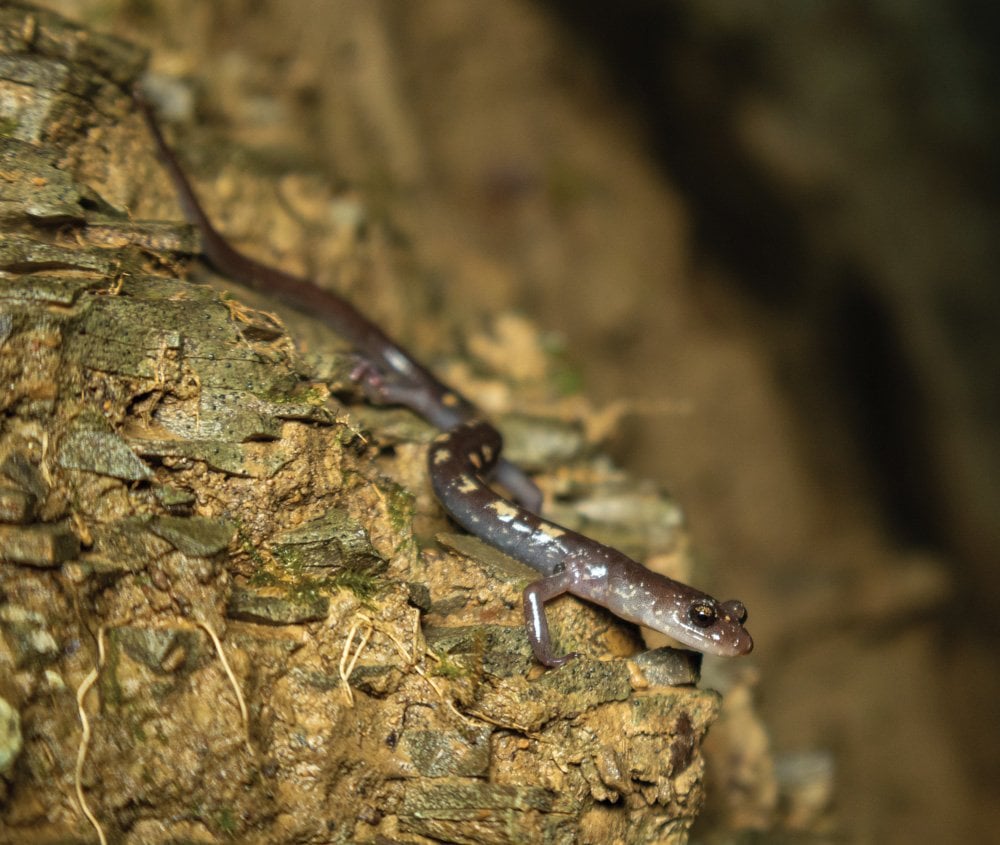
The yellow-spotted woodland salamander (Plethodon pauleyi) is a rare and elusive creature that lives on rock outcrops south of the New River. It was described as a new species in May 2019. Photo by Frank Gebhard
“We still have new species lurking in our mountains,” Pauley says. When Pauley first began studying the Cheat Mountain salamander in West Virginia in the late 1970s, there were very few herpetologists in the state. Now, he says, there are more people studying amphibians and reptiles in West Virginia than ever before, and they’re likely to continue finding new species.
Speckled, spotted wonders
The southeastern U.S. is home to more salamander species than anywhere else in world. In the Appalachian Mountains, there are at least 100 species of salamander, many of which are highly abundant. The eastern red-backed salamander (Plethodon cinereus) is only 2–4 inches long, but in some northern hardwood forests, it comprises more biomass than all the mammals and birds combined. It’s also the most common vertebrate in North America.
Salamanders eat an enormous amount and wide variety of insects and invertebrates, including mosquitoes, earthworms, snails, ants, and termites. They’re also a critical, high-energy food source for fish, birds, reptiles, mammals, and other amphibians. “If all the salamanders disappeared, the forest would be destroyed,” says Pauley.
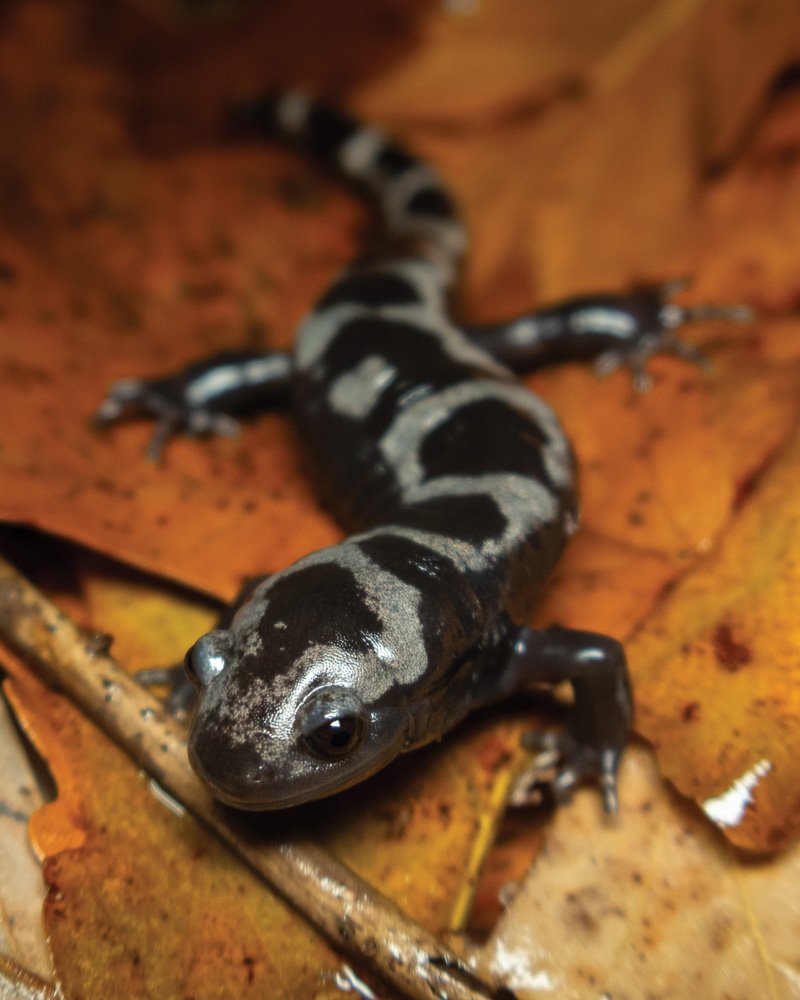
Unlike other mole salamander species, the marbled salamander (Ambystoma opacum) breeds and lays eggs in the fall. Photo by Frank Gebhard
“They’re unsung heroes,” says Kevin Oxenrider, the Amphibian and Reptile Program Leader for the West Virginia Division of Natural Resources. Because of their small stature and elusive nature, salamanders are often overlooked and underappreciated, he says. Yet they make up a huge portion of the biomass of our eastern forests and are essential for maintaining healthy and balanced ecosystems.
In West Virginia, there are currently 36 species of salamanders that occupy a range of habitats from rivers, creeks, and springs to rock outcrops, caves, and forests. “They are just these beautiful arrays of colors and designs and patterns,” Oxenrider says. There’s the beloved hellbender, which grows up to 24 inches long and can live for up to 40 years, as well as the slightly smaller mud puppy. There are also five species of mole salamanders (Ambystomatidae), so named because they spend most of the year underground. These include the Jefferson, spotted, small-mouthed, streamside, and marbled salamanders. “When you see them, you are kind of in awe just at the size of those animals,” Oxenrider adds. “I love to refer to them as little chonkers.”
The Mountain State is also home to 22 species of lungless salamanders (Plethodontidae), which breathe through their skin and mouths. This group includes the dusky salamanders, brook salamanders, and woodland salamanders. Two species in the lungless salamander family are endemic to West Virginia. The Cheat Mountain salamander (Plethodon nettingi) occurs in high-elevation red spruce and yellow birch forests in five counties. “They have black and slate gray coloration with brass flecking. There are so subtly beautiful,” Oxenrider says. The West Virginia spring salamander (Gyrinophilus subterraneus), lives in a single cave in Greenbrier County. It’s the only known population of that salamander species on the entire planet.
Because salamanders are nocturnal creatures that spend a lot of time underground, they can be difficult to spot. The notable exception is the eastern newt (Notophthalmus viridescens), which, during its juvenile stage, loves to wander about the forest on foggy, summer days. The neon orange skin of these juveniles, called red efts, serves as a warning to potential predators. “They’re super toxic,” says Gebhard. “They’re like Appalachia’s poison dart frogs.” Red efts secrete tetrodotoxin, a potent neurotoxin that can paralyze or even kill animals that try to eat them.
As amphibians, most salamanders spend their larval stage of life in the water and their adult stage on land. Yet, some terrestrial salamanders have foregone the water altogether, opting to lay their eggs beneath moist logs or in damp rock crevices instead. The eastern newt has a unique lifecycle, in which the juvenile stage is sandwiched between two aquatic stages. First, the newts hatch from eggs attached to submerged vegetation in relatively still bodies of water, like ponds and slow-moving streams. Newt larvae persist in the water for up to five months before developing into juveniles with bright orange, hydrophobic skin. The juveniles spend 2–6 years living in moist forests before entering the adult stage, when their skin becomes smooth and olive green as they venture back to the water to breed.
Persistent pressures
In 2023 and 2024, the West Virginia spring salamander and the eastern hellbender were proposed to be listed as federally endangered. The Cheat Mountain salamander was listed as federally threatened in 1989, and 15 additional salamander species in the state are currently considered Species of Greatest Conservation Need due to their risk of being extirpated from the state.
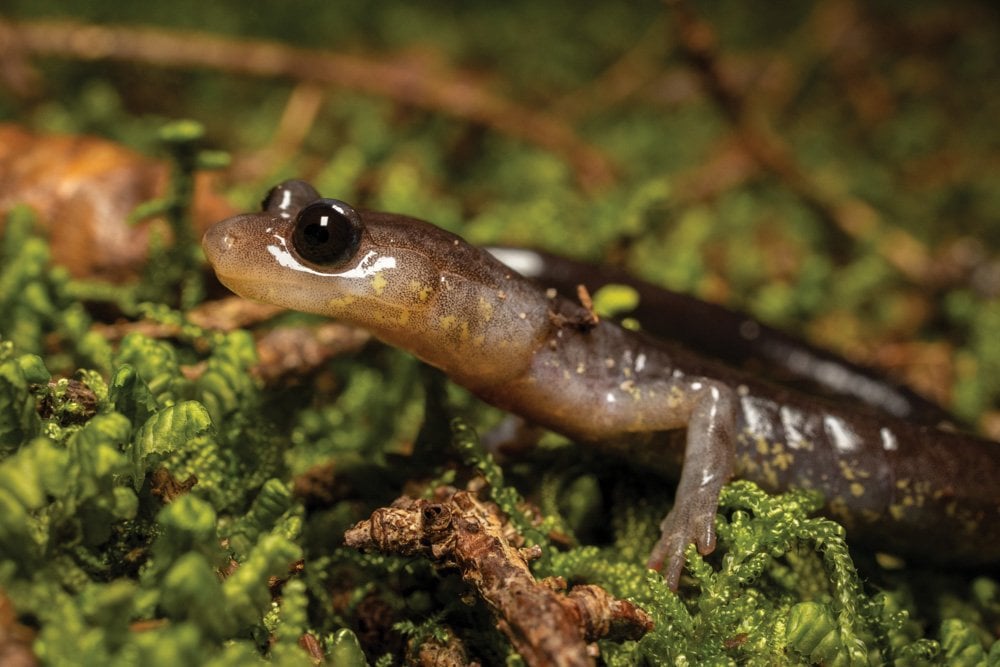
The Wehrle salamander (Plethodon wehrlei). Photo by Frank Gebhard
Declines in salamander abundances are attributed to a variety of stressors, most notably habitat destruction, pollution, warm temperatures, and less precipitation. For example, clear-cutting dries out the land, making it challenging for salamanders, which require moist environments, to survive. “We split the forest with roads and rights of way,” says Pauley, a process that separates salamander habitats and creates more isolated populations. “Down the slope, you have crystal clear, beautiful, rocky streams that gain sediment from the cutting because there aren’t any more live trees holding back all that sediment,” Gebhard adds. Pollution also poses a major threat to terrestrial and aquatic salamanders because they breathe and absorb nutrients through their skin.
Rising temperatures are also pushing species that depend on high-elevation forests, like the Cheat Mountain salamander and the Cow Knob salamander, to higher elevations. At the same time, the warming high-elevation forests are becoming more habitable to other salamander species, including some dusky salamanders, increasing competition and predation.
Just last summer, some of the state’s rivers and streams experienced their worst droughts in history. Hellbenders, which are territorial species, were forced together in the few remaining pools where frequent infighting occurred. Their high concentration also made them easy prey for raccoons, minks, and river otters.
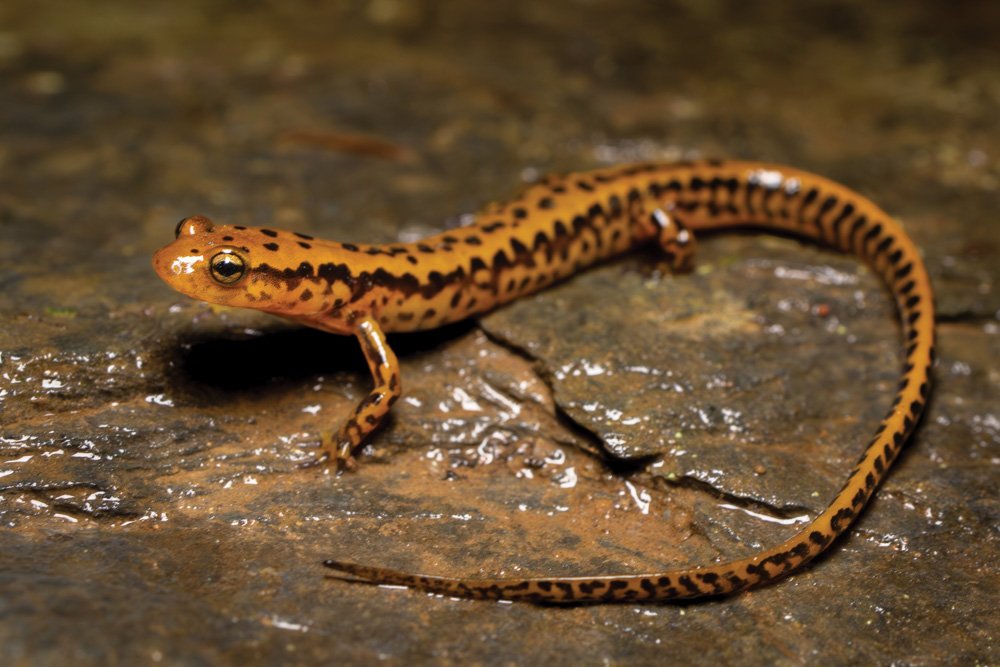
As their name suggests, the tails of long-tailed salamanders (Eurycea longicauda) comprise more than half their total length of about six inches. Photo by Frank Gebhard
Mole salamanders and other species that rely on ephemeral wetlands to breed in the late winter and early spring are also being impacted by declines in precipitation. “One thing that we have been seeing time and time again is that a lot of those wetlands are not filling because there’s no rain or snow melt,” says Oxenrider. And because climate change is causing warmer temperatures, these wetlands are drying out more quickly than they did in the past. “Some salamanders never get up to the metamorphosis stage where they’re able to persist outside of the water,” Oxenrider adds.
Tiny but Mighty
While it can be easy to despair, salamanders can still be found in our forests, ponds, streams, and rivers. “They’re not in the numbers they were before, but they’re still there. They are resilient,” says Pauley. And individual actions can go a long way toward protecting these species and their habitats. Leaving leaves on the ground, establishing brush piles, and limiting logging are all things landowners can do to create and maintain salamander habitat on their properties. Avoiding the use of pesticides, fertilizers, and other pollutants that can run off into water supplies is another highly effective way of supporting salamander conservation. As Oxenrider says, “folks have so much power to move the conservation needle forward for these animals.”
A few years ago, Oxenrider and his colleagues launched a citizen science project to gain a better understanding of where hellbenders and mudpuppies occurred throughout the state. Participants submitted 164 observations (75 for hellbenders and 89 for mudpuppies) over the course of two years. Using this data, Oxenrider learned about new streams that had mudpuppies in them. “And people observed hellbenders in streams that hadn’t had a record of a hellbender in 50 or more years,” he adds. Next year, he’s kicking off a similar study for eastern newts.
It’s comforting to think of the ways in which small actions can improve the lives of salamanders. And for some people, these small, humble salamanders have changed the course of their lives. For Gebhard, salamanders were a large part of why he decided to move to the mountains of West Virginia and the sole reason he got into photography. His salamander searches have taken him to some of the highest peaks and most remote watersheds in the eastern U.S. “The pursuit of salamanders is not about the destination. You’re there to see this one thing, but you get this whole experience out of it,” he says.
For Pauley, salamanders have been an integral part of his life. He was one of the first people to start studying West Virginia’s reptiles and amphibians, dedicating 40 years to studying the Cheat Mountain Salamander. Throughout his career, he mentored more than 90 graduate students, many of whom still work in herpetology today. Now, at 84, his work isn’t done. He’s writing an updated edition of Amphibians and Reptiles of West Virginia along with another book about his life in the Central Appalachians. “I was just at the right place at the right time. No one else was doing this work and it needed to be explored,” he says. “If I had to do it all over again, I would.”
Nikki Forrester is co-publisher of Highland Outdoors and the proud owner of a small pond full of wood frogs and spotted salamanders.