


We’re snaking through the crowded branches of a shady red spruce forest, trying to make our way back out into the open. Picking a path through the understory is slow going, and we’ve been whipped in the face and had our hats snatched by the needleless twigs more than enough times.
Nevertheless, it’s a beautiful day in the mountains. Temps hover around 60 degrees; the air is crisp with zero humidity and a steady breeze. It’s the rare type of Appalachian day where the smell of arid duff reminds me of alpine summer hikes in the Tetons. My wife, Nikki, and I pop out of a small hole between the branches at the edge of the spruce stand and enter a shrubby meadow awash with bright sunlight. The only visible paths through the thick brush are braided game trails that deer and other fauna follow on their endless quests for food and water.
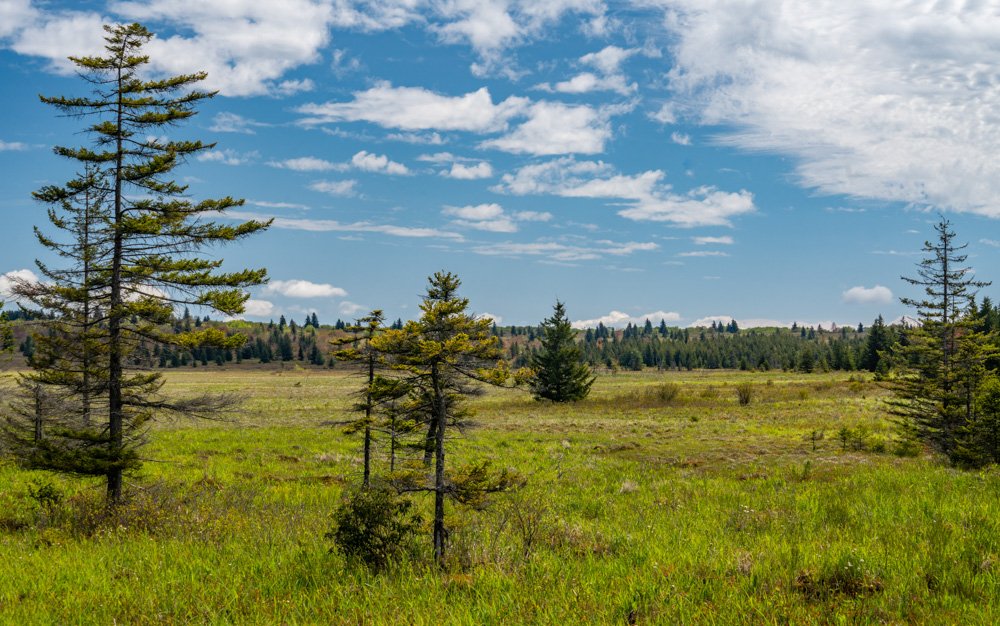
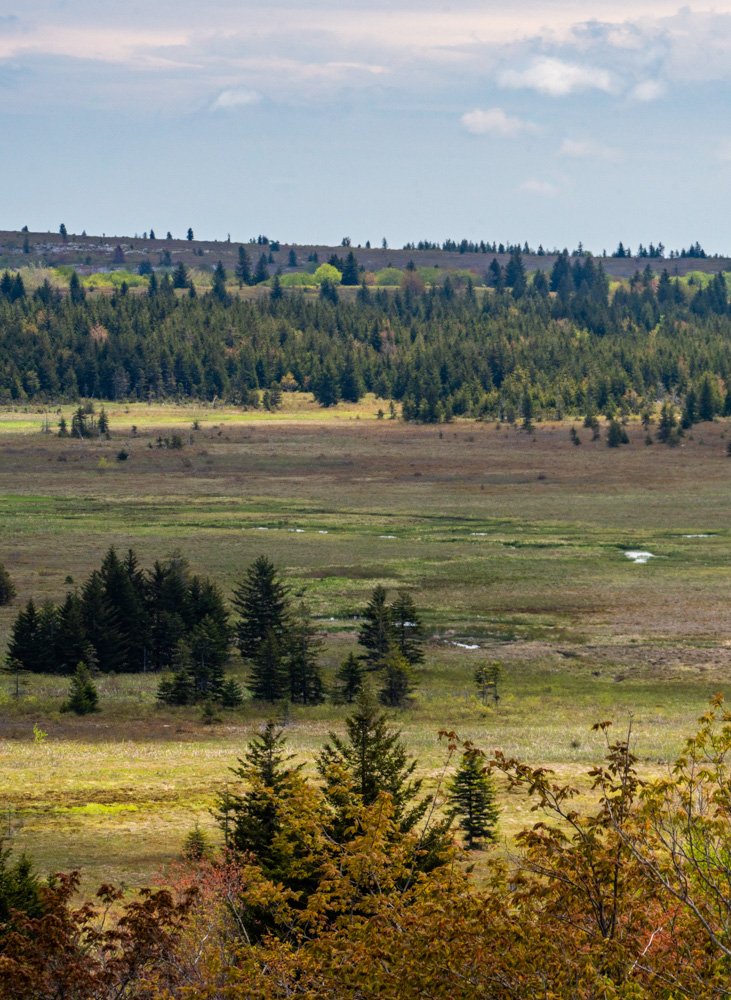
It’s mid-May, and most of West Virginia’s deciduous forests are already enveloped in the monotone green of summer. But here at 4,000 feet, the highlands atop the wind-battered spine of the Allegheny Front are just coming back to life after a long, hard winter. The late-spring tableau still assumes an autumnal color palette: the young leaves of scrubby maples are still quite red, and the tender quaking aspen leaves are so fresh that they’re yellow. The herbaceous layer of the meadow bursts with hues reminiscent of a coral reef: crunchy mats of turquoise reindeer moss, spongy hummocks of blood-red sphagnum, and neon-green shoots of unfurling fiddleheads. Sun-bleached white chunks of Pottsville sandstone, weathered into grotesque shapes with potholes stained orange from algae, punctuate the scene.
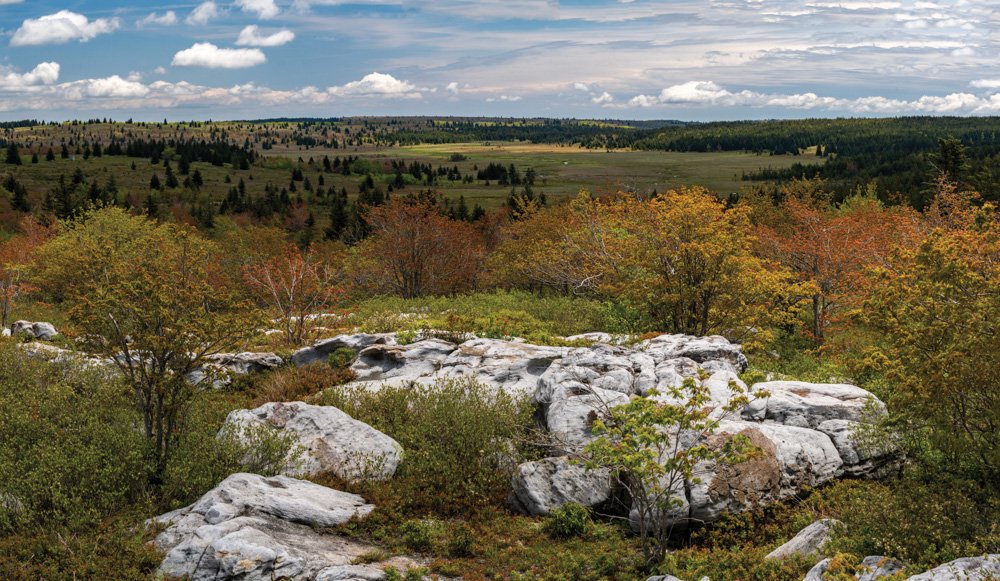
Looking east from the rocky spine of Cabin Mountain into the Dobbin Slashings bog. Photo by Dylan Jones
While we only drove an hour and hiked up a single ridge, it feels as if we’ve traveled thousands of miles to northern latitudes. The sun’s rays seem to radiate a little more energy at this elevation, and I imagine the plants are having a photosynthetic party, collectively celebrating a full day of not being enveloped in the thick fog or beaten down by the driving rains typical atop the Front.
A Bog Above The Rest
We’re deep into our inaugural exploration of the Dobbin Slashings Preserve, a 1,393-acre property situated atop Cabin Mountain in Tucker and Grant counties that represents a huge conservation win for The Nature Conservancy (TNC).
Here, the meandering ridgeline of Cabin Mountain is part of the Eastern Continental Divide, splitting the mountain’s hulking mass between two major watersheds. To the north of the Dobbin Slashings Preserve, the Stony River originates and flows into the Potomac River watershed, eventually reaching the Atlantic Ocean. But the centerpiece of the preserve is the Dobbin Slashings bog, an 800-acre wetland complex featuring myriad plant communities and a wealth of rare species. This spectacular wetland creates the northernmost headwaters of Red Creek, a pristine high-elevation stream that drains the Dolly Sods Wilderness. Red Creek is a tributary of the Dry Fork of the Cheat River, which joins the mainstem of the Cheat and several other rivers along its aquatic journey to the Mississippi and the Gulf of Mexico.
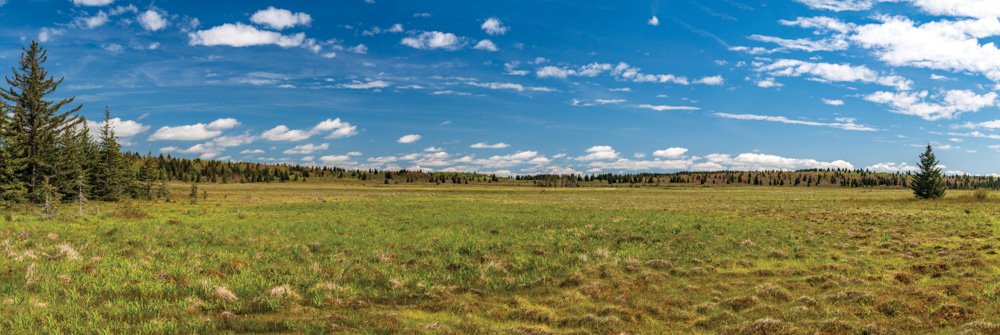
The 800-acre bog becomes larger than life and quite expansive when standing out in the hummocks. Photo by Dylan Jones
While headwater stream protection is always a noble conservation cause, the big attraction of the Dobbin Slashings bog for TNC is its high concentration of rare plant communities. “The initial interest in the property was in the high-elevation peat wetlands, including several unique wetland types that host rare species that are tracked by the [West Virginia Division of Natural Resources],” says Mike Powell, director of land management and stewardship for the West Virginia chapter of TNC. “There’s also a significant red spruce forest on the southern part of the property, which is one of the largest intact red spruce forest ecosystems on the plateau [of the Allegheny Front].”
Longtime West Virginia ecologist Elizabeth Byers penned an even more verbose description of the tract during an exploratory mission to catalogue the bog’s ecology in August of 2023: “It has an open shrub and herbaceous, beaver-influenced, central portion, bordered by seepage fens and peaty shrub swamps, with a few small remnants of forested peaty swamps on the southwestern margin.”
The sinuous steam that forms in the Dobbin Slashings bog is the headwaters of Red Creek. Photo by Dylan Jones
Additionally, the natural bowl of the bog creates a frost pocket, which is a landscape feature that traps cold air on clear, calm nights. Powell says that David Carroll, a meteorology professor at Virginia Tech who monitors a weather station in the northern, undeveloped end of Canaan Valley, believes that Dobbin Slashings bog could be the coldest spot in West Virginia when atmospheric conditions are just right. In the first three days of June this year, Carroll recorded three sub-freezing mornings in a row at his professionally equipped weather station in Canaan. It’s plausible that Dobbin Slashings, 1,000 feet higher than the station on the valley floor, hosted even colder temperatures on each of those mornings.
A Long Time Coming
Dobbin Slashings bog is one of the largest wetland complexes in Central Appalachia and was the largest remaining unprotected wetland in the region until TNC’s acquisition of the property in November of 2024. TNC purchased the tract from Western Pocahontas Properties (WPP), the largest private landowner in Tucker County. WPP maintains ownership of land north of the preserve, including the Stony River headwaters.
According to Powell, the deal, like most large-scale conservation acquisitions of this scope, was “several years in the making.” Unlike the Big Cove tract in the northern end of Canaan Valley, which TNC purchased in 2023 and transferred to the Canaan Valley National Wildlife Refuge (CVNWR) in February of 2024, TNC will maintain ownership of the Dobbin Slashings Preserve as a flagship tract to highlight its successes in conserving critically important ecological regions in the Central Appalachians.
TNC, a global organization, is heavily invested in conserving what it considers to be the four most ecologically critical regions for the fight against climate change: the sprawling grasslands in Kenya, the lush Amazon Rainforest, the cloud forests of Borneo, and the ancient forests of the Appalachian Mountains. Like these other incredible natural wonders, Appalachia is home to some of the greatest biodiversity on the planet. The mountain range’s north-south orientation and east-to-west-facing slopes offer multiple migratory corridors for species to respond to pressure from a rapidly changing climate.
A Resilient Landscape
Dobbin Slashings bog, and much of the Dolly Sods area, has been subject to a harsh history over the last century. The region was first settled and farmed in the late 1700s by the Dahle family, German immigrants who undoubtedly suffered through some hardscrabble living while grazing sheep atop the notoriously windy and wintry plateau.
In the late 1800s and early 1900s, the entirety of the Allegheny Front—and the majority of Central Appalachia—was completely deforested by a relentless logging spree that left no sapling standing. George Dobbin was an early white settler of the region who built the Dobbin House settlement in what is now Blackwater Falls State Park. He also formed the town of Dobbin on the North Branch Potomac River in Grant County, and transported timber from the Allegheny Front down the mountain along what is now the infamously muddy Dobbin Grade trail in Dolly Sods. In the early 1930s, the remaining brush, called slash, was piled up and set ablaze across 25,000 acres. Some of this slash burning occurred in the bog, hence the name of Dobbin Slashings. The hungry flames consumed everything and smoldered until the soil was burned down to the bedrock.
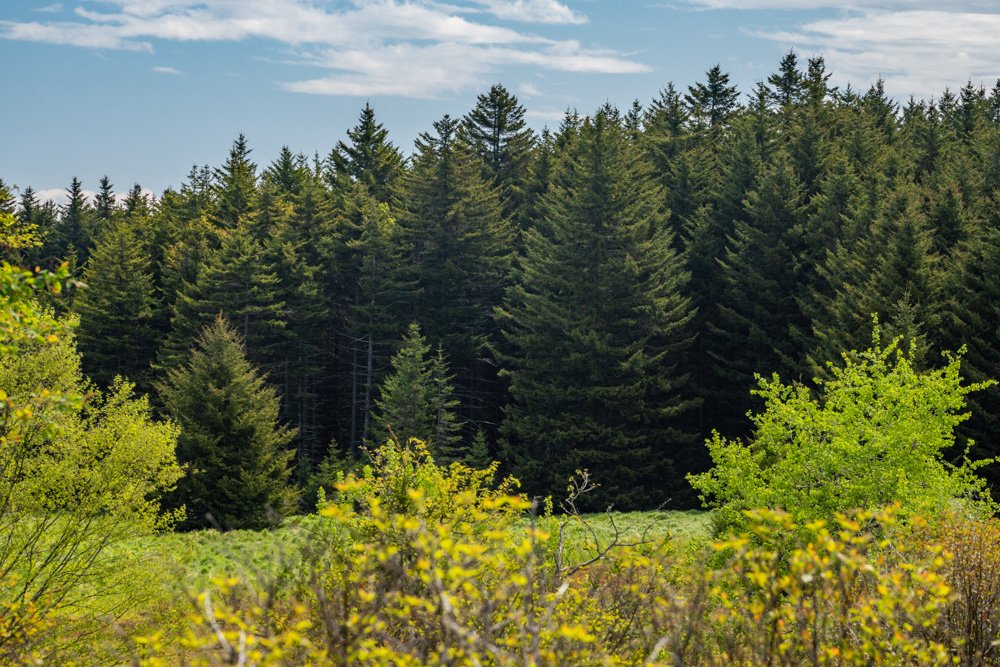
Mature red spruce stands now flank what was once a barren landscape. Photo by Dylan Jones
In the mid-1930s, the Civilian Conservation Corps planted red spruce saplings upon the barren wasteland, ushering in the ongoing recovery of the high-elevation red spruce ecosystem. In October of 1943, fire and flame returned to the bog, this time as part of the national WWII effort. The U.S. Army created the 60,000-acre West Virginia Maneuver Area, where artillery units trained for mountain operations in Italy by using the open plains atop the Front for bombing drills.
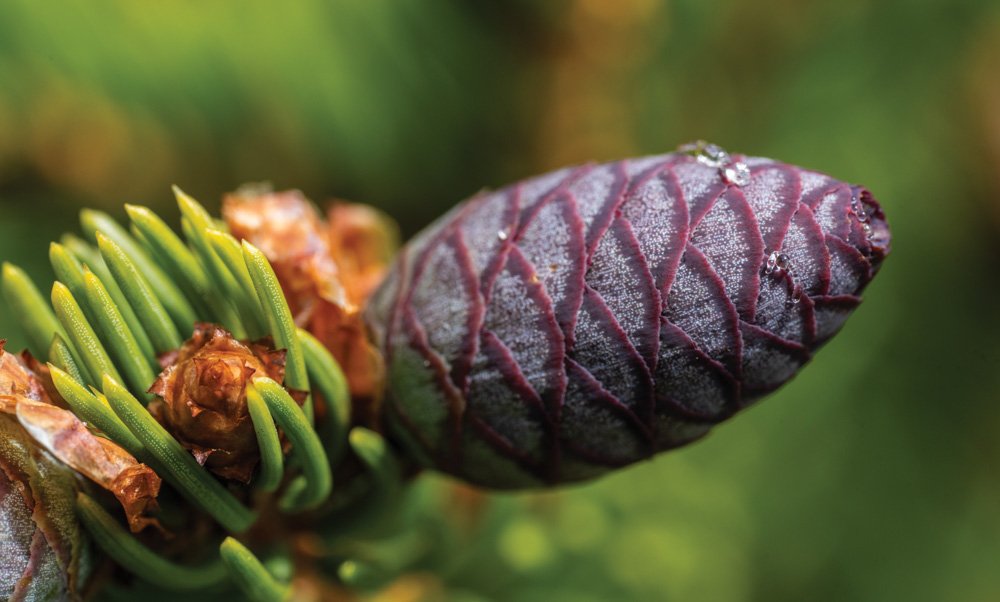
A nascent red spruce cone, rich in color as well as sap. Photo by Nikki Forrester
Long after the last bomb exploded in the bog, a new threat appeared. In 1970, the Davis Power Project was proposed: a pumped-storage hydroelectricity system that would have required damming the Blackwater River and turning Canaan Valley into a nine-mile-long lake. The upper pool of the system, which would have water pumped up into it so it could flow back down to turn hydroelectric turbines, would have been created by damming Red Creek where it flows out of the Dobbin Slashings bog. Fortunately, the U.S. Supreme Court ruled in favor of those opposing the project, paving the way for the creation of the CVNWR in 1994.
But despite its tumultuous history, the Dobbin Slashings bog has made a remarkable recovery. “That’s another part of why this property is so special,” says Powell. “It’s really hardy and really resilient. It’s been logged and burned and bombed and degraded, and it’s still a really special place with significant reforestation, restoration, and recreation opportunities.”
A Cornucopia of Rare Species
The Dobbin Slashings bog and its surrounding slopes are home to over 400 priority plant and animal species of greatest conservation need. There are several rare plant communities, each a mouthful to recite: blueberry–bracken fern shrub swamp, bluejoint wet meadow, cottongrass fen, cranberry–beakrush peatland, red spruce–three-seeded sedge peat wetland, and silky willow shrub swamp. “Being able to protect a large swath of high-elevation wetlands with surrounding uplands, along with the opportunity to reforest those uplands, really elevates the conservation value of the property,” says Powell.
Rare plant species include balsam fir, several types of sedges, creeping snowberry, northern club moss, small cranberry, and northern stitchwort. Rare insects include the spreadwing damselfly, the black-tipped darner dragonfly, and a handful of other insects and spiders. Several spider species were described as new state records, meaning the first time they were identified as being present in the state.
The boreal stitchwort, a type of flowering plant typically found in Northern Canada, finds the southernmost extent of its range in the bog and at TNC’s Bear Rocks Preserve just to the east. The southern rock vole, an adorable short-tailed mouse typically found in the Great Smoky Mountains, finds the northern extent of its range in the preserve. These two range extremes are a nod to the Allegheny Front’s importance as both an ecological transition zone and a critical corridor for these imperiled species—and many others—to be able to move in response to a changing climate.
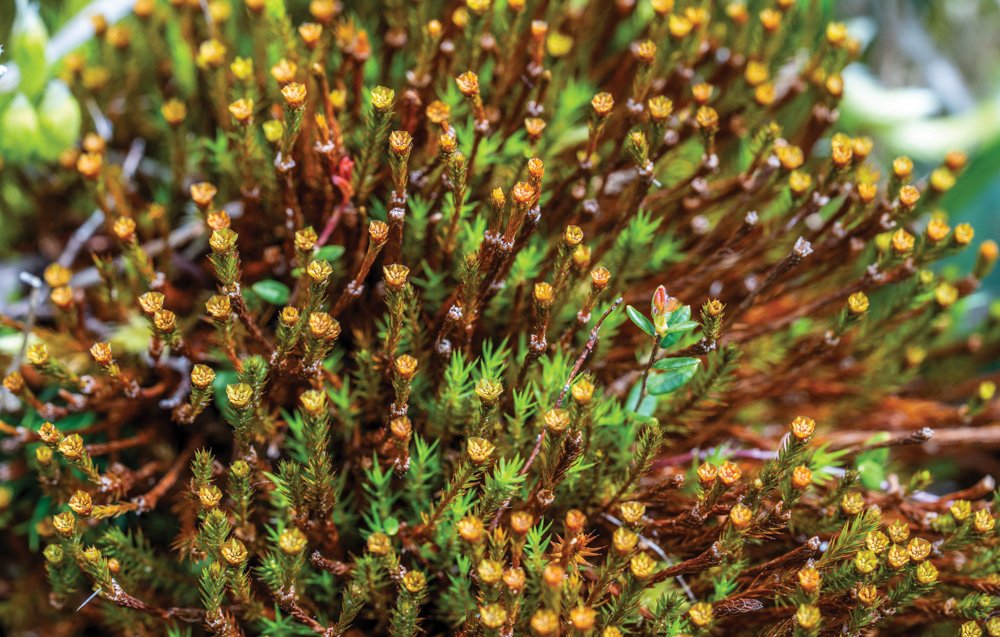
Dobbin Slashings bog is home to a variety of rare species. Photo by Nikki Forrester
The bog offers refuge for 25 bird species of greatest conservation need, including the American woodcock, American bittern, green heron, northern harrier, and veery. The grounds are also known habitat for bald and golden eagles. “The property provides breeding habitat for those birds; the secluded nature of this site gives them relatively uninterrupted space to forage and feed and do their nesting activities,” Powell says.
Additionally, peatlands are of interest to conservationists for their outsized role in sequestering carbon into soil for long-term, natural storage. “When you think about climate resilience, these wetlands store a lot of carbon, so that’s one of the big drivers of protecting these high-elevation peatlands in addition to the spruce forests and their soils, which also play an outsized role,” Powell says. Forested wetlands store nearly 20 times as much carbon as upland forests because of the ancient peat deposits, some of which can be upwards of 10,000 years old. “These ecosystems are the two heavyweight champions at sequestering carbon.”
In 2023, Powell and a group of ecological scientists went up to dig a horizon pit to study the soil composition. A soil scientist interpreted the red spruce soil layers, while a mycologist found the mycelium that produces truffle mushrooms, which in turn are eaten by the once-endangered West Virginia northern flying squirrel that lives among the red spruce canopy. “That was a really neat trip; it was with people I consider my mentors and these young people that are grabbing the reins and learning all the science, it’s just amazing to see,” he says.
A Long-term Vision
Securing the protection of the Dobbin Slashings bog was only the first step—now the property needs to be managed in a way that fosters climate resiliency and mitigates current and future impacts. Powell says TNC plans to hire professional crews to plant 60,000 native red spruce and balsam fir trees on the property to make sure the bog can continue to function ecologically as both a giant sponge and carbon sink.
Many Dolly Sods afficionados are equally interested in TNC’s recreation management plan. The Dobbin Slashings Preserve serves as an important connector between the CVNWR and the trails in Dolly Sods, and Powell says TNC plans to work with land managers to develop a system that will connect 80 miles of existing trails around the tract. “It’s an important recreational connector between public lands, and we want to work with our partners to potentially take some of the pressure off of the east side of Dolly Sods, where parking is limited and crowds are large.”
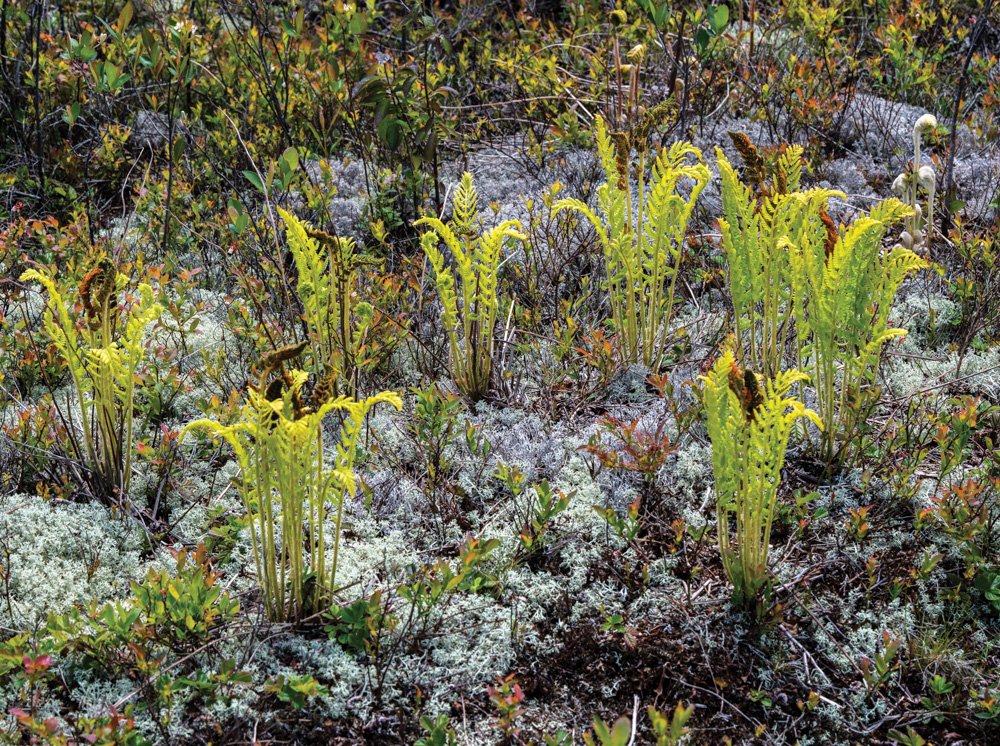
West Virginia’s high-elevation bogs offer a stunning display of colors year-round. Photo by Nikki Forrester
Although the property is open to the public, there aren’t any officially marked or mapped trails. A historic network of unmaintained jeep and hunting trails has led to erosion and sedimentation of the wetland. Because of the wealth of rare species that are sensitive to impacts, Powell says there are no plans to authorize camping on the property. “We want to develop professionally built, sustainable trails higher up around the property, so that people can enjoy the wetland without negatively impacting the native vegetation. As a land manager, I find a lot of value in projects like Dobbin Slashings and Big Cove, where there’s this intersection of recreation and conservation,” Powell says. “Both the natural world and the human world benefit from our work.”
A Timeless Place
It’s hard to capture the scale of the landscape in a single image. But feeling compelled to try, I bogwhack out as far as I can go, water rushing into my high-top Goretex boots, before the murky, tannic water becomes too deep for my own taste. I snap a series of images that I’ll later stitch into a single panoramic photo on my computer. I sling my camera back around my shoulder and stand there in awe. The forward march of time seems to freeze. It’s totally silent; only the faint breeze on my skin gives any inkling of change in a raw place that, right now, feels timeless.
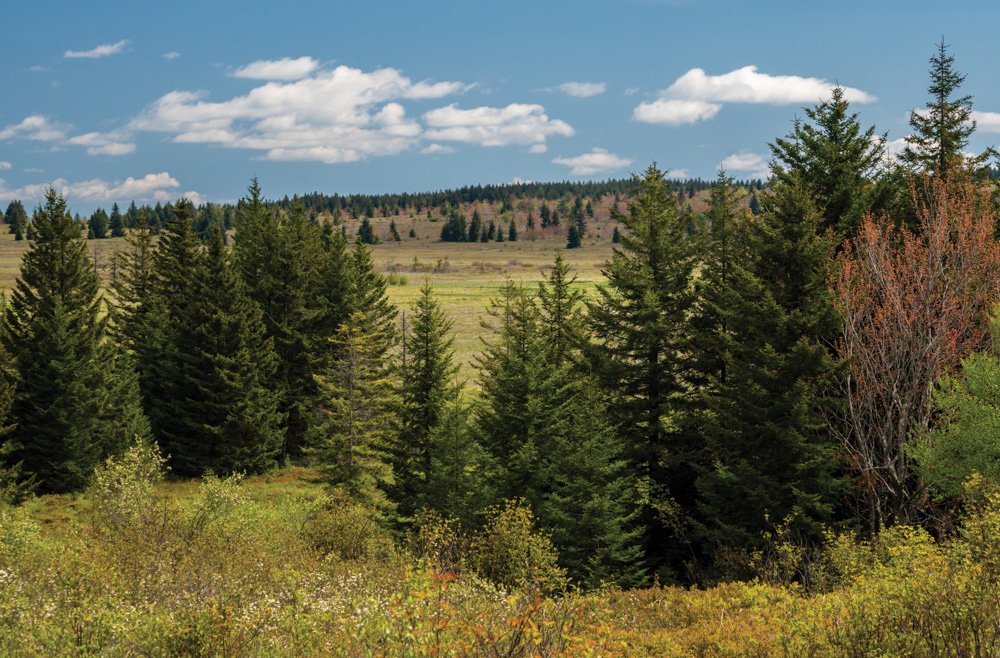
Visitors can experience solitude, quiet, and a serene feeling of timelessness when cradled by the bowl of the bog. Photo by Dylan Jones
Nothing is forever, and this bog will undoubtedly face myriad changes, whether wrought by humans, animals, or geologic processes. But I take a bit of cosmic comfort knowing that, despite the inevitable acceleration of entropy, this place is safe for now. Nikki joins me on a hummock, and we share the view—and the sentiment—before retreating to higher, dryer ground. We traverse the bog’s rim to the west and north, gaining a commanding view atop a sun-bleached scree slope that emerges from the barren edge of Cabin Mountain like the spine of an ancient skeleton. I can see down and across the entirety of the wetland to where we stood knee-deep in the bog a few hours ago.
Turning to the west, I see nearly all of Canaan Valley, gazing a thousand feet down upon the human development that houses my friends, local businesses, and places I love to play. It’s amazing to know that just up and over the mountain, this place sits isolated, protected from said development for what I hope is a very long time. I consider what it would have looked like as a lake had the proponents of the Davis Power Project been successful.
Although it’s only around two square miles, it’s two square miles of one of the rarest landscapes in all of Central Appalachia. For decades, people wanted to take something that can’t be found anywhere else and turn it into more of something that can be found everywhere: the sterile, manicured, artificial landscapes of industry. But conservationists were able to notch another win, and now we all have a spectacular place to go simply exist and commune with the timeless wonders of our natural world.