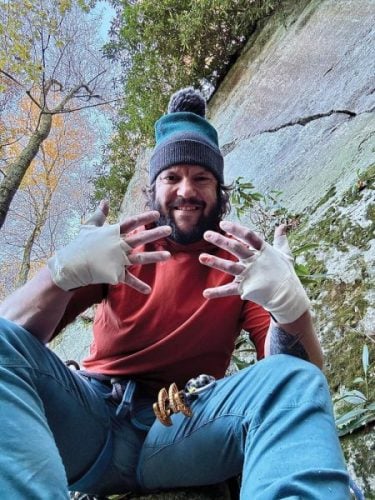
Written by Mike Paugh
This is a climbing story about commitment. Not the typical kind of commitment most people face in daily life, but the type of commitment required to move beyond the point of no return. This is the type of commitment where venturing into the no-fall zone means that failure will likely result in severe consequences—consequences that can reverberate for years.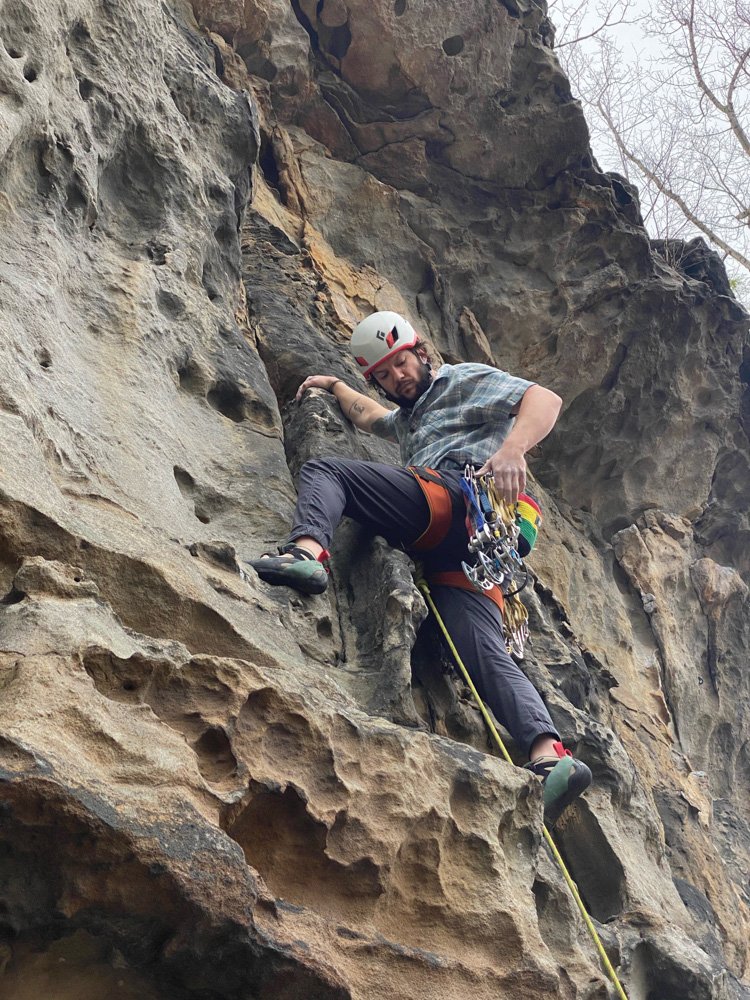
It started way back in October of 2020, during the height of the pandemic—a time when outdoor recreation became crucial for maintaining physical and mental health, along with providing a way to still connect with others. At that point, I had been rock climbing for nearly 20 years and had been guiding professionally for about 15 years. Guiding was a way for me to share my love of climbing with others by helping them learn proper technical skills to be safe and proficient in what can be a dangerous activity. As a certified guide enjoying what was, at the time, a brand-new climbing gym in Morgantown (RIP Gritstone!), I quickly noticed the need for a gym-to-crag course to help teach outdoor climbing skills to new gym climbers. That summer, I started Ascension Climbing Guides and taught clients on the famed gritstone boulders and cliffs found throughout Coopers Rock State Forest and the Cheat River Canyon.
On October 4, 2020, my girlfriend Sarah, now my wife, and I went out to Coopers Rock to climb and find some cliffs that would be ideal for guiding clients. After coming up with some routes and ideas for the new curriculum, I asked Sarah to give me a belay on a short, rather powerful traditional climbing route called Upchouca (5.12a R). In the Yosemite Decimal System, which grades routes by their difficulty, the “R” denotes that the route is run-out, meaning it offers few placements for protection to anchor yourself to the wall while you climb. When climbers see an “R” rating, we know that a fall will likely involve hitting the ground and getting injured. Basically, if you’re going to attempt the route on lead, then you’d better make sure you’re confident in your abilities if you want to make it home unscathed.
The movement on Upchouca is very sequential, meaning I had to know where the tiny gear placements would be to protect myself accordingly. After climbing up and down the start of the route around 10 times without any kind of ground protection, Sarah suggested that I return with a crash pad—a thick mattress-like pad for cushioning falls when climbing short boulders—and rehearse the moves of the route safely anchored to the route with a top-rope. I stubbornly didn’t heed her advice and finally decided to fully commit to the best hold where I thought the first good piece of protection gear could be placed. I immediately realized that I was in quite the pickle, stuck between a rock and a mentally hard place. With no way to safely downclimb the route, I had officially passed the point of no return, the dreaded situation where up is truly the only way out.
To make matters worse, the crack in the rock where I had placed my first point of protection turned out to be subpar. I turned up the risk dial a notch and climbed six feet higher to a horizontal crack, where I placed a small camming device for protection and called down to Sarah to take the rope in taut so I could rest. At this stance, my feet were close to 20 feet off the ground, with only two pieces of protection to keep me safe. As I nervously shook out my exhausted arms, I realized that I had not only put myself in this dangerous position, but also my new climbing partner and future wife.
 But the camming device was still holding me safely in place, and the lactic acid in my arms and hands was starting to dissipate. I shouted to Sarah, “Ok, ready to climb!” As I lightly shifted my weight to the left to position myself on the rock to start climbing, I suddenly heard what sounded like a shotgun blast as what seemed like a tiny meteorite flew out and hit me below my right eye. The cam had exploded out of the rock, and I was suddenly weightless, freefalling toward the ground. What felt like an eternity was probably no more than a single second.
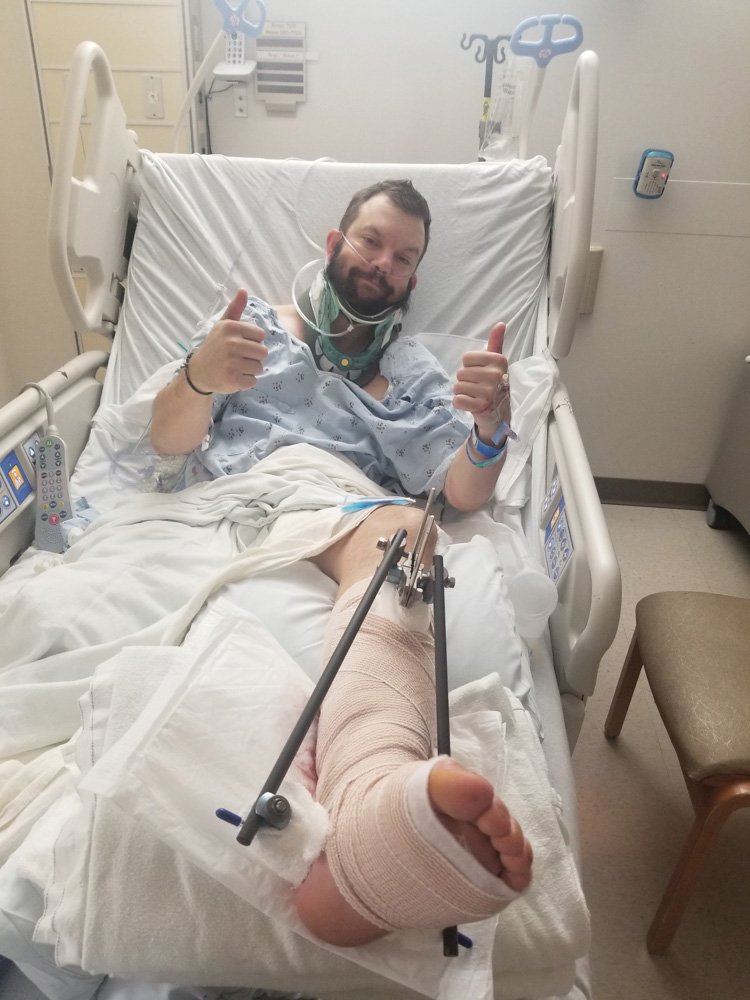
I hit the ground, immediately shattering my left ankle and sustaining a compound tibia-fibula fracture in my left leg. I had never broken a bone before, so to make light of the situation, I joked that at least I had done it right. The rescue extraction was an epic effort, kicked off by other climbers calling 911, which led to me being hauled out in a litter by EMS personnel and volunteers from the Mountaineer Area Rescue Group.
What followed that moment would become the true crux of my journey. I endured three surgeries over the course of one month to repair the broken bones in my left leg. A few weeks after the swelling of the third and final surgery had receded, I returned to the orthopedic surgeon to receive a walking boot, even though I wasn’t allowed to put weight on my left leg for many months to follow. But I had already made the conscious decision to get right back in the saddle. I was bound and determined to not let this accident determine my future—physically or mentally.
What got me through the grueling pain of the physical recovery process was knowing deep down that I needed rock climbing for my mental recovery as well. I fully accepted and recognized that I had made a mistake, and that I had to learn from it to gain something useful. I surrounded myself with positive support from members of my community, got back into training at the local climbing gym, and had more help than I could have ever imagined.
My first outdoor lead climb since the accident (after receiving the OK from my orthopedic surgery team) happened in April of 2021, roughly six months after my fall. I called up my best friend and climbing partner of close to 20 years, letting him know I was ready to get out on some rock. In retrospect, I think he was more scared to watch me climb than I was to actually climb. I wasn’t scared or intimidated at all. This climb was something I knew I had to do to put the trauma of the injury behind me, to put my new lessons to use and heal in my own way.
Now over four years since the accident, my repaired leg becomes quite sore with arthritis from the bones that were repaired over the three surgeries. Through my skin, I can feel quite a bit of the metal that was used to hold my leg together while the bones healed. I still suffer from muscle tightness in my “good side” from overuse during my recovery. And despite all of that, I still get out and climb for fun and guide clients whenever I can. I train indoors when the weather doesn’t allow for outdoor climbing. I appreciate each day more, knowing my life could have been snatched away from me in that one-second fall.
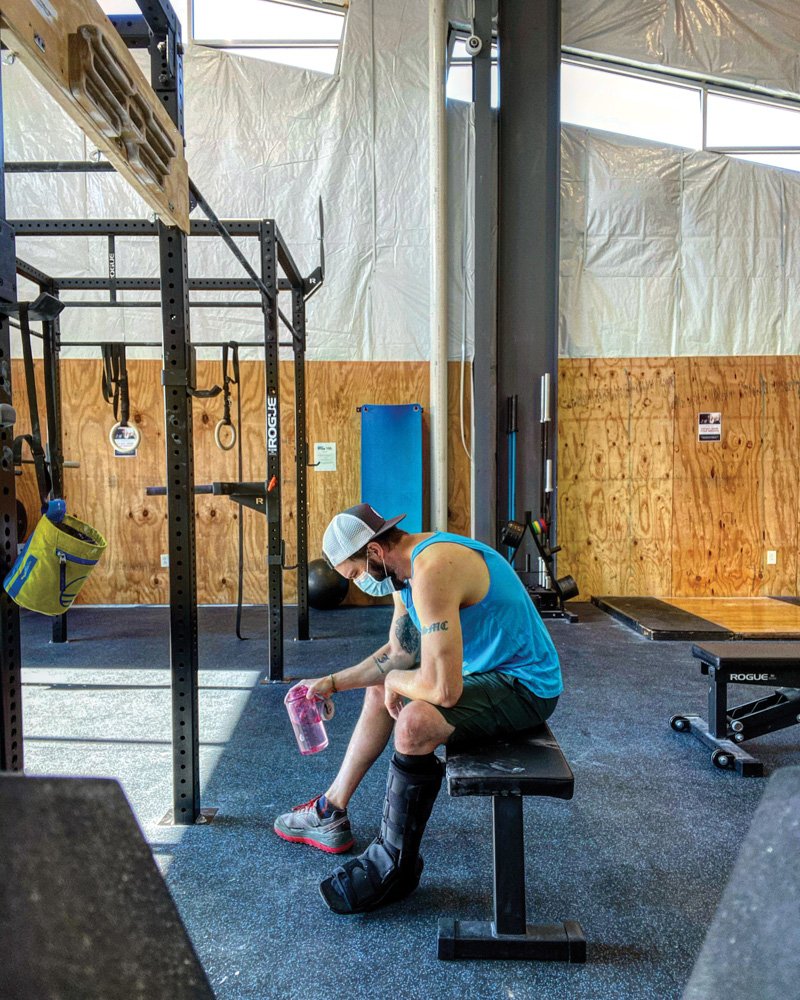
The author back in the gym, training while recovering to boot. Photo courtesy Mike Paugh
I readily admit that ego was the primary cause of my injury. I saw a short and powerful route with a high difficulty grade as a major accomplishment for my climbing resume. In the realm of adventure sports, ego needs to be checked at the door. It’s highly important to leave your sense of pride behind before entering a dangerous situation, especially when others are with you. If it wasn’t for the efforts of everyone involved in my journey, from the climbers who called 911 and the rescuers who got me out to the orthopedic surgery team and professional guiding community, I would not have the motivation and positive outlook I do today.
Every day, I look down at the many scars on my leg. I know that those scars represent a lesson in life that I still continue to learn from: I was broken but never defeated. All of us have scars of one form or another. In life, it’s vital to not hide our scars, but to embrace and learn from them moving forward.
Mike Paugh lives in Morgantown, WV, with his wonderful wife. He’s an avid climber, stoked guide, and proud dad to two rad kiddos.