Snakebit
Photographs Courtesy of Andrew Leich

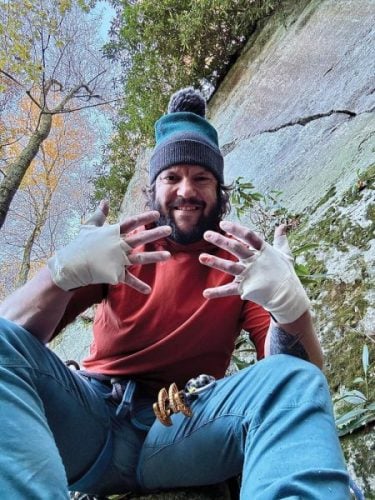
Andrew Leich was an avid rock climber who established a difficult climbing route on Seneca Rocks, and then his encounter there with a timber rattlesnake changed his life. Leich faced a long road to recovery after the bite and spent two years finding his way back to climbing again.
In July 2023, Andrew Leich, of Morgantown, was hiking in the Snake Hill Wildlife Management Area. As the avid rock climber and guidebook author was picking blueberries, he felt a sharp prick on his ankle and heard a rattle. A timber rattlesnake—one of two venomous snakes in the Mountain State—lay quietly curled in the brush. “There was absolutely no way anyone could have seen it,” he says.
Leich had written his college thesis on timber rattlesnakes and knew most bites don’t inject venom, so he remained calm. But when his lips and tongue started to tingle, he knew something was wrong. In just six-tenths of a mile, he was dragging his numb leg as he slowly hobbled uphill. “I was trying to keep my heart rate down to prevent the venom from spreading faster,” he says. “I thought I was going to get the antivenom shot and be just fine.”
By the time the ambulance arrived, the neurotoxins had triggered full-body paralysis, and Leich had to be carried to the ambulance. “The most alarming moment was when the EMTs smacked me in the face really hard,” he says. “I had closed my eyes, and they said I had to stay with them. I thought, ‘They think I’m going to die!’ ”
A few hours later, Leich lay completely paralyzed in the ICU, waiting for the antivenom to start working. He remained conscious but unable to communicate due to facial paralysis. “I was trapped in my body,” he says. “Nothing worked.” He received two vials of antivenom every six hours over a 36-hour period and knew he was going to be OK when he was able to wiggle his fingers again.
After three days in the ICU, he was discharged, but his journey was just beginning. Initially, Leich wasn’t able to move without a walker, and going from his bedroom to the kitchen exhausted him. “I would need to rest for a full day—I was wiped from hobbling around the house.”
The venom damaged nerve endings and dissolved muscle mass throughout his body. Leich—a climber who once trained steadily and climbed extreme routes—was now unable to walk more than a few hundred feet without complete exhaustion.
But his walks to the kitchen slowly became walks to the mailbox. He graduated to a cane as he added weight to his damaged leg. In a few months, he was walking on wooded trails to the boulders he used to effortlessly climb, but simply grabbing on to a handhold without even leaving the ground would tire him for hours.

Nevertheless, Leich was grateful for every step.
“I was just happy to breathe,” he says.
Almost a year after the bite, Leich made it to Coopers Rock State Forest and needed all his strength to climb a beginner boulder route. Two years after nearly dying, he found himself at the base of Green Magic in the Hills, an extremely difficult climbing route that he and a fellow climber established in 2022 at Seneca Rocks. On his fourth attempt of the day, he completed his mission of free-climbing the route—an unfinished goal he’d been attempting since before the snakebite.
Despite his life-changing trial by venom, Leich still admires rattlesnakes as he did while studying them in college, and he encourages people to let them be if spotted in the wild. “Rattlesnake bites are extremely rare,” Leich says. “Statistically, you have a greater chance of being struck by lightning.”
Other perspectives, however, have changed.
“A lot of stuff doesn’t matter as much,” he says. “It’s a lot harder for me to get upset about certain things now. When I was in the ambulance, I wasn’t thinking about the routes I had climbed or the places I had been—I was thinking about the people I love and want to spend more time with.”