

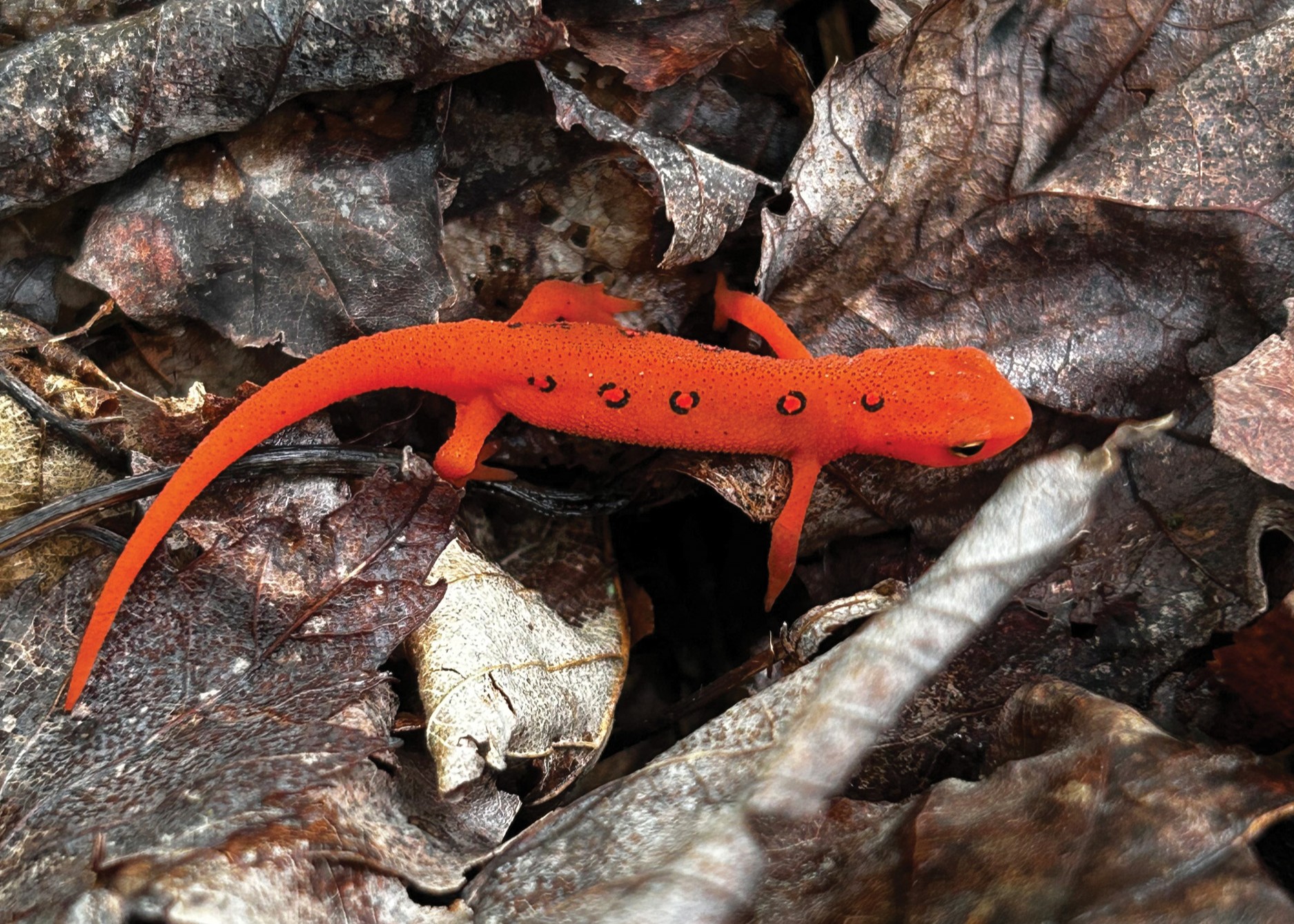
Appalachia has a lot of unique wildlife, but some of the region’s most quintessential critters are the many salamander species that frequent our rivers, creeks, springs, and moist—yes, we said moist—forests. Some are a more coveted find, like the elusive snot otter (AKA eastern hellbender, for folks who aren’t on a nickname basis with them), but they’re all iconic. Most people have stumbled upon the common, yet no less beloved eastern newt. Its juvenile stage is the most recognizable, with its striking orange coloration, fittingly known as a red eft.
Those sightings might not have felt like something to write home about. But they are something to write to the West Virginia Division of Natural Resources about, so put on your amateur herpetologist hat for an Eastern Newt Citizen Science Survey. You might be thinking, “If they’re so common, why does the WVDNR need us to count them?” Well, right now they’re a familiar sight in West Virginia and beyond—but that might not always be the case, thanks to a looming threat by the name of Batrachochytrium salamandrivorans, or Bsal.
Bsal is a species of chytrid fungus that causes chytridiomycosis, an amphibian fungal disease. The effects are like a zombie movie designed to scare baby salamanders into eating their vegetables. Parasitization of epidermal cells leads to skin lesions, weakening skin functions and causing death within just a few weeks. It’s yet to be documented in the United States, but scientists fear it’s only a matter of time before it arrives through avenues like the pet trade. And susceptibility trials show that eastern newts are especially vulnerable to the fungus.
“Salamandrivorans means ‘salamander devourer’ in Latin,” says Kevin Oxenrider, the WVDNR’s amphibian and reptile program leader. “It actually eats away at the skin, causing crazy water loss, which is a huge deal for amphibians. If they don’t have water, their skin isn’t permeable, which means they’re not breathing properly. It’s a really horrid way to go.”
So, how do we combat this Lovecraftian enemy? With good old-fashioned data, of course. It’s not as boring as it sounds, we promise. The more dramatic defensive measures—like ongoing trials of vaccines disseminated via waterways or other antifungal water treatments—will come later. But for now, scientists are ready to get ahead of the game by taking a snapshot of eastern newt distribution, pre-Bsal.
“Trying to restore a population is difficult when there is no baseline,” says Oxenrider, referencing the information gap of regional bat populations before the spread of white-nose syndrome. “We want to make sure that we have our ducks in a row to prepare for this disease.”
That’s where you come in. Until the survey ends in 2028, take the following steps:
- Stop the spread of disease by cleaning your gear—like shoes and boats—between outdoor expeditions.
- Spot an eastern newt anywhere in West Virginia, in any of its life stages.
- Snap a photo.
- Submit your findings at wvdnr.gov/plants-animals/surveys/eastern-newt-survey/.
- Sleep easy knowing you’re supporting the preservation of the Mountain State’s spectacular salamanders.