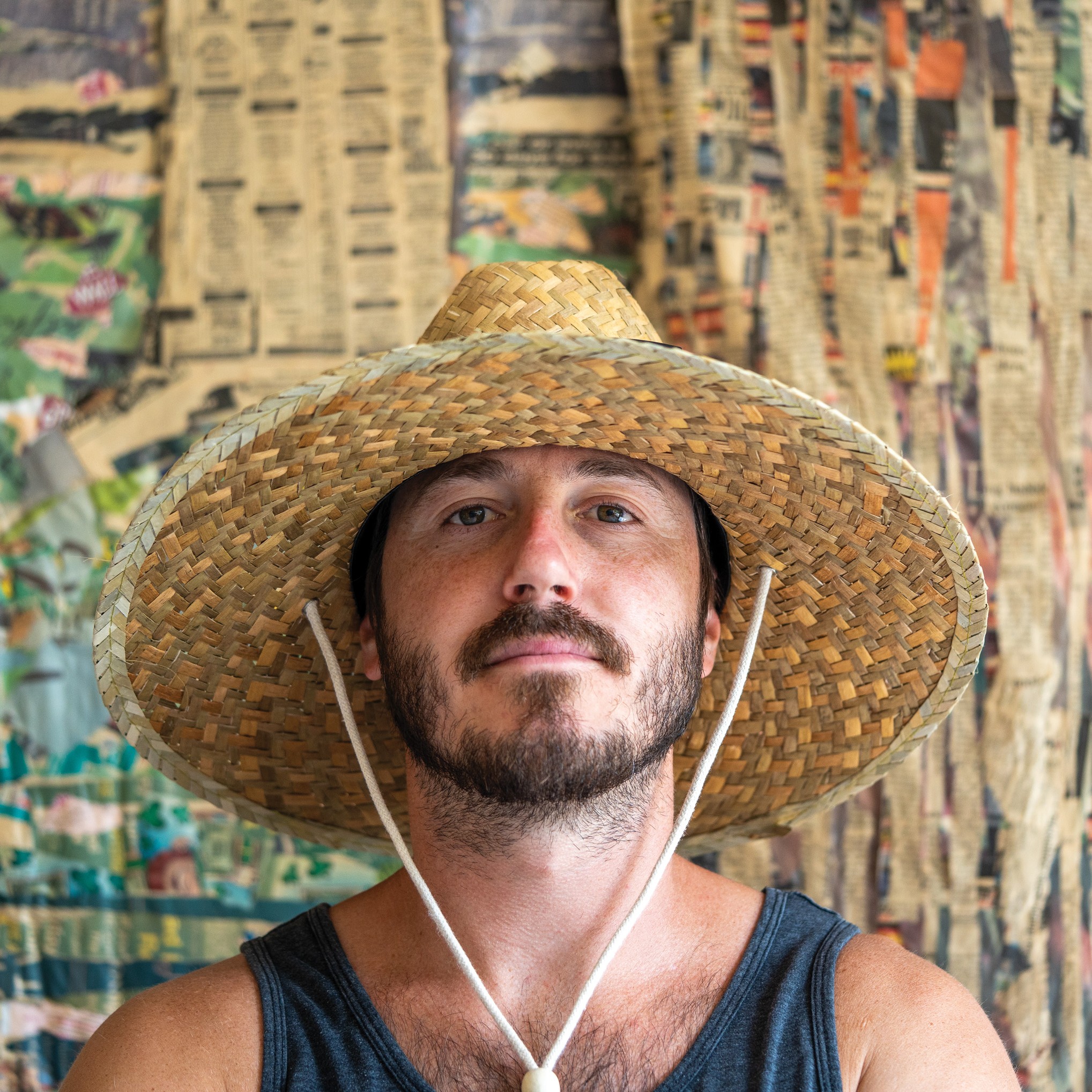

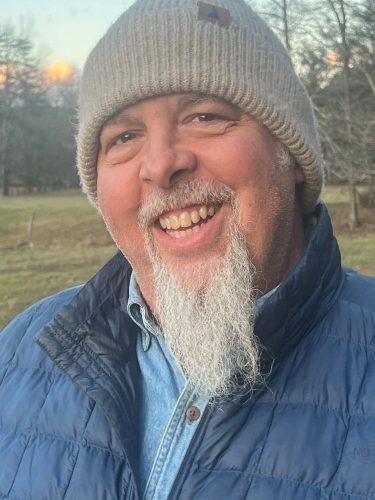
I’ve only had two deep conversations with Ken Gaitor in my life. But every time we talk, I feel like I’m catching up with an old friend. Ken speaks calmy and authentically about his life growing up in West Virginia, getting into snowboarding, and working his way through the ranks of the ski industry. Now, as vice president of mountain operations at Snowshoe Mountain Resort, he oversees nearly 30 departments, ranging from vehicle maintenance to ski patrol to mountain biking trails. Perhaps it’s his laid-back demeanor, signature beard, and concert T-shirt attire, but it can be difficult to grasp not only the amount of time he puts into his work, often pushing 80 hours per week, but also the impact he’s had on Snowshoe, Pocahontas County, and the state.
What always shines through in our discussions is how humble Ken is. He doesn’t attribute his success to his own actions, but rather to the support he’s received from mentors who took a chance on him and the people who work for him that, as he says, “make me look good.” His appreciation for the people and natural wonders of the state fuel his passion for giving back and preserving the places we love. It’s a passion many of us share. Although we’ve only talked a few times, I leave our conversations with a renewed sense of hope and optimism about the future of the Mountain State. Ken is certainly doing a lot of good for West Virginia, but more importantly, he’s just a good West Virginia dude. This interview was edited for length and clarity.
Where did you grow up?
I grew up in Summers County, West Virginia, in a little town called Talcott. I lived up on Great Bend Mountain, which is where John Henry raced the steam engine. It was a great childhood. I spent my time in the woods, adventuring, climbing trees, and getting into whatever kind of mischief you can in the woods, which is kind of hard actually, because you really just hurt yourself.
We left, as many West Virginians have, to pursue work in other areas. We moved to Delaware when I was in the ninth grade and then I went up to Albany, New York, for college. It was kind of shocking to leave because I went from a school with a graduating class of 12 to a high school with about 2,000 students. Not only did I not want to go to a school with 2,000 people, I didn’t want to leave the woods. I had a really hard time with that.
How did you get into snow sports?
I started skateboarding in Delaware, which was a great thing that came out of that move. When I moved up to Albany, the winters were pretty rough. I told myself I should make the most of it and learn to enjoy the snow instead of just fighting it like everybody else. The first time I went snowboarding was with my uncle at Stratton Mountain. We went straight to the top in the gondola. My skateboarding background helped immensely. I made it to the bottom after a lot of trial and error. By the end of the run, I was linking turns.
Snowboarding was challenging, but also exhilarating. When I was skating a lot, I was always going as fast as I could. I realized I could go even faster on a snowboard and not kill myself. It was Vermont, so when I fell, it wasn’t exactly soft, but it wasn’t concrete. I did run into a skier and get stabbed by a ski pole on that run. I’ll never forget it. I felt horrible. I’ve only hit two people in my entire snowboarding career, and one was on the first run of my first day snowboarding.
When did you start working in the ski industry?
I was at Stratton one day with my buddy Nate. He was a great snowboarder, a close friend, and somebody I always looked up to. We went before the mountain opened to hike up and ride the half pipe. We were totally poaching, which is funny to think about now that I’m in this job. As we’re hiking up, this guy comes snowboarding down. He had a rake with him and started raking the half pipe to smooth out the transitions. I remember thinking, ‘Wow this is this person’s job?’ It was a light bulb moment.
That February, Nate and I, along with two of our roommates, drove across the country to spend six weeks snowboarding in Utah. I picked up some contracting work because I needed to start making money right away. I spent the $200 I had saved up just to get out there. Three weeks into the job, I was in some roof trusses, and they collapsed and my leg got caught. I couldn’t snowboard or work, so I was stuck at home just watching the paper for job openings. A lift attendant job opened up at Brighton Resort, so I applied and got the job. A couple weeks later, I was able to walk around in a cast and start work.
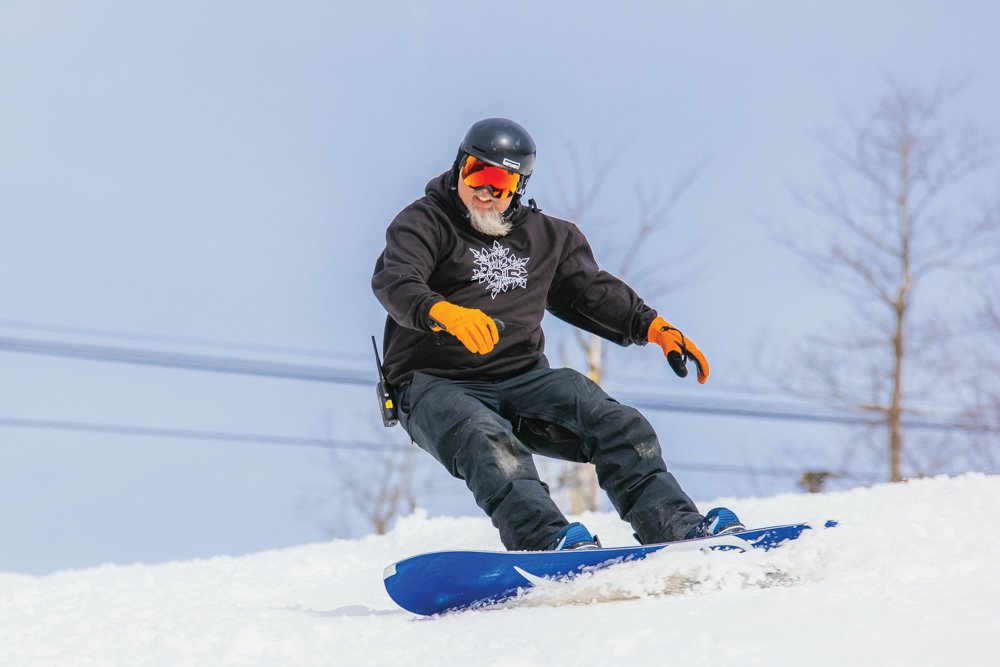
Ken taking a lap on his trusty snowboard during a shift at the Shoe. Photo by Kurtis Schachner
What was your first winter in Utah like?
I think it snowed 750 inches that winter. It was insane. I’ve never seen anything like it. As soon as I was able to get on my board, even in pain, I started riding in the powder. It changed my life. My job was at the bottom of their main feeder lift. Every day, feet of fresh powder filled in the pit and the lift couldn’t operate until it was dug out, so I made it my personal mission to dig snow all day, every day. I piled up all the snow around the shack and started building these beautiful, spiral stairsteps out of snow. I built a quarter pipe on the uphill side of the lift shack. I just pimped that thing out like it was the most beautiful pit. One day, the terrain park manager was getting ready to get on lift. He looked around and was like, ‘Who did all this?’ And I’m standing there with a shovel in my hand, looking at him like, ‘Duh, me.’ He asked me if I wanted a job and I said yes. Before the end of the season, he got fired, so I took his job. That was the winter of 1996-1997. I went back for five consecutive seasons, waiting for it to snow 750 inches again and it never did.
What’d you do during the summer?
I went back to West Virginia, lived on the family farm and worked as a whitewater guide. I had a really sparse financial existence because by the time I would move across the country, get a new place, and put a security deposit down, I was always broke. I think I was making five bucks an hour at Brighton, maybe less. I had an old beater car. I was outside every single day, sleeping four or five hours a night. When I didn’t have work on the river, especially those first couple seasons before I got a little better at guiding, I made ends meet by doing construction.
What brought you back east?
In 2003, I saw an ad for a terrain park manager at Mount Snow in Vermont. I was interested in coming back east and being a little closer to my family, but I still wanted to do the same work and further my career. They gave me the job, so I started working seasonally in Vermont and then coming back to West Virginia to guide rivers in the summer. In 2007, I took a year-round job at Mount Snow. While I was there, I met some guys from West Virginia that worked at Snowshoe. I told them I’d never been there or even snowboarded in West Virginia before. I offered to stop on my way back home and share some advice on their terrain parks. The first time I went to Snowshoe in 2009, I remember thinking, ‘Holy shit, this is a legit resort.’ I had no idea. When I got back to Vermont, I started paying attention to job postings for Snowshoe and a job popped up for a snowmaking and grooming manager the next year. During my interview, I offered to manage the terrain park as well. I just wanted to get back home. I love West Virginia. Once I realized that I could do what I love at a professional level here and that there was some room to grow, it was a no brainer.
Tell me about your role as vice president of mountain operations.
To easily sum it up, no day is alike, and that’s what I love. I do have a calendar like other executives, but I wear a concert T-shirt 90% of the time. There are probably 25 or 30 departments that are in my purview, with everything from mountain biking trails, slope maintenance, ski patrol, and lift maintenance to public safety, building maintenance, and risk management. My job at this point, and I say this with mixed emotion, involves spending a lot of time in front of the computer and in meetings.
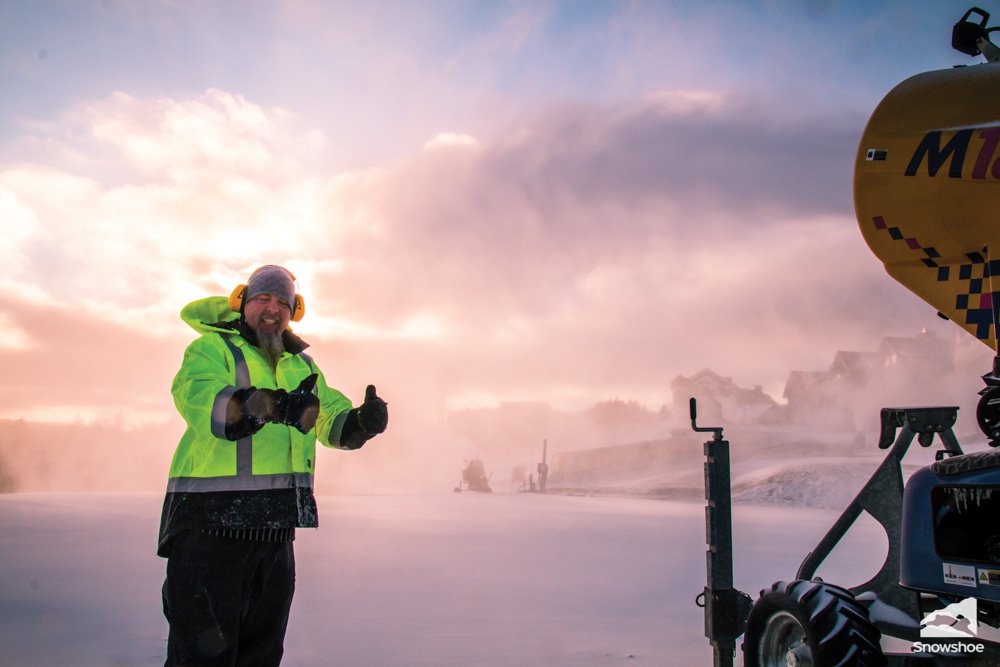
Ken hard at work, helping to make snow with the Mountain Ops team at Snowshoe. Photo by Kurtis Schachner
More and more, my job is figuring out what the future of this place looks like. I have to take myself out of the gravel of the day-to- day and try to see what this place could be beyond what I can achieve in the next five, ten, or fifteen years. I also have to develop the people that work for me. They’ve done so much for me. I owe it to them to continue to try to move on in my career.
How do you approach the work you do?
It’s my duty to do what I can for my fellow West Virginians, for our state, and for the environment. I feel really strongly about that. A lot of West Virginians feel this way. They may not verbalize it, even to themselves, but it’s in us all. I’ve become more conscious of that in recent years, and it really motivates me. Trying to contribute to the community and humbly be a part of it has brought a lot of meaning to my life. I was on the board for the parks and recreation department for years and years in Pocahontas County and we provided opportunities for kids that I needed when I was a kid. Hopefully somebody else can now look at me and say, I can stay here. I’m not rich, but I’m rich in experience. I’m not struggling and I work at a ski resort. I work with people that are fun, and our job is to have fun and get people to enjoy the outdoors. And if I ever get to the point where I don’t feel like I’m contributing, then I’ll just go build a barn.
What are some of your proudest accomplishments at Snowshoe?
With some help, I founded our sustainability action committee. We developed a huge solar project at the inn. We have a new recycling center that opened recently. I see Snowshoe as being a model to show folks in our communities that we can be sustainable and we should—it’s our responsibility. We just won a sustainability award from Alterra, which is the corporation we work for. It was one of about six awards Alterra gave out at a meeting with leaders from 18 other ski resorts across the country. That was one of my prouder moments. I got choked up standing on stage in front of everyone.
But I have to say, although I feel successful, it’s not because of me. I’ve just been fortunate in that I was in the right place at the right time. Where I have been able to shape my own path was by just saying yes to taking on challenges. It was difficult for me to come back here. I walked away from a dream job in Vermont to start a job where I didn’t really know what I was doing. But people backed me. They gave me second, third, and fourth chances. I’m grateful to all my mentors, both the people I work for and the people who work for me. I think expressing thanks on a daily basis is really important.
What’s your vision for the future of Snowshoe?
What we do well and what I’d love to see us become even better at is guiding people carefully into the outdoors. I think that comes from my experience as a guide. I remember one day on the New River where I had nine Korean girls in my boat and none of them could swim. By the end, they were all floating in the water and giggling. I think about moments like that and what it means to connect to somebody that comes here. If we show them a tree and tell them what it is, talk to them about the Cheat Mountain salamander, let them understand a little bit about nature, hopefully that small connection between people and the mountains can help them understand why these places are so important to preserve.
What makes Snowshoe unique?
The people, the mountain itself, and I’ll say the people one more time because I think that’s the most unique part. Hospitality, especially for our locals, just comes naturally. It’s not something you have to go to the Ritz Carlton Training School to learn. In fact, that approach wouldn’t work here, because it wouldn’t be authentic, but our people are.
In terms of the mountain, we’ve got the western side, which has 1,500 feet of vertical and some legit black diamond terrain. We’ve got a great terrain park program, which I take a lot of pride in. Since the village is on top, our mountain is upside down compared to so many other resorts. The biking is also unique. There’s an identity to this area. It’s kind of punk rock, and I like that. I think we need to hold true to that.
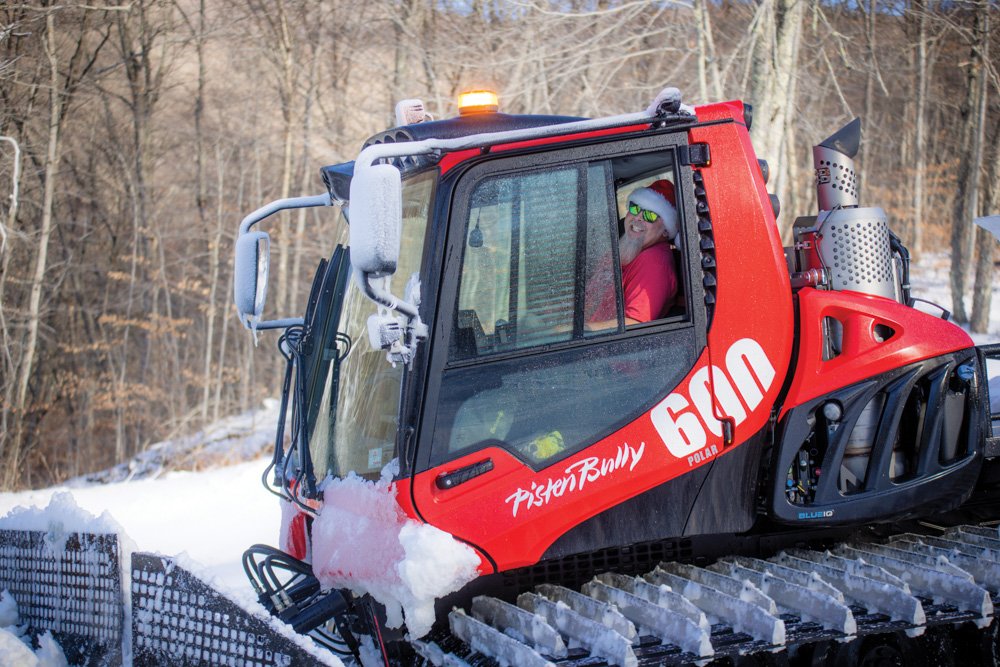
Santa Ken running his favorite machine, a snowcat, during the busy Xmas season at Snowshoe. Photo by Kurtis Schachner
What are some of your favorite parts of winter in general?
I love to go out and walk a snowmaking run. If it’s a cold night with a calm wind, you can watch the piles grow. Snowboarding ranks above that. I like to go out, especially before the ropes drop, and say hi to the folks at the lift, give some high fives, get some high fives. But my very favorite thing to do in the winter is operate a snowcat. I lived in a snowcat for many, many years. I’ve probably spent upwards of 20,000, maybe 25,000, hours in one. They’re super comfortable. They have Italian race car seats, great sound systems, and they’re climate controlled. You can move literal mountains of snow quickly and all at once sometimes. In the terrain park world, you can build these incredible shapes and they stick. When the guys get Lower Shays ready, I’m gonna be there in a winch cat helping to open that trail.
It’s also a great excuse to leave the office and phone, tune into the machine, and focus. The awesome part of guiding rivers, snowboarding, skateboarding, and all the things that I’m most passionate about is that they take you from a scatterbrained world to a pinpoint focus where you don’t have the option to let the periphery invade your thoughts. When you’re biking at 30 miles per hour between narrow trees, you don’t have time to wonder if you paid that bill. For me, that’s meditation.
What are your hopes for the future of outdoor recreation in West Virginia?
I think that ball is rolling. My hope is that we’re able to find a way to do it sustainably and keep the experiences legit. I do believe that outdoor rec and recreation tourism is the brightest future the state has. I believed that long before I knew there were terms for it. I understand that there’s mixed feelings out there. Some people want to hold the areas to themselves and I can understand why. But I also know there are a lot of really hurting communities that can use some uplifting on a diversity level, an experiential level, and, of course, a financial level. I wholeheartedly believe that outdoor recreation is the direction we should continue to go. There will be some sacrifices that come along with that, but if it’s done with thoughtful planning, I think we can do it in a sustainable fashion, be successful, and hold the parts that are dear.