


Written by Thomas Yocum
I first heard about it while working as a ski patroller and instructor on the mountain in the 1980s. The story was fresher then, and interest was stronger. Locals who remembered the original route of the stream that Timber Run follows on its way down the mountain had been scouring the area. They found other caves, but not the fabled haunt of Ab Crossland, the Tucker County moonshiner who defied the odds, beat the state of West Virginia in a historic court case, and was able to live out his days in a cabin on the grounds of Canaan Valley State Park.
Albert “Ab” Crossland was born in 1884 in Grant County, the ninth of 10 children. In the 1890s, Ab’s family moved to the southern end of Canaan Valley. The lumber boom was in full swing, and Ab’s father was a famous moonshiner who, like many others, supplied the thirsty logging camps and mill towns of the Potomac Highlands with white lightning.
The Central Appalachians have a long history of moonshining and clashes with authority. Moonshine production was based on simple economics. Hardscrabble farmers on the remote western edge of the new states struggled to get their extra crops to market before they spoiled. Corn transformed into moonshine in a jug travelled better, lasted longer, and was much more profitable. It was also a lot more fun.
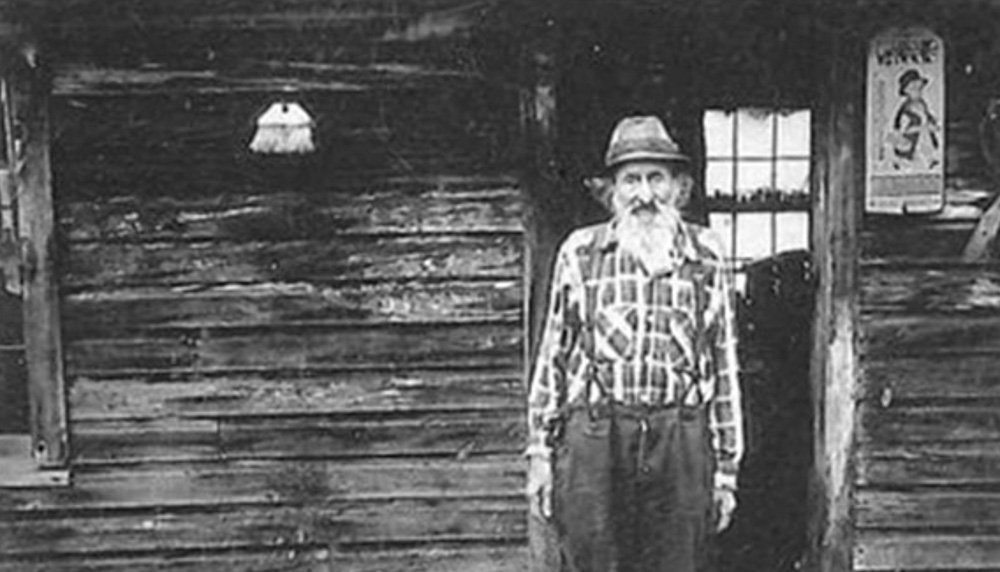
Ab Crossland at his cabin in Canaan Valley. Photo courtesy of Tucker County Highlands History and Education Project
By 1890, Canaan Valley was starting to make moonshine news. A November 1890 article in The New York Times recounted the capture of William Fansler, described as “A member of one of the most daring and most successful gangs of moonshiners, counterfeiters, and stock thieves ever infesting the mountains of West Virginia. Their stamping ground was the ‘Canaan’ wilderness and contiguous portions of adjoining counties…Here the gang had for several years operated a splendidly equipped distillery, with a capacity of eighty-five gallons a day, and made and sold immense quantities of mountain dew until betrayed by one of their own number.”
One of those men was George Crossland. “For many years, Ab’s father, George, and a number of their neighbors, made and sold moonshine,” explained Thomas Rodd, co-executive director at the nonprofit Friends of Blackwater. Rodd also co-wrote and produced “Moonshine Memories,” a pair of 2023 local stage productions that tell Ab’s legendary story. “Making and selling moonshine was illegal, but it was an important activity in many Appalachian communities. When the Great Depression began, income from moonshining, for those who had the skills and would take the risks, became even more important.”
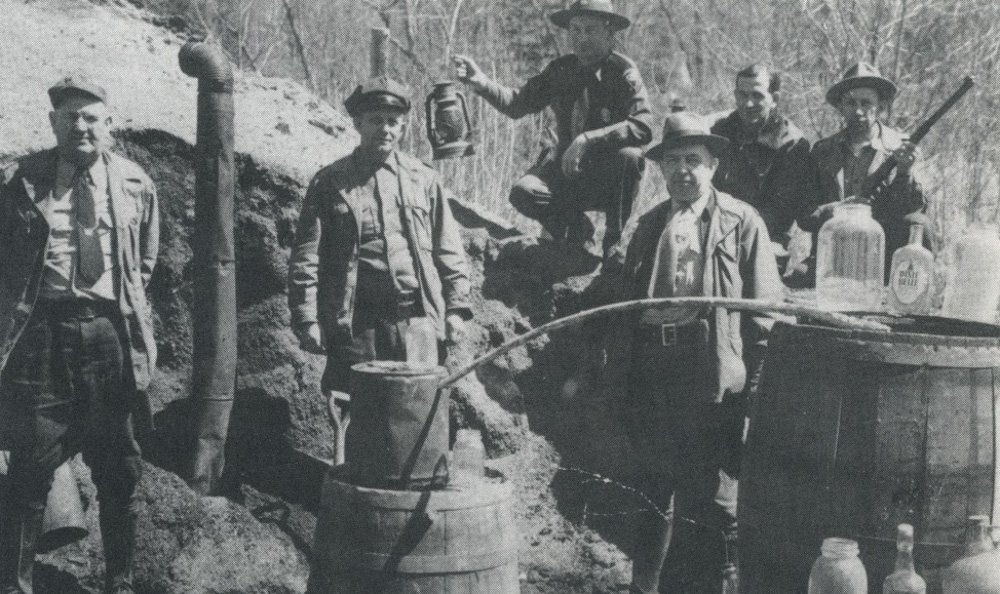
West Virginia went dry well ahead of the rest of the country, enacting the Yost Law in 1913, seven years before Prohibition. “When state enforcement began in 1914, West Virginia was one of the most bone-dry states in the country, banning all intoxicants over 0.5 percent alcohol,” said Dr. William Hal Gorby, a professor of history at West Virginia University. The payoff was high, but penalties were stiff: a two- to six-month jail sentence and a $100 to $500 fine (equivalent to a fine of about $3,000 to $15,000 today). According to Gorby, by the late 1920s, the Department of Prohibition in West Virginia was seizing over 600 stills per year; from 1928 to 1930, state agents made over 4,000 arrests.
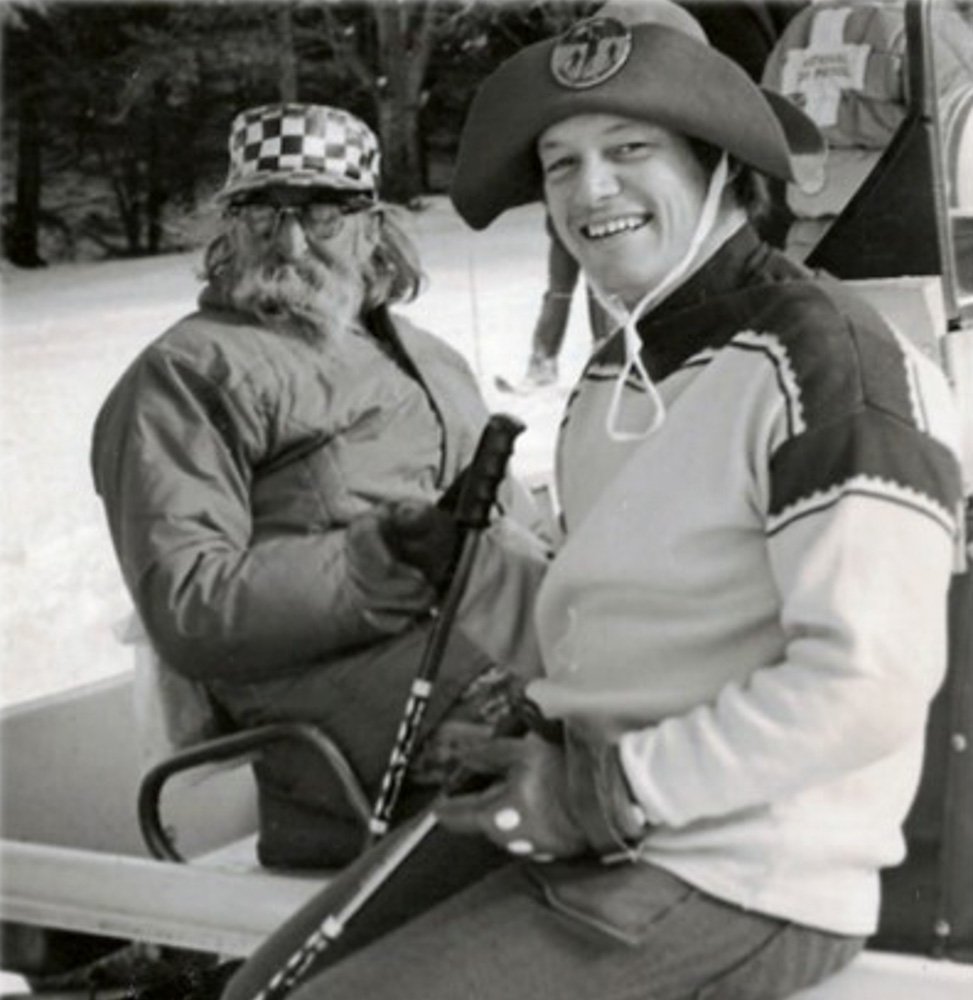
Crossland during a 1971 tour of the new Canaan Valley State Park and Ski Area. Photo courtesy Tucker County Highlands History and Education Project
Things become even more draconian in 1929, when operating an illicit still became a felony, with heavier fines and mandatory jail time in the Moundsville State Penitentiary. “State and federal ‘fizz ferrets,’ as moonshiners called them, were very active across the state,” Gorby said. “They targeted poorer, working-class moonshiners in dense cities like Wheeling, as well as men like Ab Crossland, operating in the rural mountains.” The raids were so successful that many county officials soon found themselves with budget surpluses. In Tucker County, they used the fines collected from moonshine enforcement to finish constructing the county courthouse clock more than 20 years after the building was completed.
Despite the risks, Ab Crossland continued to distill his mountain dew. In 1931, he was making moonshine on the Canaan Valley property of his neighbor and friend Joe Heitz when the law finally caught up with him. Federal law enforcement agents raided Ab and Heitz’s still, but only Ab was caught and charged in federal court in Elkins.
According to Rodd, Ab and Heitz made a deal to protect Heitz and his property. In exchange for Ab “taking the rap” on the moonshining charge, Heitz promised Ab that he could live on Heitz’s land in Canaan Valley for the rest of Ab’s life. “Ab did his part, and served a sentence in jail in Elkins, reportedly 90 days, possibly six months,” said Rodd. After Ab was released, he moved into a cabin on a corner of Heitz’s property. Ab, who never married, lived a rough, somewhat hermit-like existence there for the next 43 years. “He was a well-known character in Canaan Valley, with his grizzled beard, beat-up old pickup truck, and colorful speech. He also was known for having pet skunks. A skunk family had their den next to his cabin, and Ab fed them, along with a number of cats. He would rouse them if he wanted to keep visitors away,” Rodd added.
Naturally, Ab also went back into moonshining, but this time he did a better job of hiding his still. He chose a site somewhere along Mill Run: a hidden cave that masked the smoke from the constant fire, with plenty of fresh water to cool the condensing vapors. “Ab remained known as a reliable source of quality moonshine,” Rodd said. Heitz died in 1951, and his daughter inherited the property that held Ab’s dilapidated cabin. She honored her father’s promise to Ab, who continued his way of life on her land.
In the 1960s, the state of West Virginia began acquiring land in the southern end of Canaan Valley to make a new ski resort and state park. This included the Heitz property, which the state acquired in a forced sale. In early 1969, when the state filed an eviction case against Ab, his neighbors introduced him to Ron Brown, a young attorney who agreed to help and suggested bringing another young attorney, Larry Starcher, on to the case.
Fortunately for Ab, Starcher was the director of a fledgling, federally funded Legal Aid program based in Morgantown, West Virginia. Those unable to afford an attorney or pay court fees often couldn’t “have their day in court,” said Rodd. As part of Lyndon Johnson’s War on Poverty in the 1960s, the national Legal Aid program provided lawyers for the poor. “Providing free lawyers like Larry Starcher for low-income people like Ab Crossland was a revolutionary idea.”
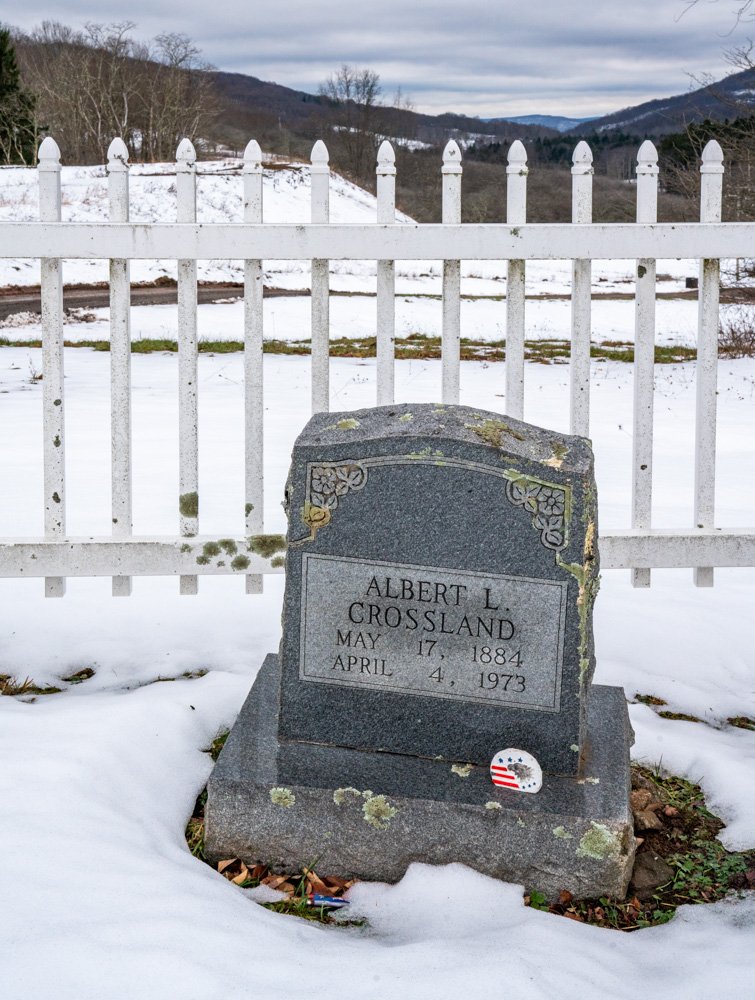
Ab Crossland’s grave in Canaan Valley. Photo by Dylan Jones
It also presented an interesting wrinkle: federal money from the Economic Development Administration was being used to develop the Canaan Valley State Park, while other federal money was being used to help Ab Crossland fight his eviction from the state park land.
Starcher and Brown made a claim based on Heitz’s promise to Ab of a lifetime right to live on the land, what Ab called his squatter’s rights. According to Rodd, bulldozers were ready to demolish Ab’s cabin, but Starcher and Brown were able to put the eviction on hold.
After more than a year of hearings, the judge ruled that the state was the rightful owner of the property, thus Ab’s claim was not sufficient to stop the eviction. “However, and this was very significant, he delayed the effect of his decision so that Ab’s lawyers could appeal to the West Virginia State Supreme Court,” Rodd said.
The judge’s ruling essentially set the stage for Ab to win his eviction case, and lawyers representing the state realized the case could drag on for months with no guarantee of success. “Faced with these uncertainties and possibilities, and anxious to complete their project, the state agreed to drop the eviction case,” Rodd said. The state made a deal that Ab could stay on the land for the rest of his life, provided that an access road be built on the portion of land Ab claimed for his squatter’s rights.
In 1971, a follow-up story about the case, complete with a picture of Ab at his cabin, hit the newswire and achieved global circulation. According to Rodd, Ab claimed he received several marriage proposals in the mail. After the ski slopes opened, Ab would often be found posing for pictures with skiers. “People say he sold moonshine to the workers building the ski slopes,” Rodd said.
Ab died in 1973, but his story and his presence live on. In a tiny corner of the ski area maintenance yard, a two-plot cemetery holds the graves of Ab and his mother, Provey Yoakum Crossland. It’s a strange scene, with surplus snow making equipment edging up to the white picket perimeter fence and heavy trucks rumbling past just a few feet away, just as the bulldozers did when the state was trying to pressure Ab to leave. He stood his ground and defied the odds; the cemetery plot seems a fitting tribute to his feistiness.
The view from the plot looks west, over the state park lodge. Away and to the right, Mill Run, now a meandering meadow stream, snakes across the valley floor. But to the east, Cabin Mountain rapidly changes into a rocky ravine with waterfalls, downed trees, and dark crevasses covered with laurel and rhododendron. It’s the perfect place to hide a still. It’s an even better place to birth a legend.
Thomas Yocum lives in Canaan Valley and is the publisher of the Tucker County Observer newspaper.