

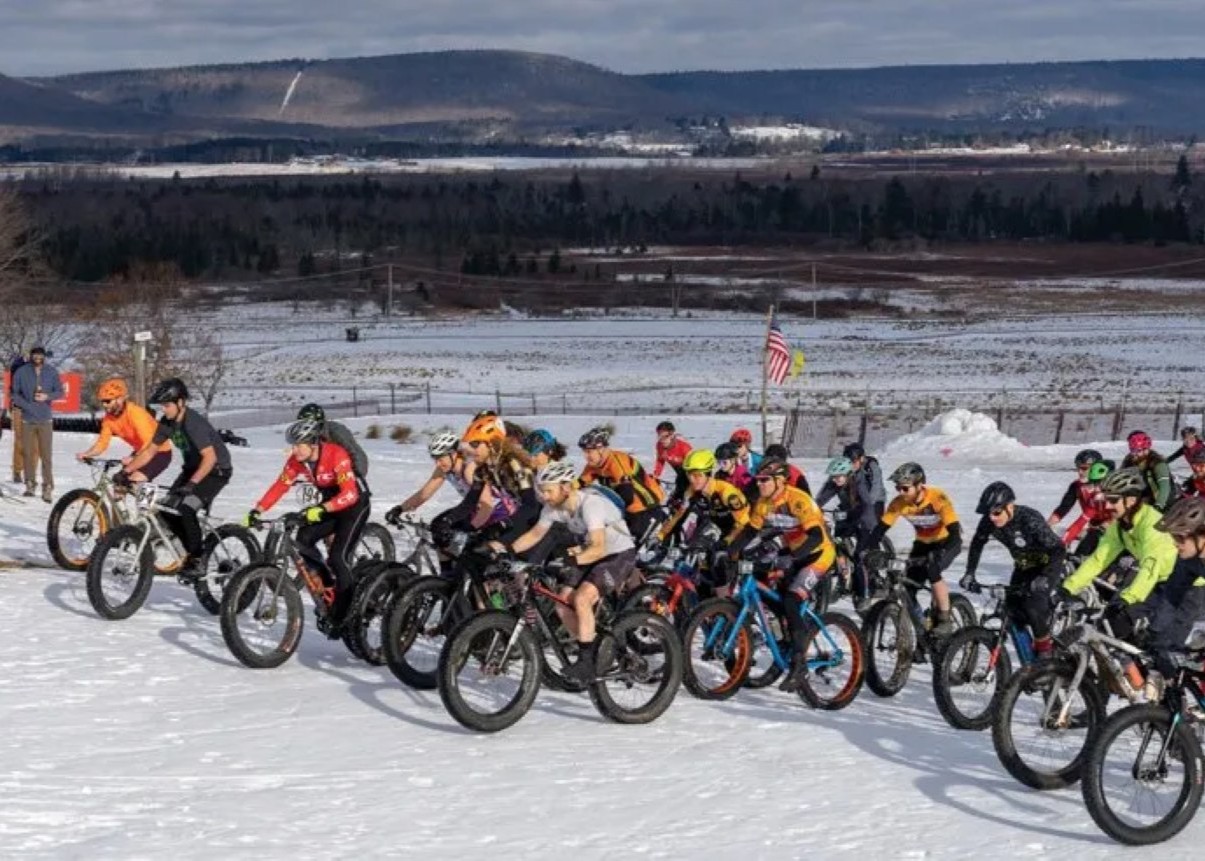
FEATURE PHOTO: Enthusiastic fat bikers toe the start line at the
2019 Mountain State Fat Bike Race at White Grass.Photo by Dylan Jones
Written by Victoria Weeks
The race hasn’t even started, and I’ve broken a sweat. The windy, icy, one-mile climb from the parking lot to the start line of the Canaan Valley Fat Bike Race is our baptism into the realm of sub-freezing temps and variable conditions that lie ahead. I wrangle my nervous energy as I grin and greet my fellow fat bikers. Let the adventure begin!
The Rise of Fat
The late 1970s saw not only the birth of my twin sister and me, but also the birth of my favorite pastime: mountain biking. A bunch of creative, fun-loving Californians modified beach cruisers and coined them “Klunkerz.” Compared to road bikes, the Klunkerz’ relatively soft, fat tires encouraged racing off-road, and the human-powered bicycle found a new home in the mountains.
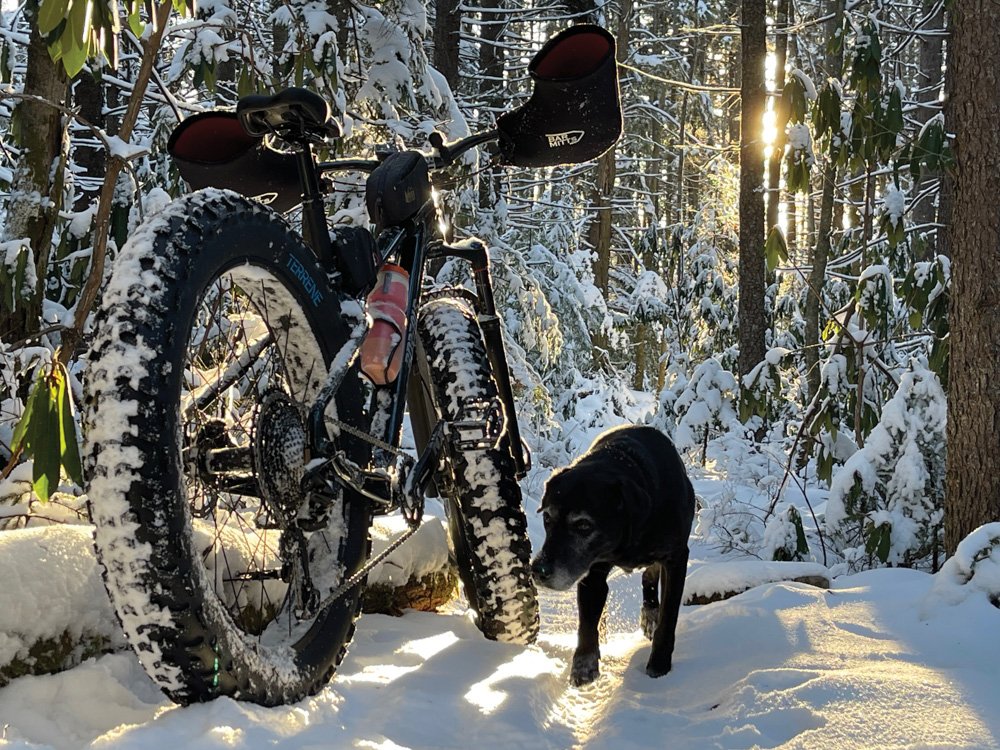
The author’s steed and her best buddy, Hazel, embraced by the enchanted forest. Photo by Victoria Weeks
Almost 50 years later, as our race pack transitions from pavement onto singletrack, I’m chomping at the bit. Between machine and human-powered grooming, the course was rolling like butter during our pre-ride yesterday. We just might be treated to three fast laps of heavenly snow flow—or not. We are at the mercy of the temperature.
As I find my groove, I consider how our fat biking heritage lies in the unpredictable, treacherously variable conditions of the Alaskan wilderness. In 1987, the Iditabike became the first race along Alaska’s famed Iditarod Trail to be powered by humans on traditional mountain bikes rather than dog sleds. Inspired by arctic snow, Steve Baker began to experiment with super-fat tires. It took welding two wheels together to mount a tire almost twice as wide as a traditional mountain bike tire, and custom forks to accommodate the extra girth. But it worked.
Purpose-built fat bikes hit the trail in 1999. Six years later, Surly released the Pugsly, the first mass-produced fat bike frame. By 2010, Surly and Salsa were selling complete fat bikes, and the trend was born. Today, the start of the Iditarod Trail Invitational boasts an array of colorful fat bikes, as do many neighborhood paths and trail systems.
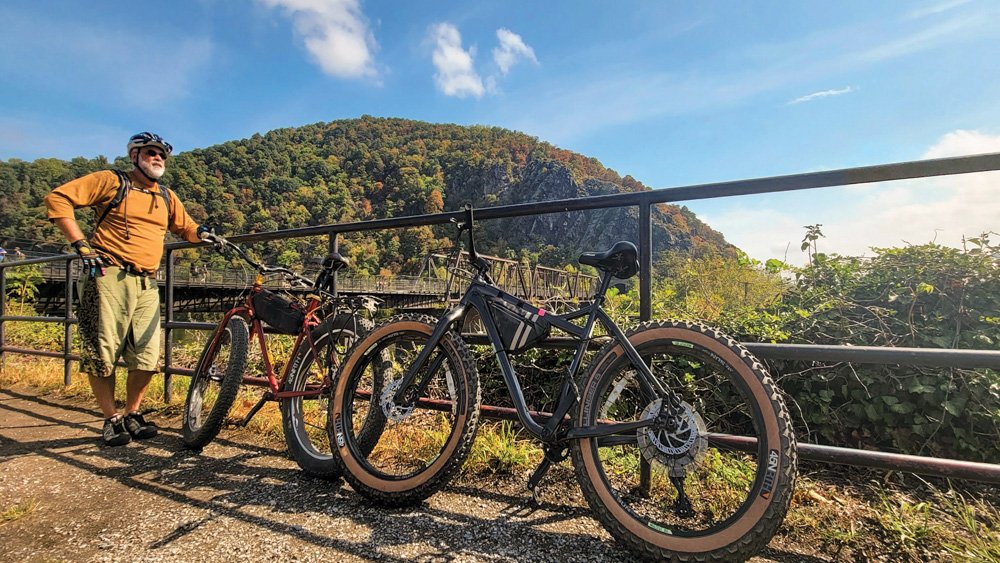
OG fat biker Scotty B shared his passion for fat bikes with his wife, Gwen. Photo by Gwen Grisham
What is that?
The first person I saw riding a fat bike here in Davis, West Virginia, was our friend Scotty B, and it wasn’t winter! It was somewhere around 2014, and I couldn’t believe how clunky and unwieldy this thing looked. But he was having a blast plowing through the rocky, technical singletrack that our area is famous for. Around the same time, Blackwater Bikes in Davis was owned and operated by Roger Lilly, who brought the brand-new Charge Cooker Maxi fat bike to town.
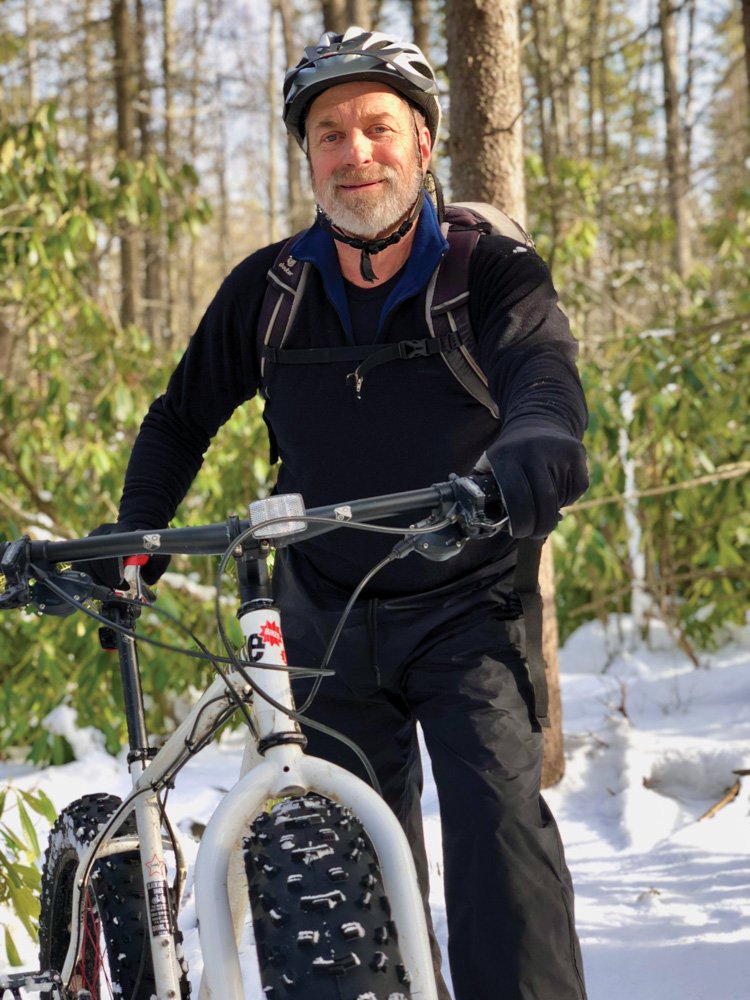
The author’s late husband, Eric Erbe, and his beloved Charge Cooker Maxi. Photo by Victoria Weeks
My dear husband, Eric, just had to have one. Like Scotty, he loved riding it regardless of the weather—the super-wide wheels, outfitted with monstrous four-inch tires, allowed for significantly lower tire pressure. The additional stability, traction, and float allowed the rigid steel frame to eat up the trail much like a full-suspension mountain bike.
Sadly, we have lost both Eric and Scotty to cancer. But their love for adventure on two wheels will always inhabit the enchanted forests and trails surrounding Davis.
The Problem of Snow
While the average snowfall for our area over the last decade is about 125 inches, it comes and goes. Cross-country skiing in the wild is not as reliable as it once was, although the professional snow farmers and groomers at the White Grass Ski Touring Center know how to make the absolute best of it.
Pair this fickle snowpack with a decline in the area’s downhill ski resort options at the time, and 2015 into 2016 saw fat bikes come to the rescue. In 2015, local trail builder Zach Adams promoted the first fat bike event in Canaan Valley. Adding to the fat bike fever, Tucker County’s very own John Logar was regularly competing in the Iditarod Trail Invitational 350. In 2019, he and Petr Ineman were co-winners of the 1,000-mile race to Nome.
As more of us fell under the spell of fat bikes, winter riding gained traction. We’d meander cross-country and then bomb down the snow-covered roots and rocks of Canaan Mountain. The droopy rhododendrons and mountain laurels shed their snow upon us as we whipped through them like motorcycles in a car wash. We laughed and tried to keep our eyes open despite the onslaught.
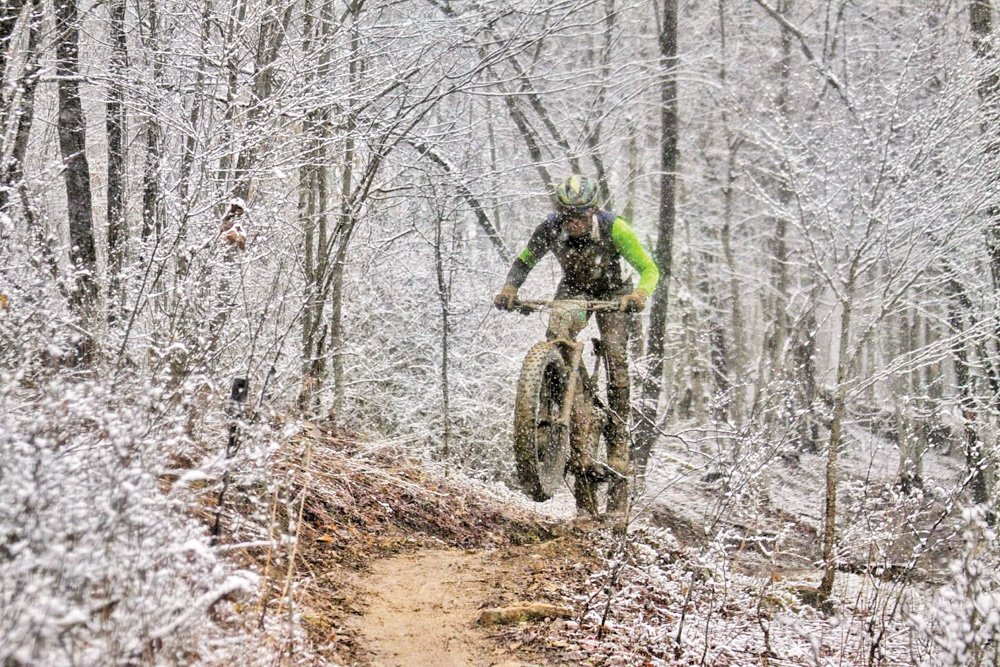
Zach Adams charges into first place at a 2024 fat bike race. Photo by Pat Hamlin
These tight, rocky, snow-ensconced single-track rides are some of my most treasured. I was enamored with the beauty and absurdity of it all. In 2018, cheered on by Eric, I completed my very first mountain bike race: the Mountain State Fat Bike Champs held at White Grass.
Growing Community
Six years after that initial race, zipping along through lap one, I could feel my hopes rise and the feeling return to my fingertips. Riding this hard generates a lot of heat. Making the turn into the second lap, encouraged by cheers and a smoky fire, I began to feel the dreaded softening. Sun-struck snow was losing its density. The rising temperature had started its betrayal.
Fat bike racing has fostered a vibrant community around the sport. Most folks who sign up for a race actually show up, even if they claim they’ll “watch the weather.” As Scotty and Eric taught us, fat bikes are fun in all conditions. And so the fat bike races roll on through rain, snow, sleet, dirt, mud, ruts, ice—all of it.
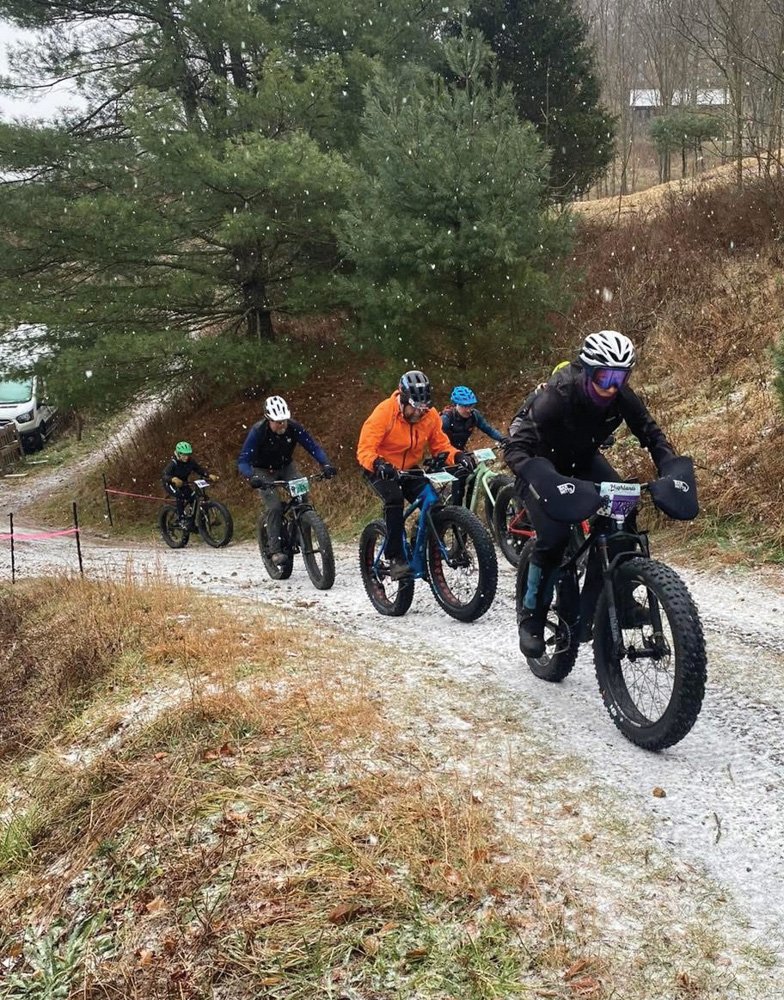
Snow showers grace the race pack. Photo by Zach Adams
In 2022, Sarah Meyers of the Deep Creek Adventure Bureau across the border in Garrett County, Maryland, teamed up with Zach Adams of Trail Labs, and the Highlands Fat Bike Series was born. The regulars peel out in conditions thick and thin. We encourage each other before the start and swap stories and soggy embraces at the finish. We’re either covered in mud, soaked with freezing rain, or crusted over with sweat and snot-cicles by the end. But every one of us has a blast pushing the envelope while questioning our life decisions, including our choice of tire pressure.
Speaking of tire pressure, halfway into my second lap, I know I have too much. Temps have risen above freezing, and our hard pack is turning into deep ruts of sloppy snow. Pedaling is significantly harder, and even the descents are exhausting. Speed takes a back seat to staying upright.
Just as with skiing, a groomed trail allows for speed and efficiency. In primo groomed conditions, it’s like riding on clouds. It’s flow without rocks, grip without slip, and the perfect landing should you get too much speed and crash. These spectacularly rare conditions inspire fat bikers to drop everything and ride. We are all extremely grateful to Zach Adams as well as the crew of the Deep Creek Adventure Bureau, who selflessly practice the art of grooming natural snow on wooded singletrack.
Fat and Happy
One’s initial impression of a fat bike thrashing through the woods is usually one of absurdity and disbelief. And so the sport attracts complete newbies as well as seasoned mountain bikers for the same reason: something this crazy-looking just has to be fun.
So as I pedal through the wheel-sucking quicksand that has become third-lap conditions, I remind myself of how much fun I was having yesterday. Today, I’m just building character and finally earning my Canaan Valley Fat hatchet award as I finish third. The cheers from my friends as I cross the finish line can’t help but transform my grumbling into an ear-to-ear grin.
The Spirit of Fat is born of the same energy that drove Californians skidding down mountain roads on their Klunkerz: pure we-shouldn’t-be-doing-this fun. There’s nothing that makes me feel more like a kid again than riding over the mountain and through the snowy woods on a bike with monster tires. And when a little kid perched atop skis or snowshoes sees me and exclaims, “Mommy, what is that?” Well, that, little one, is the Spirit of Fat.
Victoria Weeks lives, rides, and writes in Davis, West Virginia. You can follow her for riding tips and racing adventures at victoriaweeks.com.