
Highland Profiles is a series highlighting West Virginia’s exemplary outdoor adventurers, business owners, and community innovators. If you’ve got someone in mind worthy of a profile, drop us a line: info@highland-outdoors.com.
In the U.S., there are 42.5 million people with physical or cognitive disabilities. Outdoor recreation has the potential to help these individuals improve their quality of life, physical health, social relationships, and self-confidence. However, the logistics, gear, skills, and money required to participate in outdoor recreation can prevent people with disabilities from engaging in these activities.
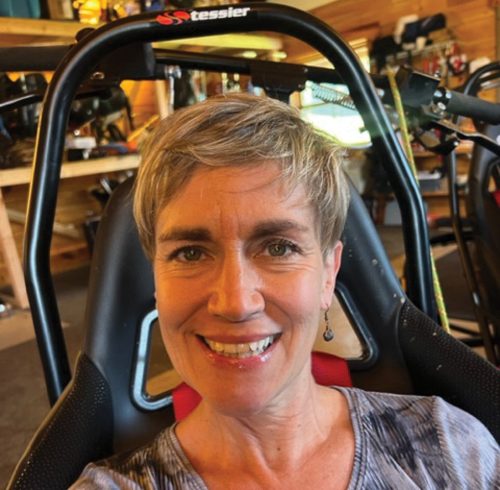
Carol Woody sits in the rider seat of a Tessier Cimgo adaptive bike. Photo courtesy Carol Woody
Carol Woody, executive director of the Challenged Athletes of West Virginia (CAWV), is working to overcome these hurdles and ensure that everyone who wishes to play outside can do so. Instructors and volunteers at CAWV, a non-profit organization based at Snowshoe Mountain Resort in Pocahontas County, provide adaptive ski gear and teach more than 300 ski lessons to children and adults every winter. Now, the organization is embracing the state’s explosion in mountain biking. I chatted with Woody about what drew her to West Virginia and how CAWV is making waves in adaptive recreation. This interview was edited for length and clarity.
How did you discover West Virginia?
I’m from Knoxville, Tennessee. My passion for skiing was sparked at a tiny resort in Gatlinburg, Tennessee. In my early adult life, I went skiing at Snowshoe several times. In 1996, my husband and I were looking to move to a mountain town out west. We thought Snowshoe would be a good introduction to that lifestyle, so we moved there to be ski bums for a season. I taught skiing and he waited tables and we really enjoyed it. At the end of the winter, we got offered jobs for the summer, so we decided to stick around. We fell in love with the beauty of the mountains in the summer. It’s been 27 years now and we’re still here.
How did you get involved with CAWV?
I started out as a ski instructor at Snowshoe, which was my first introduction to the winter sports adaptive sports program through CAWV. CAWV is a non-profit that was founded in 1996 to enhance or improve the lives of people with disabilities, whether it be physical, cognitive, or a combination of both, through outdoor sports and recreation. In the late 1990s, the director of CAWV often asked if volunteers from the ski school could help with special events, like the Wounded Warriors camps. I’ve worked in a lot of different roles around Snowshoe over the years, but I would always volunteer with CAWV anytime I had an opportunity to do so.
When did you become executive director?
When my daughter was born, I was working in human resources, which required a lot of travel. I decided to take some time off to focus on her. David Begg, the executive director of CAWV, called me up to ask if I wanted to work there as an instructor a couple of days during the week, so I did that for a few years. In 2018, Dave passed away. I was at a point in my life where my daughter was older and a couple of people approached me about coming on as director. I couldn’t imagine anything else I’d rather be doing, so I jumped on board.

Tessier’s adaptive bike, the Cimgo, helps all mountain bikers hit the trails. Photo by Kurt Schachner / Snowshoe Mountain
Where is CAWV based?
Around 2004 or 2005, Dave and his team raised enough money to build a beautiful center at the Silver Creek area of Snowshoe right next to the slopes. One of the great things about our location is that people can park right next to the building, get outfitted inside, and then go out the back door and get right on the snow. We’re fortunate to have such a wonderful environment where athletes and families can make themselves at home.
Who do you serve?
A lot of people around the mid-Atlantic and southeast regions of the United States, which is a very big part of the country’s population. Some people seek us out because we have a fully dedicated program that operates seven days a week during the winter. We serve people of all ages from four to 94 and older. For example, we have a family from the Pittsburgh area who started coming to Snowshoe specifically for our program for their daughter who has autism. Since then, they fell in love with Snowshoe, bought a home, built a hotel and restaurant, and became valuable community members.
What programs do you offer?
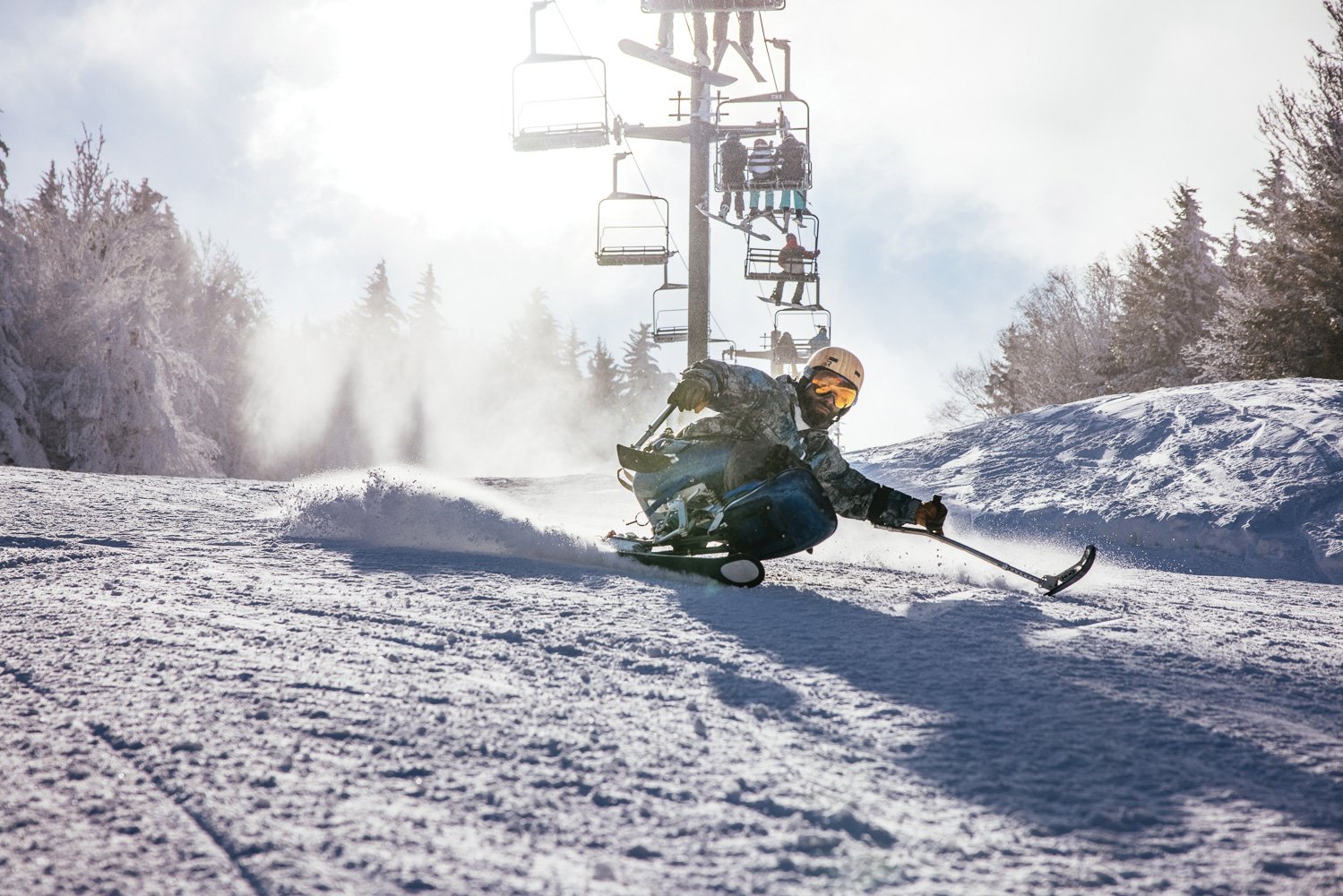
Our biggest focus over the past 25 years has been winter sports. We have a great team and lots of different types of equipment. People who come visit can book a half-day or full-day lesson directly with us. We also go through a phone interview with every person before they come, so that we can be prepared. At minimum, we have one instructor per person, but we often have more. We also have a variety of equipment, including sit-down mono-skis and bi-skis, that people can use. More recently, Pocahontas County, and West Virginia as a whole, has become known throughout the world for our exceptional mountain biking. In 2019, Snowshoe hosted the UCI Mountain Bike World Cup, and I thought, Wow, mountain biking is something we need to be doing.
How’d you kickstart your mountain biking program?
In 2019, we started thinking about how we were going to run a program and what equipment we would need. 2020 was going to be our big push, but, of course, we had a few setbacks. We did a lot of fundraising that year and were able to raise enough funds to get our first two adaptive mountain bikes. We got the first one in 2021 and the second one last summer. Our program had been a little more geared toward people that have a specific physical disability but are still able to ride the adaptive bikes, but this year we added a new bike called the Cimgo that allows us to get more people out riding.

Adaptive athlete Kinzie Dickman rips down a trail at the Snowshoe Bike Park. Photo by Kurt Schachner / Snowshoe Mountain
How did you discover the Cimgo?
The Cimgo is made by a company called Tessier from France, which is world-renowned for building adaptive ski equipment. A lot of Paralympians use their mono-ski, but they make a wide range of adaptive equipment. I discovered the Cimgo while looking at their skis. It’s a full-gravity mountain bike that has a seat up front and is operated by a pilot in back. I immediately saw the potential since we have so many people that come to use our bi-ski, which is a sit-down ski guided by an instructor. With the bi-ski, we can take anyone down the ski slopes, no matter their ability, and see the joy it brings them to get outside and experience something they don’t get to do every day. The Cigmo is very similar to the bi-ski, so I knew it was perfect for opening the door to our mountain biking program.
What makes the Cimgo unique?
When I started looking into the Cimgos, I realized there wasn’t a single one in North America yet because you have to be certified to operate it and the only certification program is in Europe. I was hoping to get a grant for the actual bike, but in the meantime, I made plans to go to France with three other instructors to get certified.
What was the training process like?
We went to France in May 2022 for the training. They shuttled us along these super winding roads to the top of some mountain bike trails in the Alps. We piloted the Cimgos down trails that could take you half a day to get to the bottom. We did a few drills and practiced drifting. Then our instructor took us down one super-steep trail that I never would have gone down on my regular bike, and I’m a pretty avid mountain biker. The Cimgos were just amazing. They’re pretty slow-moving, but they love steep, technical terrain and can brake anywhere. We also had a chance to tour the manufacturing facility and meet the owner of Tessier while we were there, which was a real privilege.
Have you taken people down Snowshoe’s bike trails in the Cimgos?
We have four Cimgos now and four certified instructors, including my daughter and me. Several riders have come out to enjoy the trails on the Cimgos this summer. We have also spent a lot of time piloting each other down the mountain and being guinea pigs because it’s really important for us to find the right trails for the Cimgos. We want options for every rider, from those who want some adrenaline pumping action to those who want gentler options and everything in between.
What are your goals for the future?
We are the first program in North America to have the Cimgos. The goal is to work in a partnership with Tessier to become a training location in North America so that other adaptive programs can have them and serve individuals they’re not currently able to.
What are your hopes for the future?
Hopefully people will come to think of Snowshoe as a great place for adaptive riders to come and experience the world-class mountain biking trails in our beautiful state. I want to continue growing our summer and winter programs so we can serve more people. It’s so inspiring to offer outdoor experiences that can improve people’s quality of life.