



Krista Noe could barely contain her excitement. “There’s the snappy single sync,” she says to the tune of a catchy jingle while shimmying her shoulders. This firefly species, which synchronizes its flashes, has only been found one time in West Virginia. “My favorite species is probably the blue ghost—but don’t tell the other fireflies.” Blue ghosts are extremely small fireflies, not much larger than a grain of rice, that produce a steady green glow. From far away, their glow can appear blue, hence the name.
Noe began studying fireflies when she joined the West Virginia Division of Natural Resources (WVDNR) in 2022. She still remembers her first official firefly outing. “I was on the heels of Pyractomena dispersa, which is one of the orange-glowing ones,” she says. As an elusive species, little was known about where it occurs. Walking into an open field, Noe and her colleague spotted several species of fireflies, including the one they were seeking. “That’s when it all started for me. Then I went deep down the rabbit hole.”
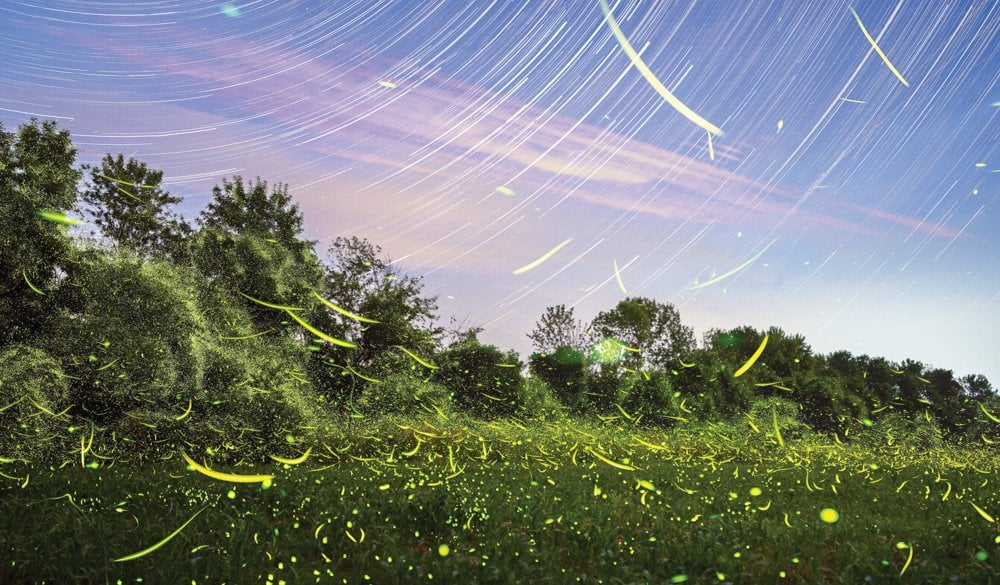
A stunning firefly display in Lesage, West Virginia. Photo by Jesse Thornton
Now, Noe is one of the state’s leading firefly experts. During the summer, she can frequently be found walking through the woods at night without a headlamp or flashlight. Because adult fireflies use their glowing patterns to find mates, their eyes are finely tuned to their dim glows and, as a result, extremely sensitive to bright lights. “It’s amazing,” she says. “You just have to trust that the path is there and follow the light.”
Luminous displays
West Virginia is home to 29 known species of fireflies. They occupy a range of habitats, from lawns and open meadows to hardwood forests, wetlands, and stream banks. Each species has a unique flashing pattern, similar to a fingerprint or birdsong. Some firefly species produce steady green glows, while others emit orange flickers or distinct yellow flashes. Adults of a few species, including the winter firefly, don’t glow at all, relying instead on pheromones to find mates.
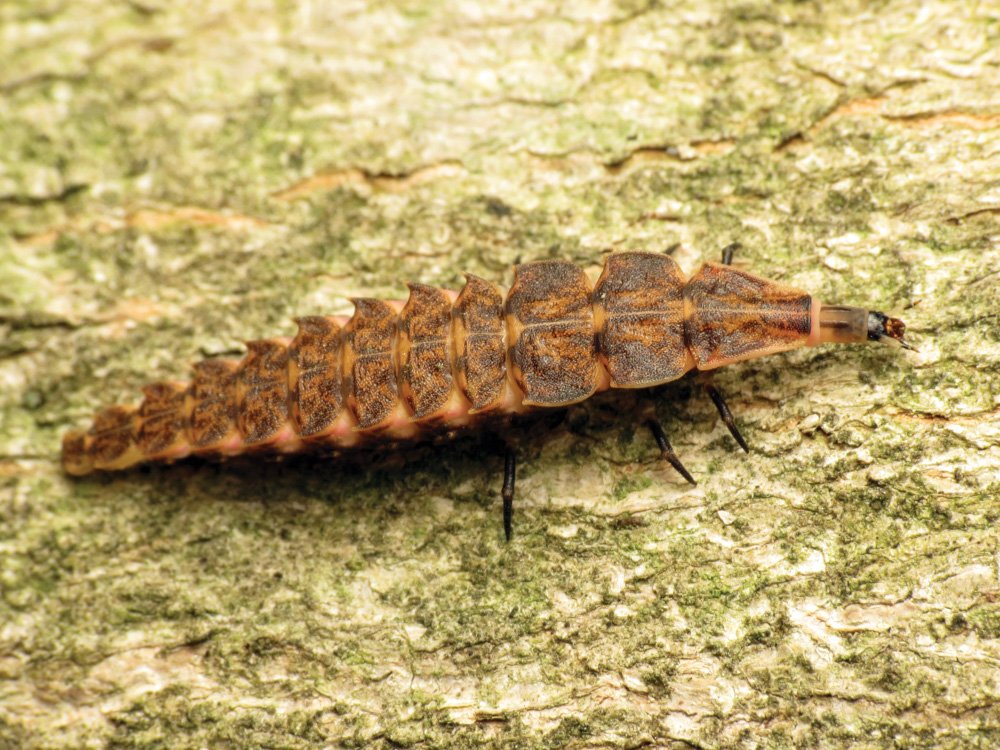
Larvae of the spring firefly (Pyractomena spp.), like this one, are voracious predators with tough-looking armor for protection. Photo by Katja Schulz
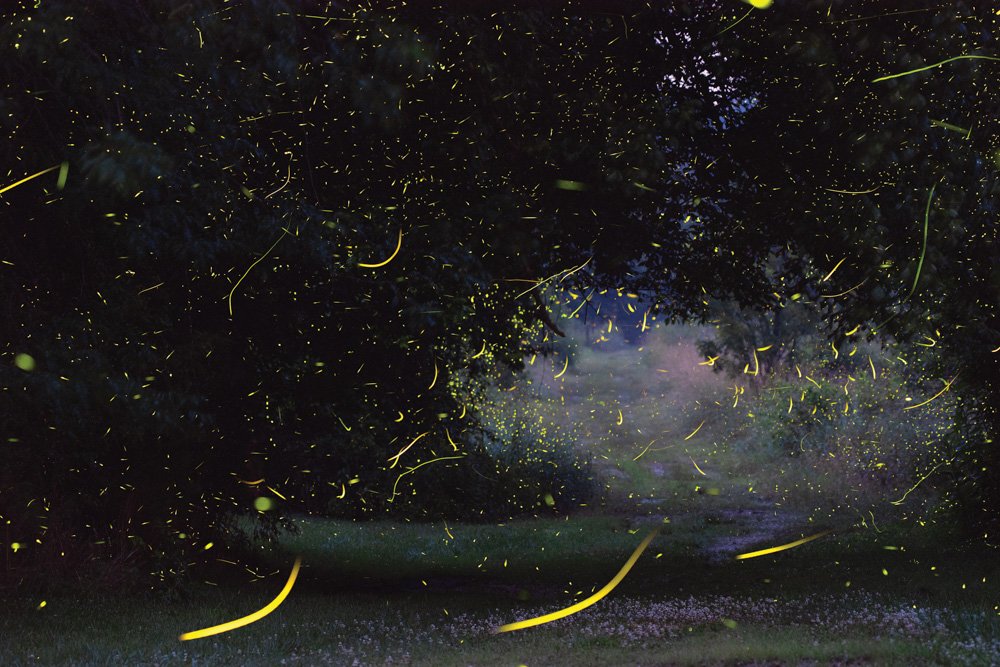
The Mountain State is also home to two species of synchronous fireflies. “They all start flashing at about the same time and then they all shut off for the same amount of time. It moves almost like a wave through the woods,” says Jakob Goldner, a terrestrial invertebrates entomologist at WVDNR. “Their displays can be very spectacular. But most fireflies in large concentrations are spectacular.”
Fireflies or lightning bugs are flying beetles in the Lampyridae family. Although we typically think of them in their glowy adult form, they spend the vast majority of their lives as wriggly, worm-like larvae crawling around underground, in leaf litter, or beneath tree bark. In West Virginia, fireflies live for one to two years, but only survive for two to three weeks as adults. Firefly larvae consume snails, slugs, worms, caterpillars, and other soft-bodied invertebrates. Most are voracious hunters that inject their prey with neurotoxins to immobilize them and then secrete digestive enzymes that liquify their prey before eating them.
While not all adult fireflies glow, all of the larvae do. “We think the purpose is to deter potential predators,” says Candace Fallon, a senior conservation biologist at The Xerces Society for Invertebrate Conservation. “It’s a warning that says, ‘Hey I’m toxic. Don’t eat me, you’ll regret it if you do.’” Several firefly species produce defensive compounds called lucibufagins that make them unpalatable to predators like spiders and birds.
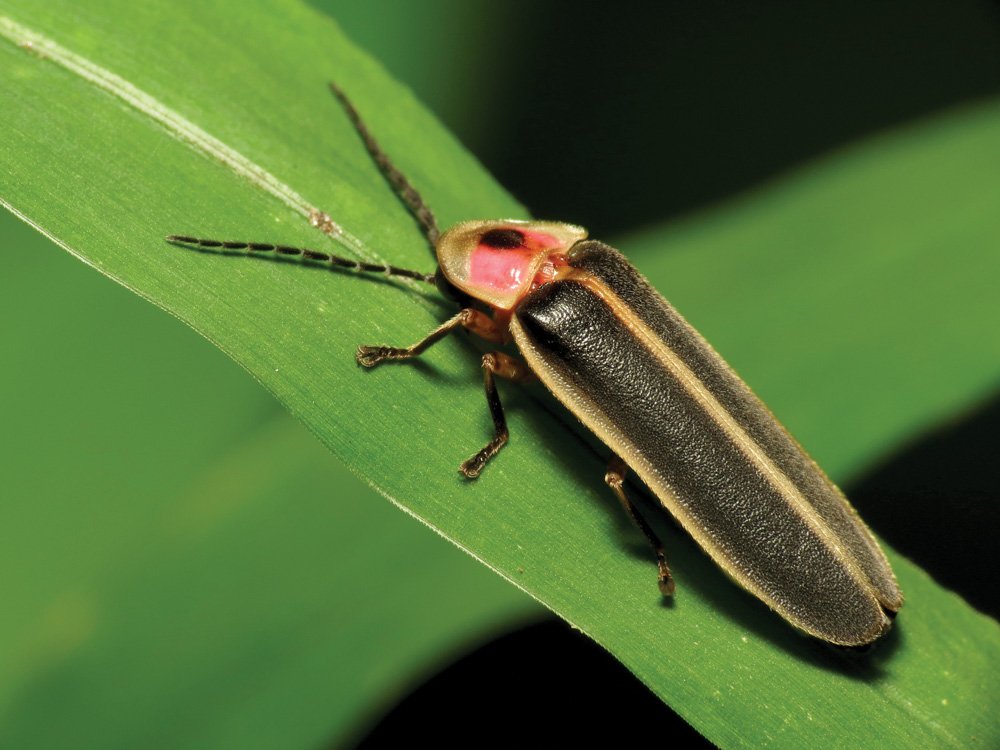
An adult big dipper firefly (Photinus pyralis), the most common firefly species in West Virginia. Photo by Katja Schulz
In species that can’t biologically produce these defensive compounds, female Photuris fireflies have a more macabre way of protecting themselves. They mimic the flash patterns of male fireflies that produce lucibufagins in order to draw them in. Once an unsuspecting male ventures too close, the female attacks, consumes the male, and steals his lucibufagins in order to defend herself and her eggs from predators.
“They call them the femme fatales of the firefly world,” Noe says, noting that capturing fireflies can be a risky gamble. “If you put a few of them in a jar, it might be all well and dandy. But if there’s a female Photuris in the mix, then it could be a crime scene that you’ve created.”
Searching in the dark
One of the wonderful things about fireflies is that almost everyone has a story about them. Whether you remember catching fireflies as a child or recall seeing a magnificent display of flashes as an adult, these glowing creatures never cease to amaze. “They are just so magical,” says Fallon. “Every time I bring people out in the field with me, my favorite moment is when the very first firefly starts flashing. Without fail, everyone starts whooping and hollering.”
But over the years, Fallon has heard countless tales from people who saw fireflies all the time as a kid, but no longer see them. In 2018, Fallon and her colleagues decided to start conducting inventories of fireflies to see if they could backup these reports. They partnered with firefly researchers and other conservation groups, surveying 132 of the 177 firefly species known to occur in the U.S. and Canada. “Something we found when we did the assessments was that we don’t actually have population data for any of the firefly species. We have no baseline to say 100 years ago or 50 years ago, these were the estimates.”
This lack of historical data may reflect the fact that studying fireflies in the wild is extremely difficult. Imagine walking into a vast field at night without using any lights to guide your way. Tall grass tickles your feet as you stare into a flat backdrop of distant trees beneath a starry sky. After adjusting to the darkness, you see a faint glow blinking in the grass, then another in the tree tops. All of a sudden, you’re surrounded by flashing lights, each moving in a different direction before disappearing into the landscape. To accurately identify a firefly species, you have to determine its unique flash color and pattern by tracking a single individual as its light blinks on and off. “It’s really hard to anticipate where it’s going. And then you need to record the length of time of the flash, how many flashes, and if there’s a break between them,” Fallon describes. “If you’re at a site with multiple species and hundreds or thousands of individuals, it becomes nearly impossible to track them all.”
In 2020, Mack Frantz, a zoologist with WVDNR, launched a community science survey to track firefly sightings in West Virginia. Noe joined the effort two years later, creating videos, handouts, and other resources to help enthusiastic participants hone their firefly identification skills. One resource, a flash chart, shows the flash colors and patterns of 22 firefly species over a 12-second interval. For instance, the heebie-jeebies produce one yellow flash every second, while the dot-dashers produce a green flash followed by longer, green glows before going dark for four seconds. Some species have two types of patterns, and, complicating things even further, fireflies change the speed of their flashes depending on the temperature. “It’s a very technical skill to identify a lot of these fireflies from flashes,” says Goldner. “I still have to call Krista at 11 o’clock at night when I’m in the field and saying, ‘What is this? What am I looking at?’”
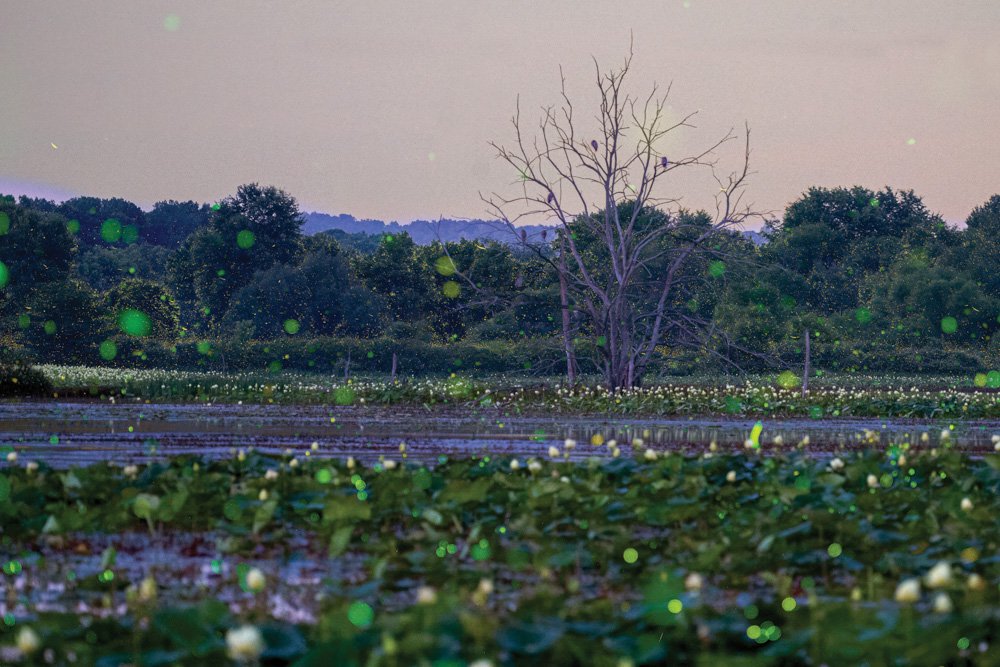
During the summer, fireflies of many species flock to meadows and forests to show off their flashy displays. Photo by Jesse Thornton
Although the learning curve can be steep, Noe and Fallon say that with some time, patience, and a smidge of knowledge, you can begin to see the patterns, making the process of identifying fireflies much easier. For instance, a general rule of thumb is that the tiny species with yellow flashes come out earlier in the evening. “As the evening shifts and it gets later and darker, you see more Photuris. They’re the ones that light up green,” Noe says. Instead of trying to scribble notes in the dark, Noe and her colleagues speak into recorders, using distinct tick sounds to represent the different types of flashes and the timing between them. They also take notes about the weather and habitat. Fireflies don’t flash or glow when the temperature is below 50 degrees or raining. “But if it’s raining in the evening, and then it stops, they love that,” Noe says.
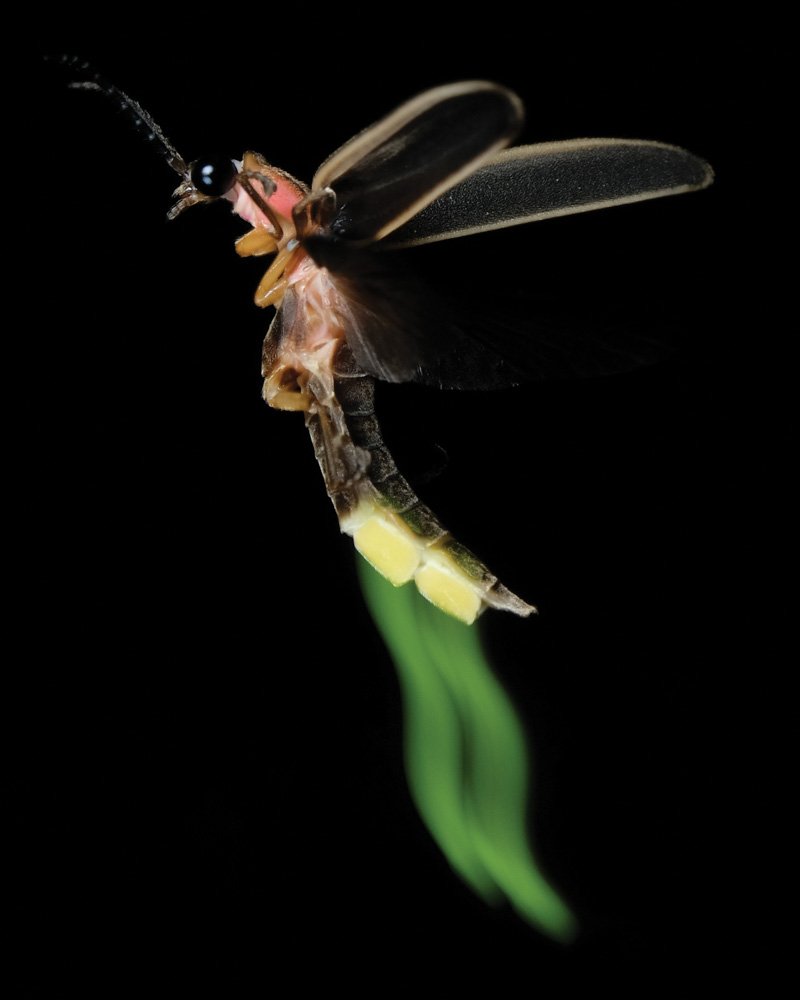
Fireflies have large, sensitive eyes that are finely tuned to spot flashes from potential mates. This sensitivity also makes them vulnerable to being blinded by light pollution. Photo by Terry Priest
In West Virginia, fireflies begin flashing around late April, reach a peak of activity in June, and stop flashing toward the end of July. The first species to begin its mating display is the spring treetop flasher, which produces one yellow flash every three seconds. Big dipper fireflies, which are the most common species in the state, are the last ones at the party. They continue flashing until August, and Noe has even seen a few flash into September.
The WVDNR received many responses to their community firefly survey, showcasing the community’s passion for studying fireflies, but it was tough to validate all of the information they received. The team is taking a brief hiatus this year to restructure the project around a single firefly species in the hopes of making the survey more approachable. In the meantime, they’re continuing their efforts to monitor the state’s 29 known firefly species and discover new firefly species as well.
“In the past, we’ve taken more of an inventory approach because we didn’t really know what we had,” Noe describes. Now that the team has a better grasp of which species occur in the state, they’re switching gears to establish some baselines and evaluate which firefly species are at risk.
Kill the lights, save the show
“Across the world, there seems to be this pretty consistent trend of a 1 to 2% decline in various insect species each year. We don’t know what’s happening with fireflies, but it’s not outrageous to think that something similar is happening to them,” says Fallon.
According to the International Union for the Conservation of Nature, one in three North American fireflies are at risk of extinction. This risk is driven by a variety of factors, including habitat loss, pesticide use, climate change, and especially light pollution. “Light pollution is a really big issue, because they need to see each other,” says Noe. “Their heads are mostly eyeballs, so even a flashlight or a passing car headlight can be blinding to them.” And if fireflies can’t see one another, then they can’t mate and produce the next generation.
The good news is that there are plenty of individual actions we can take to help protect fireflies. “You can literally turn off the light and the threat is no longer there,” says Fallon. For those who use outdoor lighting at night, it’s beneficial to use motion sensors or timers so the lights turn off when they’re not in use. Even the simple act of closing your blinds or curtains at night prevents the light from inside your house from spilling outdoors.
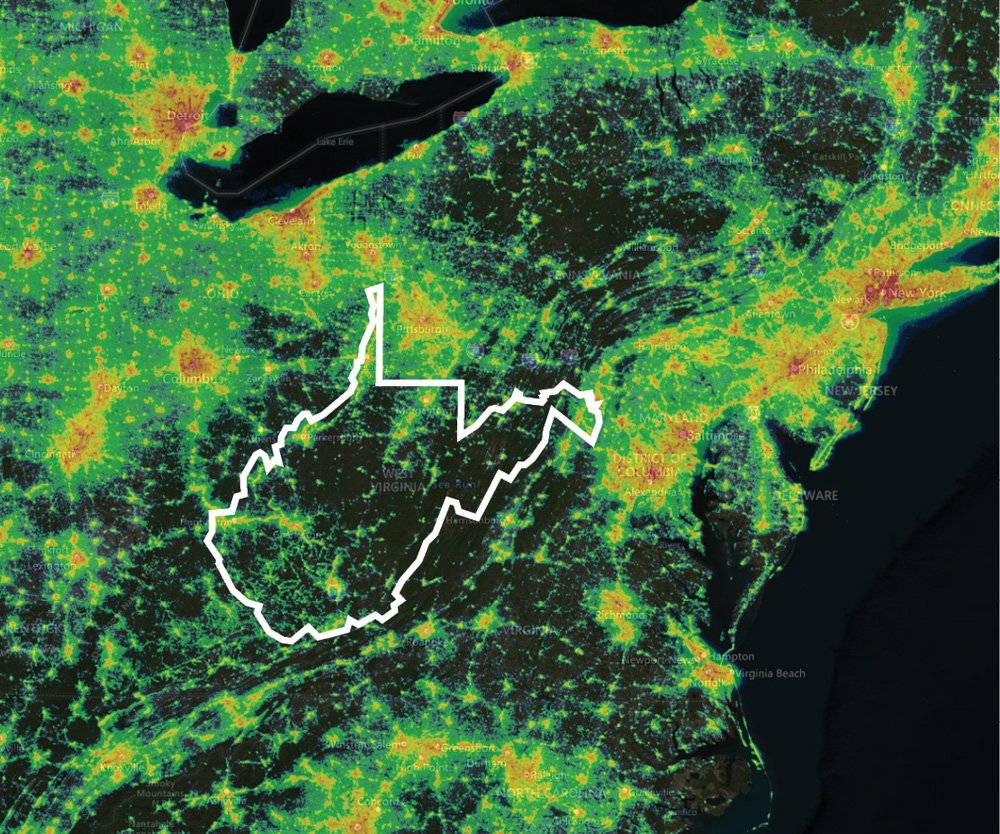
A light pollution map of the eastern U.S. West Virginia is one of the few remaining places with dark, starry skies. Map courtesy Earth Observation Group, NOAA National Geophysical Data Center
Because firefly larvae live in leaf litter, rotting logs, and tree bark, keeping your lawn a little messy and wild can go a long way toward protecting these glowing wonders. Some beneficial actions include mowing your lawn less often, keeping leaf litter and fallen branches on the ground, reducing or avoiding the use of pesticides, and letting a portion of your yard grow wild. The nonprofit Firefly Conservation & Research even offers certified firefly habitat signs for people who create firefly havens around their homes and businesses.
While it can be extremely tempting to capture fireflies and observe their flashes up close, it’s best not to hold them for too long. “One thing we don’t always think about is that our bodies are much bigger and much hotter than a lot of small animals. Just holding a small animal in your hands can be enough to elevate its body temperature to a dangerous level and kill them,” Goldner says. “And if an animal is freaked out and stressed and scared, it is more likely to get sick or act abnormally. There are a lot of reasons to be very gentle and kind to our wildlife.”
And I’d argue that it’s worth taking the time to be a bit kinder to these creatures so we can continue enjoying their brilliant displays for generations to come. In the Mountain State, we’re particularly fortunate to have expansive swaths of dark, starry skies. Take a look at a light pollution map and you’ll see a West-Virginia-shaped hole in the midst of glowing metropolises. These dark skies are critical resources not only for fireflies, but also for us to feel that unique sense of awe that comes from staring at a vast field of flashing, flying beetles. “Looking at a good display of fireflies reminds you that this is a good planet,” Goldner says. “In the whole universe, this is the only place where we get to see fireflies.”