
I love Coopers Rock State Forest. Like many West Virginians, I’ve enjoyed this magical landscape along the eastern rim of the Cheat River Canyon for as long as I can remember. From scampering around the towering rock corridors with my parents as a klutzy child to my formative years in high school and college hiking, mountain biking, and rock climbing (still with plenty of klutzy moments), the countless hours I’ve spent at Coopers Rock have played a significant role in shaping who I am today.
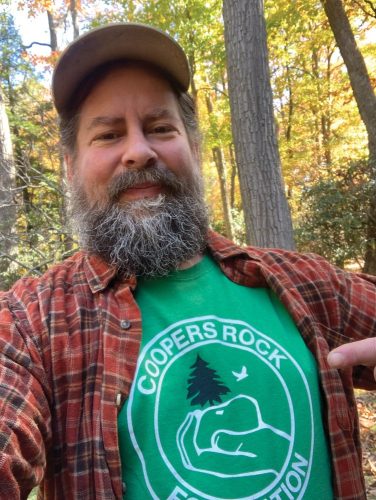
Coopers Rock also significantly shaped Adam Polinski, a Morgantown resident who’s been a mainstay among the rocks and trails for over 40 years. One could argue that Adam has, in turn, significantly shaped Coopers Rock through his involvement with the Coopers Rock Foundation (CRF), of which Adam is a founding member.
I first met Adam Polinski in the late 2000s, when I was wrapping up my undergraduate days at West Virginia University (WVU). While taking a parks and recreation course, my classmates and I did some volunteer work with the CRF. Next to a pile of tools, work gloves, and safety glasses, Adam stood out as a stout, energetic man with bright eyes, a bushy beard, and a permanent smile. When the volunteer shift ended, I stuck around and helped Adam clear some downed trees. He showed me how to improve my axe technique as we talked about biking and climbing, immediately bonding over our shared love of the West Virginia mountains.
If you’ve spent any time at Coopers Rock, odds are you’ve seen Adam at some point, whether it’s out on the trail or during a CRF event like the annual WinterFest celebration. And if you haven’t had the pleasure of meeting him, you’ve undoubtedly enjoyed the fruits of his labor from the countless hours (he estimated around 10,000) he’s put in over the decades.
During my meandering conversation with Adam, I recalled that my familial connection to Coopers Rock runs deep. My great aunt, Carol Headly, was a founding member of the CRF, and my grandmother, Shirley Jones, had a bench dedicated to Aunt Carol upon her passing, which still sits along the paved path to the ADA-accessible overlook.
If you love Coopers Rock as much as I do, I hope you’ll enjoy my conversation with Adam, someone I consider synonymous with one of West Virginia’s most iconic natural wonders. This interview was edited for length and clarity.
Tell me about your upbringing.
My father was from Ashland, Kentucky, and my mother was from Gary, Indiana. They married and moved to New York City, then to New Jersey, where I was born in 1963. The things I most remember from those days are riding my bike and going fishing, two things I still do today. In the middle of tenth grade, my dad got a new job with the Department of Energy in the South Hills of Pittsburgh. I didn’t adjust well to my new high school. I was so far out of the mainstream that I referred to myself as a fringe nerd. I didn’t make that many friends and I cut class a lot, but not to do delinquent things. I hung out in the library and read. My grades were poor, but my learning continued. When I applied to college, I got accepted to two schools: a Penn State branch campus and good ol’ WVU.
What was your introduction to West Virginia?
I did a solo backpacking trip in the Laurel Highlands of Pennsylvania in eleventh grade, where I met four WVU forestry students out in the woods. That chance meeting opened my eyes to WVU and to people I could relate to. Because of that experience, I ended up going to WVU to major in forestry. My first backpacking trip in West Virginia was to Dolly Sods during my freshman year in October of 1981 with some dormmates, which is hilarious to think back on. I brought along my chemistry workbook thinking I was going to be responsible and do homework in my tent. It was way colder than we expected; there was snow on the ground and it was really windy. We struggled to set up the tent and then cooked dinner in the freezing dark. I was like, “There’s no way I’m doing chemistry homework!”
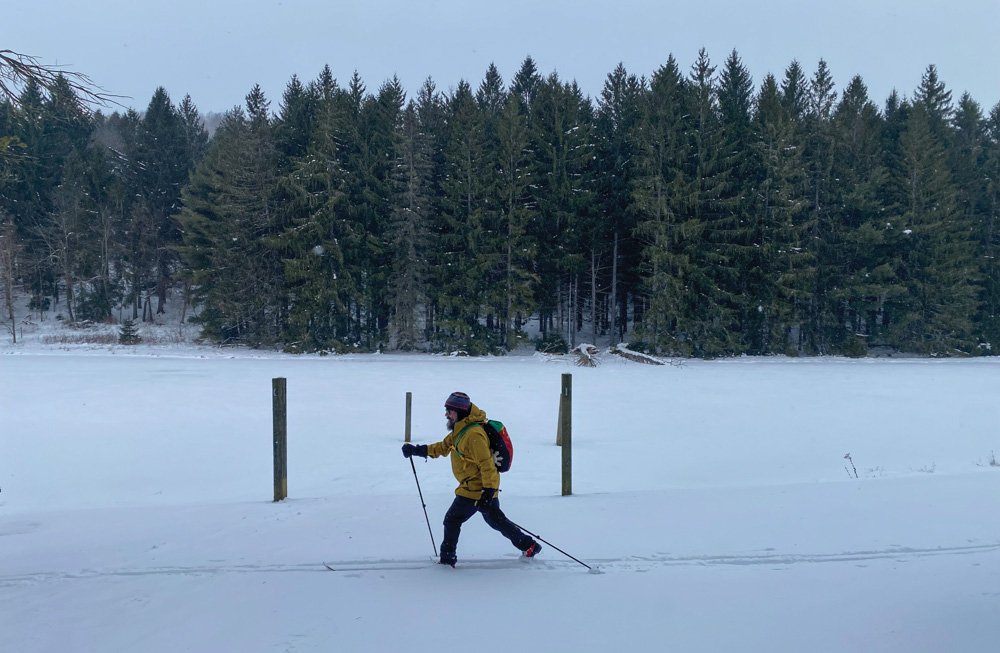
Polinski cross-country skiing in New Germany State Park in Maryland. Photo courtesy Adam Polinski
What role has Coopers Rock played in your life?
When I started at WVU, some kid on my dorm floor had a car and said, “Let’s go to Coopers Rock.” I said, “What’s that?” I remember going up and parking near the overlook and running into the woods, and was wowed by the big rocks and trees, just thinking Man, this is so cool. My next memory is getting back to my dorm room and realizing I had lost my wallet. There were already plenty of jitters as an incoming freshman, and the last thing I needed was to lose my wallet. I organized a group of dudes from my floor to go back and look for it and offered everyone pizza. I couldn’t guarantee we’d find the wallet, but I guaranteed we’d have pizza. Sure enough, one of the guys found my wallet. Some Good Samaritan noticed it and placed it on a rock in clear sight. I was so relieved. I had my first two Coopers Rock experiences in 24 hours and had something dramatic happen both times. I had no idea that Coopers Rock would become such a large part of my life.
After school, at age 23, is when big things happened for me. I became a vegetarian, I started doing yoga, and I started rock climbing with college friends. Skiing and rock climbing at Coopers Rock were huge influences in my life. Over time, it evolved to the point where Coopers Rock was the place that meant the most to me, and it has increasingly become more so. It has all these different facets as a state forest. Everyone loves Coopers Rock for their own reasons and that complexity fascinates me.
What role has Coopers Rock played in West Virginia’s outdoor history?
It was purchased by the state from a lumber company in 1936; most of that land is still part of the Coopers Rock State Forest today. Early on, it was visited by the public primarily for sightseeing at the overlook, which is why the road, parking lot, and restrooms were originally built. The spring house was built by the Civilian Conservation Corps to provide visitors with drinking water. The oldest recreational activity at what’s now Coopers Rock is certainly hunting. In the 1970s, Coopers Rock became recognized for trail running and rock climbing and cross-country skiing. Recreational usage was branching out and more trails came into being from the WV Department of Natural Resources and the Youth Conservation Corps. Then mountain biking started up in the 1980s. When Route 48 became Interstate 68, traffic increased, and the proximity to Morgantown and other states combined for more visitors.
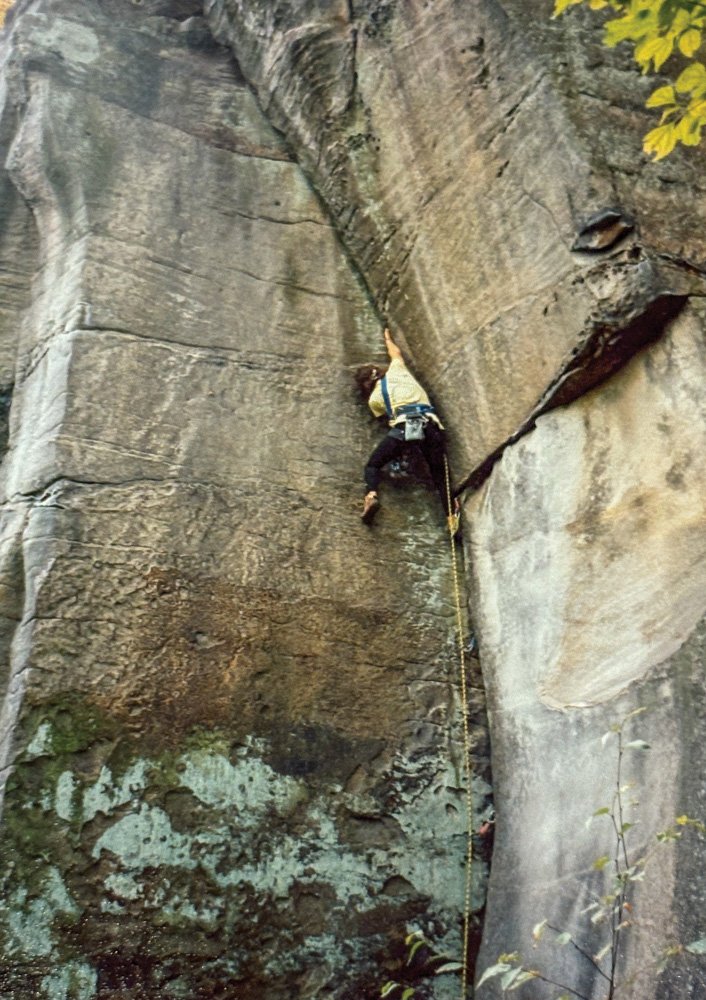
Polinski leading a rock climb at Cheat View in 1991. Photo courtesy Adam Polinski
What makes the rock climbing at Coopers Rock special?
It probably has the longest continuous bouldering history in the state. When you look at Bill Webster’s original guidebook from the 70s, there were a couple of named boulder problems established. Coopers also provides opportunities for people to boulder at whatever level of difficulty they want. There are great rocks for little kids who want to scramble around and learn how to climb. As a well-traveled boulderer myself, not a lot of places in the country have the volume and difficulty spectrum of the boulder problems offered by Coopers Rock. And, of course, there’s the scenery and gritstone. Some people fall in love with a certain kind of wine or music, and some people fall in love with a certain kind of rock. There’s a tenuousness to it and a certain texture to the rock that is unique.
How did the CRF form?
It formed in a reactive way, much like Friends of the Cheat formed because of a massive acid mine drainage blowout. Our equivalent was the threat of a proposed tram that would have spanned across the Cheat Canyon from Coopers Rock to Snake Hill. I went to the public hearing that was held in November of 1987 at a pavilion by the overlook. After that meeting, almost everyone in attendance was against the tram. That meeting is where Friends of Coopers Rock was born. George Longenecker was the first informal leader and became the first president, and we won that battle. In 1989, the Friends of Coopers Rock decided to become a nonprofit state park foundation to be able to accept donations and do service and educational work. We grew out of a crisis, and after that big victory, we decided to be proactive instead of just reactive. That was our big turning point, because a lot of groups might have said, “Okay we won, we’re done.”
What’s the CRF do nowadays and what’s your role?
The CRF is a collection of people who feel that Coopers Rock is important to our lives and the lives of many others. Our goal is to help preserve and improve the state forest for recreation. I’ve been on the board since its inception nearly 40 years ago. I’m also the volunteer coordinator and trail work coordinator.
We have a lot of trail work and facilities improvements going on. Just last week, we finished something that we should have finished years ago, but we’re all volunteers and sometimes it just takes a lot to make things happen. We recently put in 15 tent pads and 25 lantern posts in the Rhododendron Campground, so now you’ve got a flat place for your tent and a place to hang your lantern at every single site. We’ve facilitated improvements to the old spring house and the information house; we have a wonderful benefactor who sponsored the updates of those. We’ve also got a new restroom and pavilion in the day-use parking lot. And gosh, how about the new entryway, which is just fantastic. All the trail work, including building all the bridges, might be the most expensive and extensive thing that we’ve done. Above and beyond anything else is the constant drainage work on the trails.
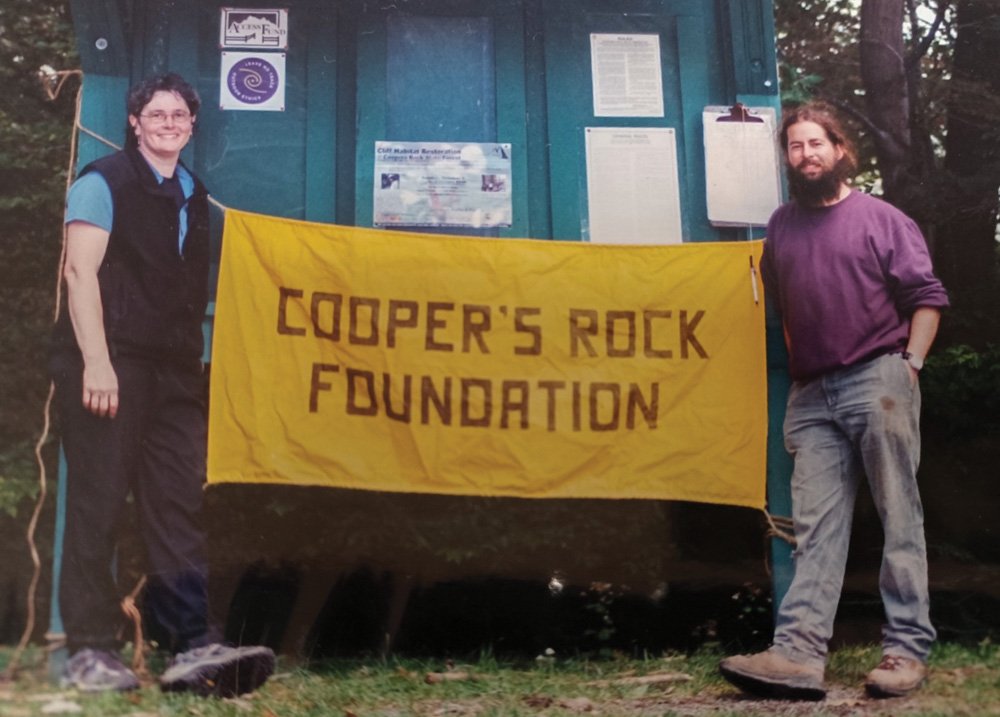
Jan Kiger (left) and Adam Polinski (right) in the early days of the Coopers Rock Foundation. Photo courtesy Adam Polinski
What do you love about trail work?
As humans, we have to eat, sleep, and do all the regular, mundane things of our lives. But we also get this fourth component, which is our free time. When a person spends their free time on the trails of Coopers Rock, we just want them to have a good time. We want to provide options for the entire spectrum of trail users. I love working with weather and gravity and figuring out how to create different trails for each season and type of recreational fun. And the work is never done. With Roadside Trail, or any other trail, I can go back and keep improving it. I might retire from trail work at age 80. One day, I’m going to leave Coopers Rock on a given evening and say, “Dang, now everything is just right.” But I haven’t achieved that yet.
What are you most proud of with the CRF?
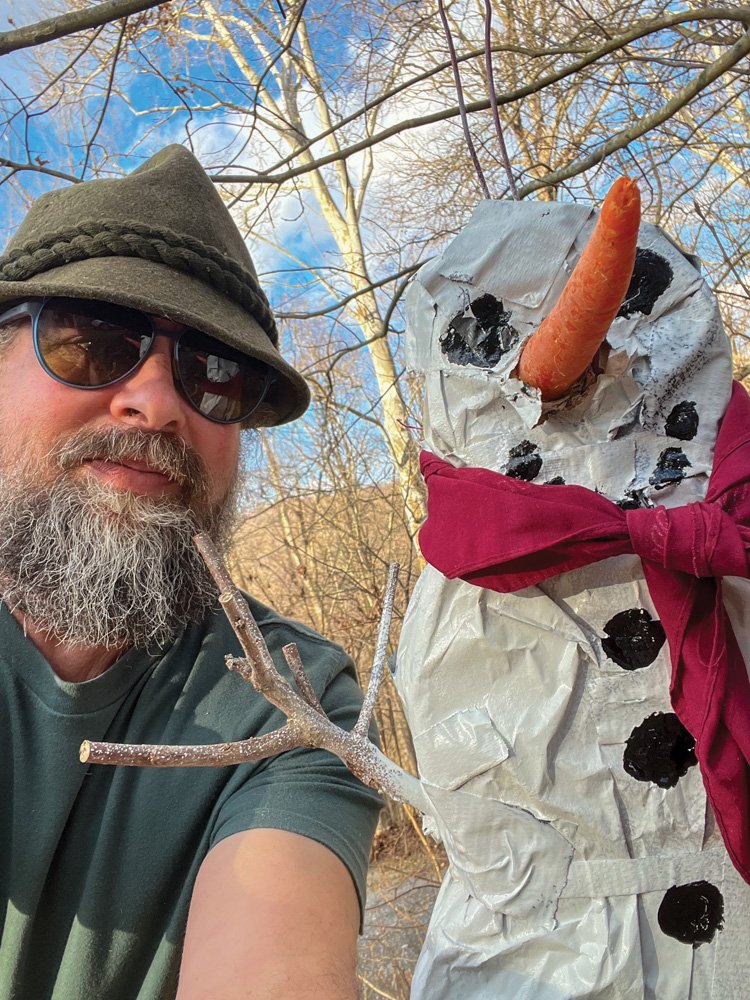
Polinski, who’s got a perfect last name for someone who organizes a winter festival, builds a snowman immune to the sun’s rays for the annual celebration at Coopers Rock. Photo courtesy Adam Polinski
Our longevity and the body of work that we’ve done over the years. If people respect our dedication, our accomplishments, and the fact that we’ve been around for a third of a century, I’m proud of that. I’m also proud of the large spectrum of board members we’ve had over the years, somewhere around 100 people.
What is WinterFest and what makes it special?
WinterFest is a day-long celebration of the winter side of Coopers Rock. It’s a great way to bring people together and promote the fact that Coopers is a true four-seasons spot. Coopers Rock has a long history of cross-country skiing as it’s the highest-elevation area with the longest snow season in the Morgantown region. People ski there day and night when the surf’s up, so I wanted to capture that spirit and celebrate it. Whether you’re skiing, hiking in the snow, sledding, snowshoeing, or fat tire biking, there are so many people here that love winter. WinterFest is a way for all of us to get together. Winter lovers unite!
What are your hopes for the future of Coopers Rock?
I worry about the impact of social trails and how they bring people off official trails and deeper into the woods. If we let this happen at the current level, there will be no more mystery; there won’t be unfragmented forest. I think some rocks should be left out of guidebooks and that some areas should be left without trails. And I say this as a trail builder, climber, and mountain biker. If Coopers Rock is going to be all mapped out and sanitized, it won’t be rough around the edges. You need wild corners where animals can get solitude, and people can, too. There’s a good reason we all love Coopers, but overuse is a real concern. I don’t know what people are going to want out of Coopers in another 20 or 30 years, but we have to figure out how to keep parts of the forest relatively wild and intact.
Highland Profiles is a series highlighting West Virginia’s exemplary outdoor adventurers, business owners, and community innovators.