


If you grew up within a day-trip radius of Fayette County, Pennsylvania, you probably took a field trip to Laurel Caverns as a kid. Generations of students have discovered a passion for geology in its up-lit passages and started their rock collections with a polished or sparkly treasure from its gift shop.
If you missed out on that childhood delight, you can make up for it as an adult—and now, thanks to the stewardship and generosity of David and Lillian Cale, you can do it at Laurel Caverns State Park, Pennsylvania’s first underground state park.
With four miles of passages excavated so far, Laurel Caverns is the state’s largest and deepest cave system. David Cale’s grandfather bought the property, originally known as Dulany’s Cave, in the 1920s, and Cale helped his grandfather open it as a show cave in 1964. He took ownership, alongside Lillian, a schoolteacher, in 1986.
If you hear “cave” and imagine clusters of soda straws and slabs of cave bacon, that’s not this place. Those are limestone caves. Their rock is more than half calcium carbonate, which rainwater dissolves and redeposits to create the fantastical dripstone and flowstone formations.
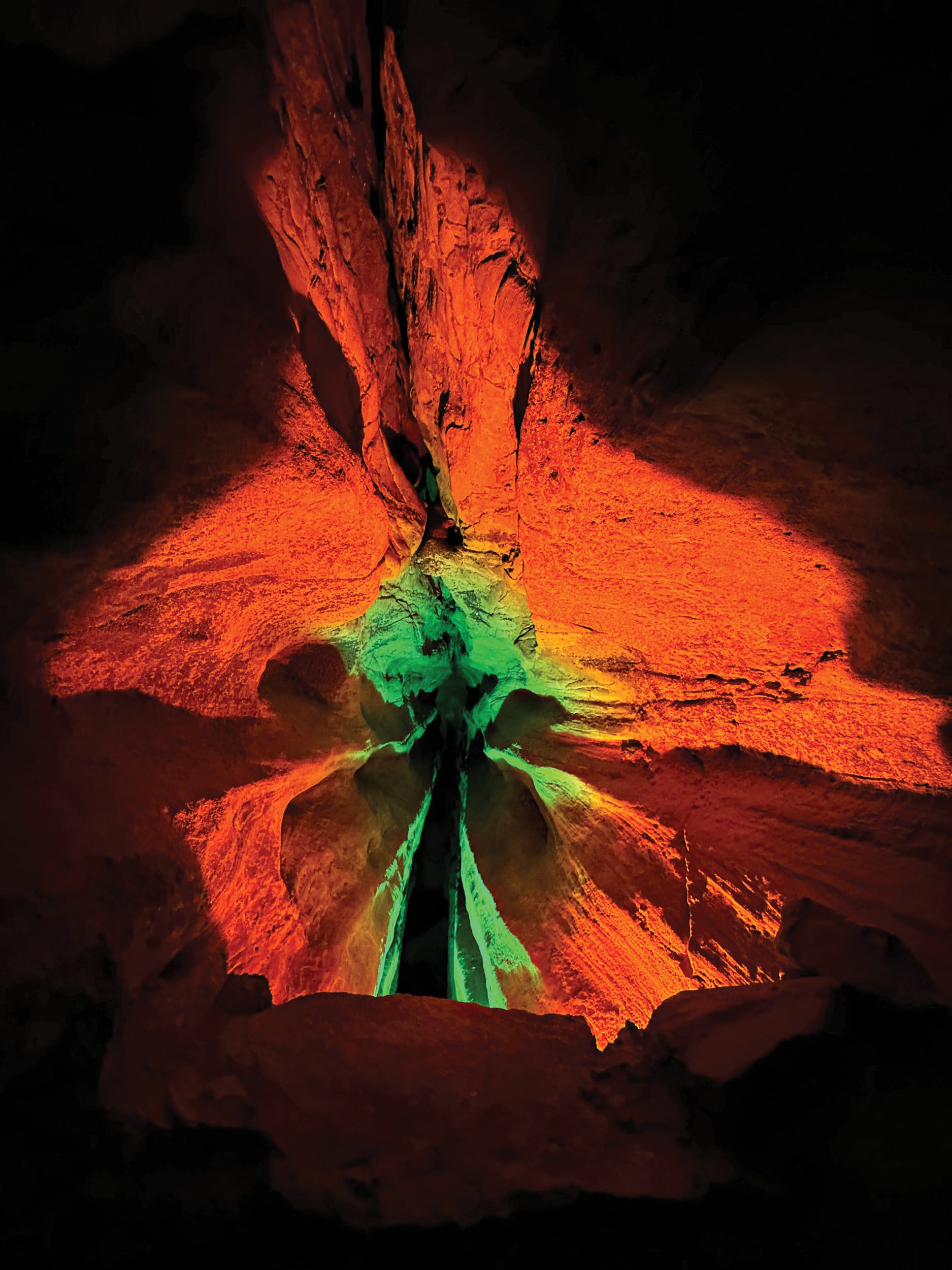
Laurel Caverns isn’t limestone, but calcareous sandstone—it’s about two-thirds sand and only one-third calcium carbonate, Cale explained in an interview with Think Outside, the podcast of the Pennsylvania Parks and Forests Foundation. When rainwater dissolves the calcium carbonate here, it leaches it out, leaving the sand behind. “The normal status is to be clogged floor to ceiling with sand,” he said. The Cales and other explorers have cleared sand away to expose rooms and passages. Laurel Caverns’ beauty isn’t in dripstone—it’s in the texture of its walls, he said, where corrugations reflect variations in the proportion of sand to calcium carbonate.
Calcareous sandstone caves are rare. “There are some in the Laurel Highlands, but only on Chestnut Ridge,” Cale says. “I know of none anywhere else.” And among show caves, Laurel Caverns is rarer still—of the 91 members of the National Caves Association, it’s the only one described as calcareous sandstone.
Over the decades, the Cales created an educational destination by developing guided tours in lighted and dark parts of the cave for all levels of ability and interest, welcoming as many as 50,000 people a year. They respected the cave’s ecology—Laurel Caverns is widely recognized as the largest bat hibernaculum in the northeastern U.S., and they shut tours down in winter to protect bat health. They also preserved the surrounding property from development that would spoil the cave’s wild setting or alter its hydrology.
And in April 2026, after decades as caretakers, the Cales donated their 435 acres, cave included, to the Commonwealth of Pennsylvania.
How will things change? It’s still early days. Laurel Caverns State Park is communicating with local residents about the changes they’d like to see, says park Manager Corie Eckman. “And we’re doing what we need to do to meet labor and industry standards, like ADA compliance,” she says. “We’re also adding a generator so, if the lights ever go off, we’ll still have lights—Chestnut Ridge is no stranger to storms.”
Meanwhile, tours for the underground-curious continue, mid-April through the last weekend in October. Four guided experiences range from the half-hour Maze Tour on a level path in the lighted section to the Intro to Caving program that goes 25 stories into the mountain and calls for some crawling. The Maze Tour is accessible to two- and four-wheeled walkers, and the visitors center, which has interpretive displays about cave history and geology, accommodates wheelchairs.
To learn more, visit pa.gov and search “Laurel Caverns State Park.” For information about cave tours, go to laurelcaverns.com.