


Anticipation for the trails had been building throughout the early morning hours, from the moment I donned a pair of well-loved jeans and a T-shirt past its prime. It was a strategic choice in attireóone made with mud puddles in mind. I felt like a kid on the morning of a field trip, or a race car driver zipping up her uniform.
My excitement was heightened by my status as the only rookie of the group, but even the lifelong riders were buzzing with restless energy as we loaded up the vehicles. I had my helmet (safety first!) but didn’t bother to bring spare clothes for later. Whichever restaurant my riding companions and I descended upon to refuel would be no stranger to mud-covered patrons fresh from tearing up some trails.
I’m not talking about hiking or mountain biking trails. There are countless ways to experience the wooded ridgelines and shaded valleys of Appalachia. Some, like hiking, are driven by the strength of the human body. But trail riding relies on a different type of drive: the kind with a purring engine and all-terrain tires.
Stay cool, but you’re actually witnessing a historic moment for Highland Outdoors—this is the first time we’re featuring machine-powered recreation in the magazine. And we don’t do things in halves, so we’re setting the bar, like, super high. Let us take you on a tour of Trails Heaven—aka, southern West Virginia, home to the world-famous Hatfield–McCoy Trails (HMT).
HMT started in 2000 with just three trail systems and 300 miles of trails. Today, its 13 trail systems feature more than 1,000 miles of trails across nine counties. That makes it one of the largest trail networks in the world for off-road vehicles (ORVs): a class that includes all-terrain vehicles (ATVs), or four-wheelers; dirt bikes; and utility terrain vehicles (UTVs), or side-by-sides.
(Side note: The most accurate umbrella term for these machines would be ORV. But, you’re hardly ever going to see that used in trail-riding spaces. We’ll also use ATV and UTV as conversational catch-alls—just don’t assume we’re leaving out folks who prefer two tires over four.)
The establishment of HMT was something of a lifeline for southern West Virginia. From the Hatfield–McCoy feud to the West Virginia Coal Wars, the region has had its fair share of hardship. By the 1990s, its former coal towns were left searching for something new in the wake of declining coal production. That’s what led a group of economic development and recreation agencies to ask: Could investment in a network of managed trail systems yield enough tourism to reinvigorate the region’s economy?
Yes. Very much yes.
The idea was based on the locals’ existing love for trail riding. Just about everyone in southern West Virginia has a mud-splattered ATV parked in their driveway like a badge of honor, and it’s been that way since long before the trail system opened. You’ve heard of walkable cities, but these towns have been ATV-able for decades.
In fact, we wouldn’t get back in our car until it was time to leave—why would we, when our rented UTV could take us anywhere we needed to go? Sightseeing, shopping, restaurant-hopping—it doesn’t matter, because you can drive an ORV on just about any public road in the region.
“Our local folks were already riding on these roads,” explains Jeffrey Lusk, who was the first executive director of the Hatfield–McCoy Regional Recreation Authority and recently retired from the position after 20 years. “The idea was to create a designated area so people who did not live here and didn’t know their way around these mountains would feel comfortable coming here and riding. That was the structure—providing that venue.”
Photographed by Nikki Bowman Mills
Safety Tips from a Longtime Trail Rider
CE Scott grew up in Gilbert, West Virginia, where the forest was his playground and a dirt bike was his first set of wheels. In 1991—before HMT existed—he became a volunteer firefighter for the Gilbert Volunteer Fire Department, then, shortly after, an EMT. Today, he’s assistant chief at the Gilbert VFD and equipment operator manager for HMT.
“We was one of—if not the—first fire department in this area that had trail rescue in 1995, way before the trail system ever started. Our locals was getting out and getting hurt, and somebody had to go get them,” Scott explains. Back then, crews performed trail rescues by loading their personal dirt bikes and four-wheelers with equipment like backboards, cervical collars, oxygen tanks, and stretchers.
As HMT has evolved, so too have local fire departments’ trail rescue strategies.
“We’re set up with two Polaris six-wheelers with full Stokes baskets and
rope rescue, and we are in the process of getting a mini set of Jaws of Life,” Scott explains.
It’s similar to how emergency responders near a lake or ski resort must be prepared for unique rescue scenarios, and Lusk says rigorous trail maintenance and the diligence of local emergency services makes it—in his opinion—the safest place in the country to trail ride.
But prevention is best—so follow Scott’s top safety tips for trail riders regardless of experience level:
- Wear a helmet and protective eyewear.
- Stay on the HMT’s marked trails. Trail markers are there to help you navigate, but they also provide a reference point for rescue crews to locate you—because “Well, there are definitely trees and rocks” will not suffice.
- Don’t out-ride your ability. Scott says 90% of the VFD’s calls are from green trails because people get too comfortable and drive too fast—if you’re not sure about it, don’t try it.
The trails range from smooth riding to steep, twisting terrain, and you don’t have to go far to find yourself deep within a tree-lined labyrinth—except unlike the Greek myth, this labyrinth has trail markers and maps.
We hardly needed a map to find the entrance to the Rockhouse Trail System—it was right outside of town. Driving past the trailhead felt like entering the gates of an amusement park. A whole world free from life’s hustle and bustle.
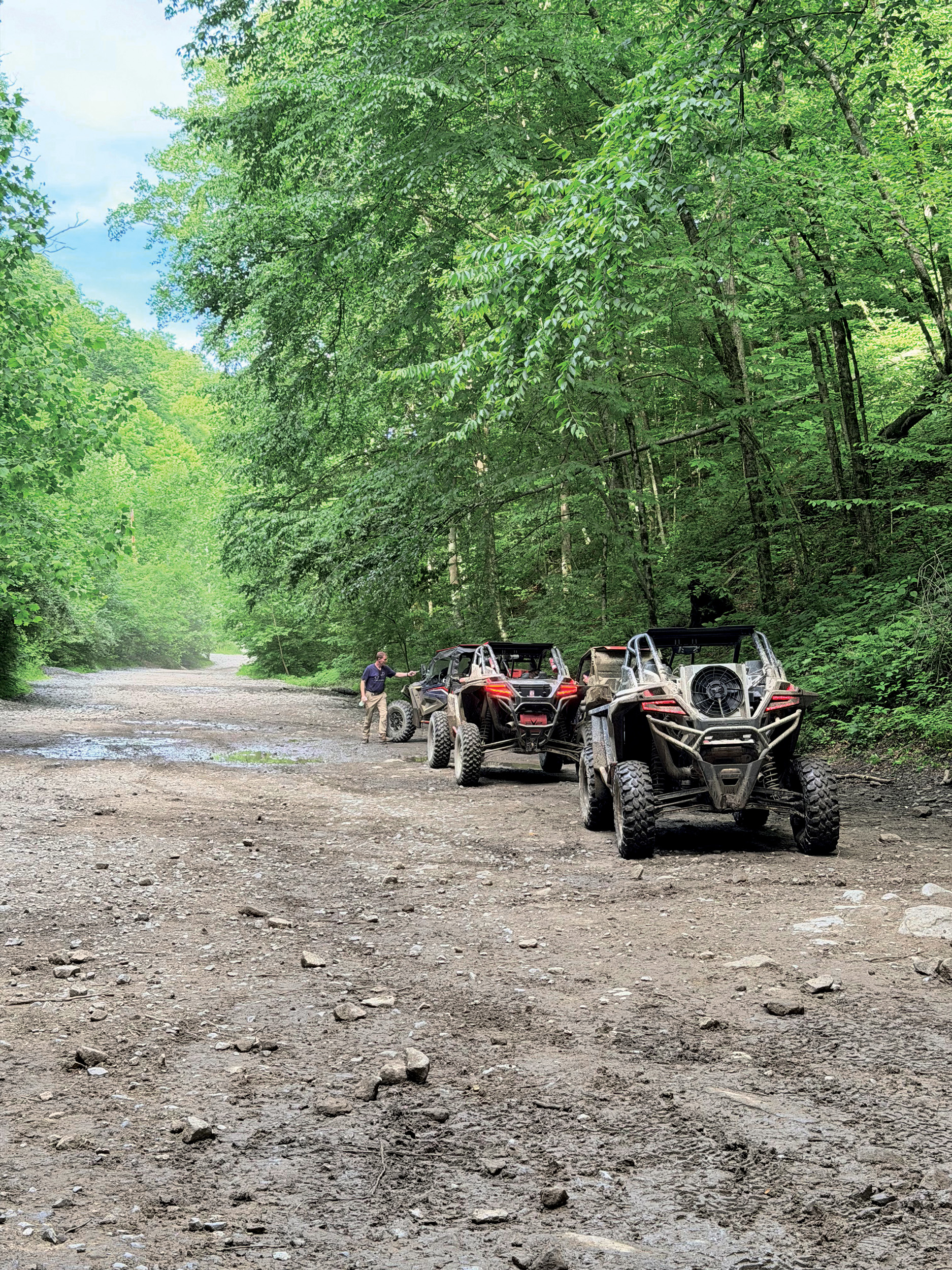
Wind and dust buffeted my face. Cool water splashed up against the sides of the UTV as we tore through mud puddles. Bursts of speed had my trail companions chasing my dust clouds like Coyote and Roadrunner until we slowed to a crawl in order to skirt around rocks and jutting trees.
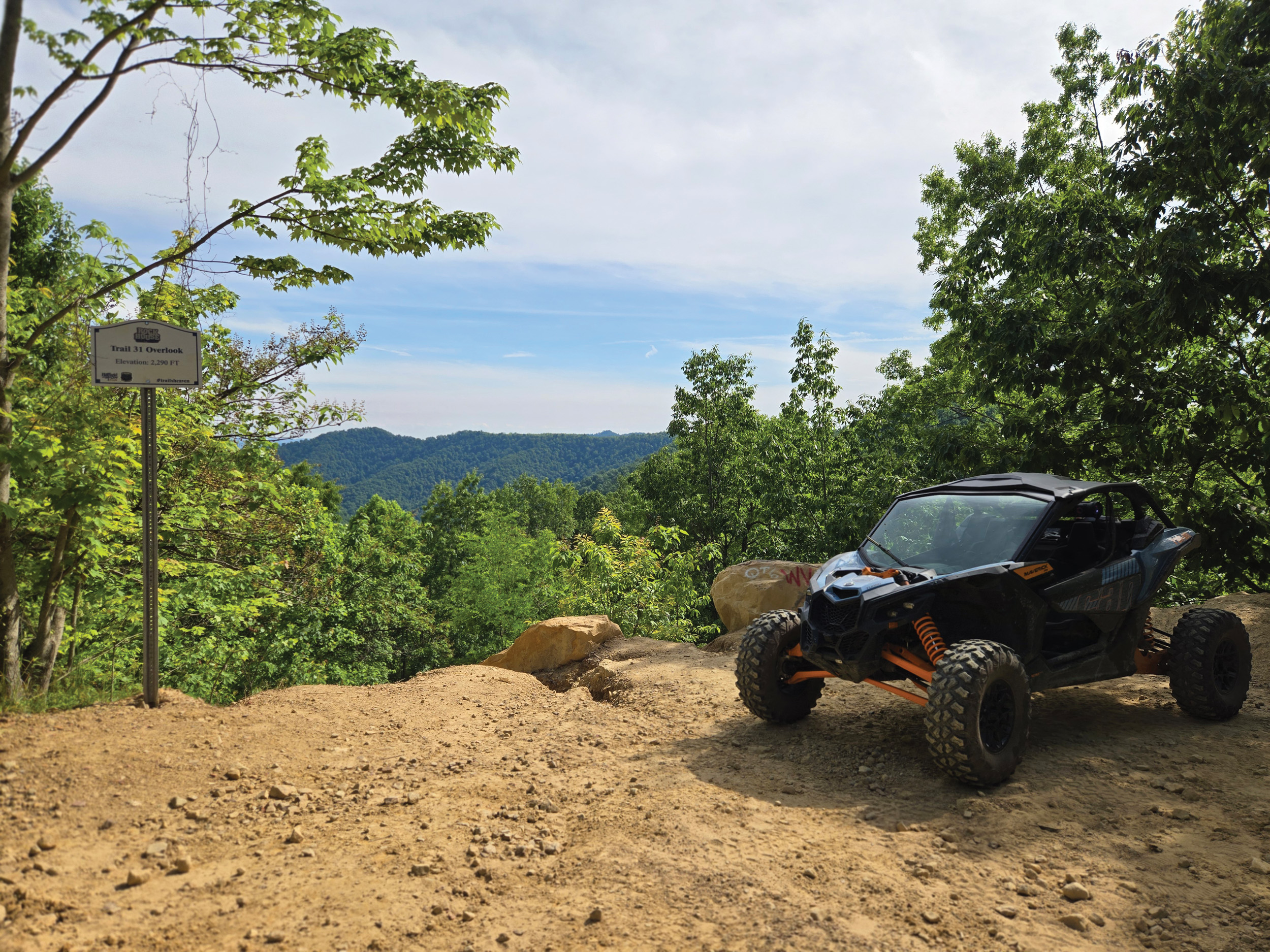
We rode up and around and up even further—until finally we came around a turn, tree branches reaching through the open window to brush across my skin before giving way to a brilliant open sky, and there was the peak. The sudden absence of rumbling engines was startling, but the bright chatter of my trail companions—“Did you see us go airborne for a second!?” “Hey, d’you think we can see our cabin from up here?”—made up for the loss as I attempted to find my land legs again.
It was wholly different from a summit achieved by hiking. Not better or worse—just different, and refreshingly so. I could feel flecks of mud drying on my cheeks, which were flushed from exhilaration and ached from grinning for—what, hours? I didn’t even know what time it was, and what a freeing feeling that is.
Fellow trail riders went rumbling past us, offering smiles and waves so sincere I wondered if we’d met them back in town—but it was just the type of Appalachian hospitality that makes you feel all warm inside.
Take that thrilling trail riding experience, unforgettable view, and Appalachian hospitality, and you’ve got a successful economic development investment. It’s no exaggeration to say that HMT has transformed the region’s economy—a Marshall University study estimated that HMT contributes $22.2 million to the state’s economy annually, roughly 85% of which comes from non-local visitor spending.
It’s easy to see why. As I meandered through the region’s self-described ATV-friendly towns, I had my pick of lodging—everything from quaint cabins to luxurious ATV resorts. Yes, entire resorts developed around trail riding. But it hasn’t always been that way.
Photographed by Nikki Bowman Mills
“For the first 20 years of the trail system’s existence, the glass ceiling was that there were vastly more people wanting to come here and ride than they had places to stay,” explains Lusk. “It’s taken a long time for that infrastructure to develop, and it really is developing now—you’re starting to see multimillion-dollar investments. It’s creating jobs and entrepreneurs.”
And they’re not your traditional entrepreneurs—he estimates that the average age of first-time entrepreneurs in southern West Virginia is double that of other regions. It’s even started a trend of generational entrepreneurship—like the father–son duo of Twin Hollow Campground and Cabins and Mountaintop Adventures. Lusk says the pair started out with the campground and a handful of rental ATVs, but it’s grown into one of those ATV resorts I mentioned: guided tours, an on-site restaurant, more than a dozen rental cabins, direct access to the Rockhouse Trail System, ATV recovery, towing and repair services, and the largest fleet of rental UTVs in the state.
Some trail riders have loved HMT since before it was trendy (Lusk calls them “ambassadors” for the region—tourists who come back year after year to introduce a group of greenhorns to the trail network), but that increase in lodging is making it possible for people from as far as Australia and Germany to choose Trails Heaven as their outdoor destination.
Outsiders to the world of trail riding might think it’s all about the adrenaline rush of high speeds and death-defying maneuvers, but that’s only as true as it is for any other form of outdoor recreation. And you won’t know what you love about it until you give it a try.
My first-time trail riding journey showed me that there is always a new way to experience Appalachia—and it was a reminder that there will always be a surplus of hospitable, helpful folks practically chomping at the bit to introduce you to their favorite pastime.
So grab some friends, buy some HMT permits, and get ready for a long weekend getaway to Trails Heaven—be sure to pack clothes made for playing in the mud.
What Type of Trail Rider Are You?
Tailor your trail riding experience in West Virginia.
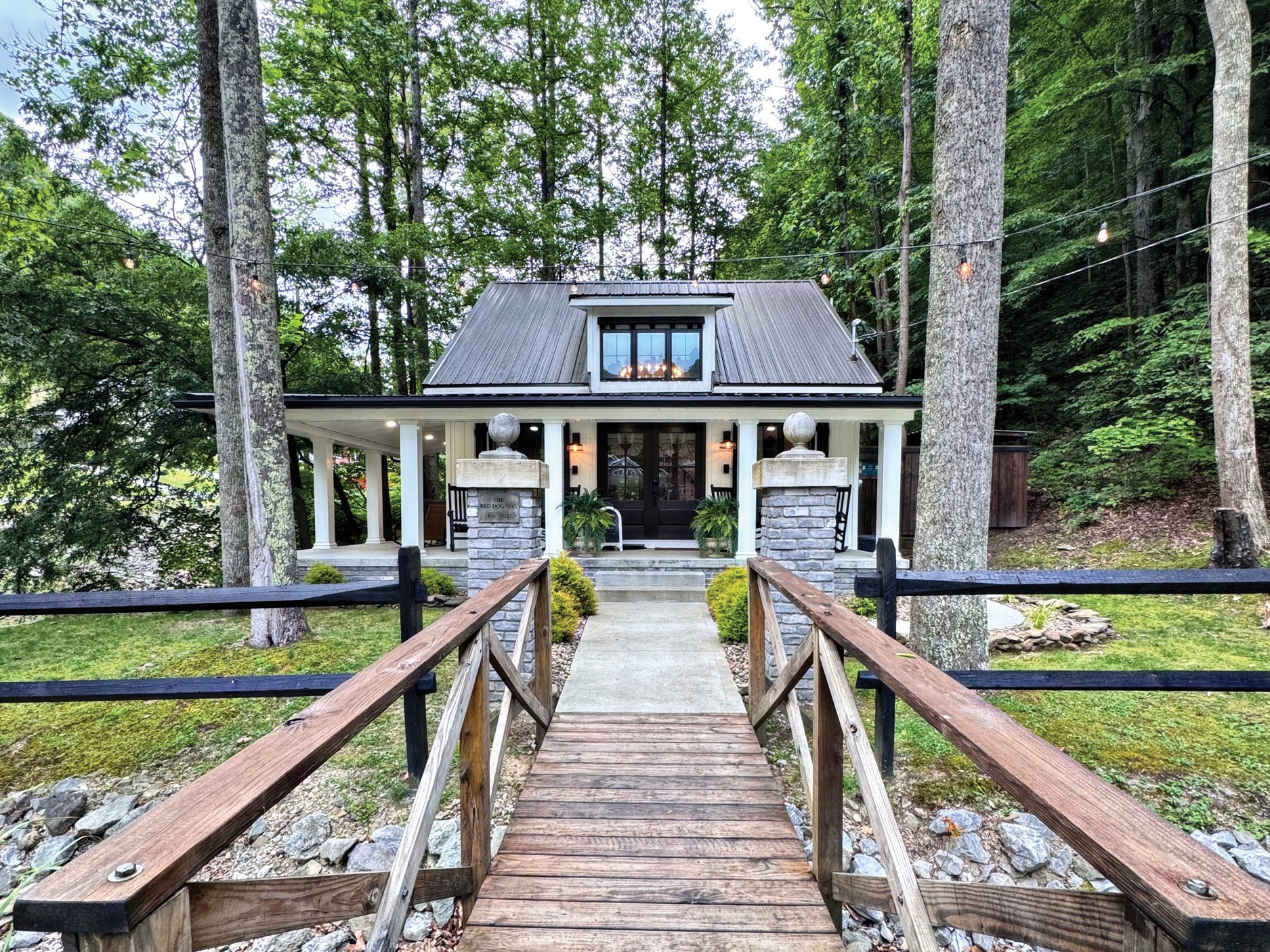
Red Dog Cottage & Chalet | Photographed by Nikki Bowman Mills
The Rookie Rider
Don’t let uncertainty keep you from a life-changing adventure—Trails Heaven has an itinerary for every type of rider.
Stay at these glamorous getaways…
Red Dog Cottage & Chalet, Williamson
Starview by Vickers Rental, Delbarton
Powerhouse ATV Mansion, Maybeury
Rent a machine and book a guided tour with …
Trailblazers Outfitters in Williamson
Mountaintop Adventures in Gilbert
WV ATV Resort and Rentals in Roc
Enjoy the charm of local towns in West Virginia with old-school drive-ins like The Sterling in Welch, Morrison’s and Parkway in Logan, and Pinnacle in Pineview.
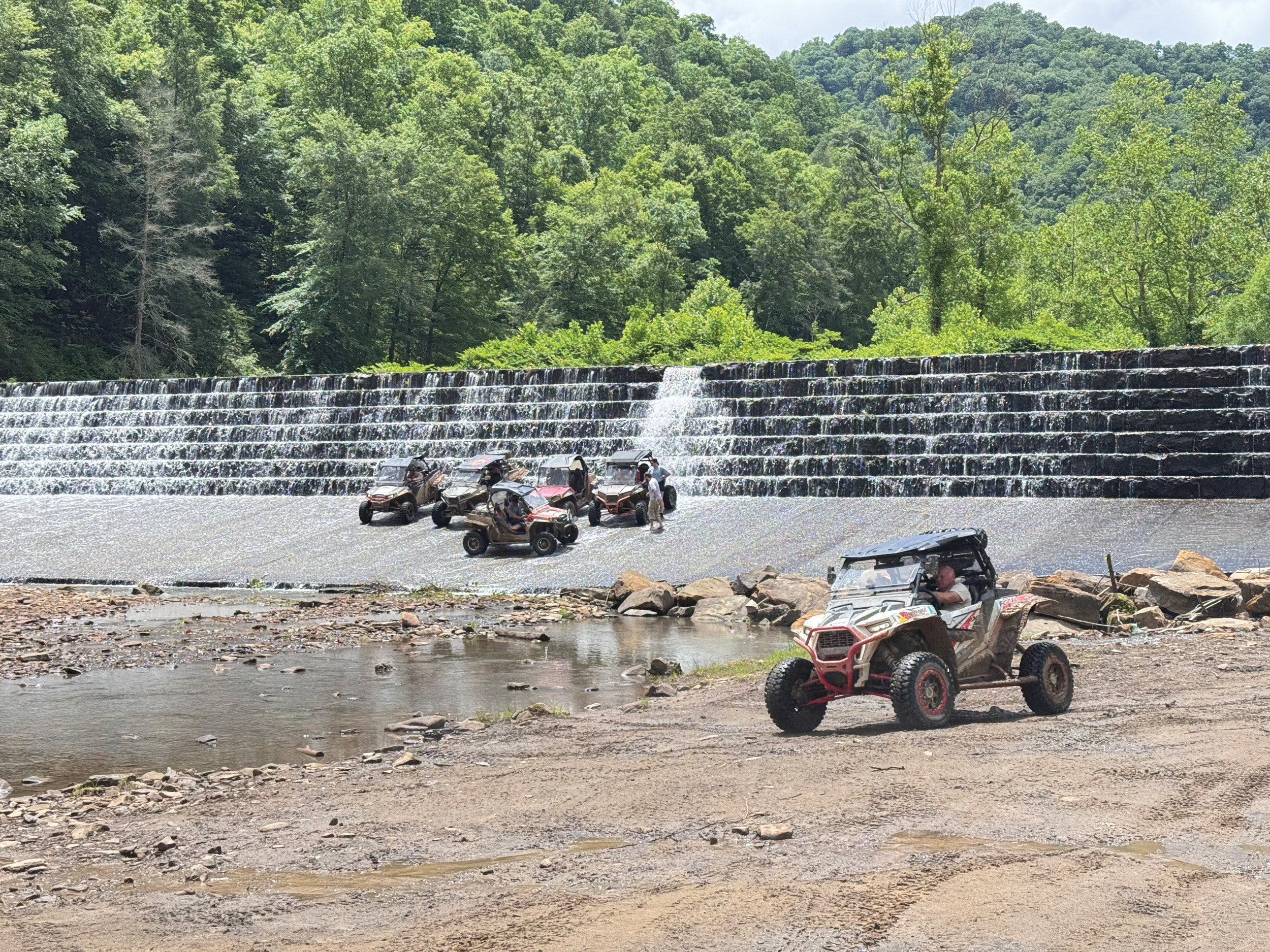
Explore the bearwallow trail system, for easy trails located near the town of Logan. Ride your ATV under the waterfall at Wilmore Dam near Iaeger.
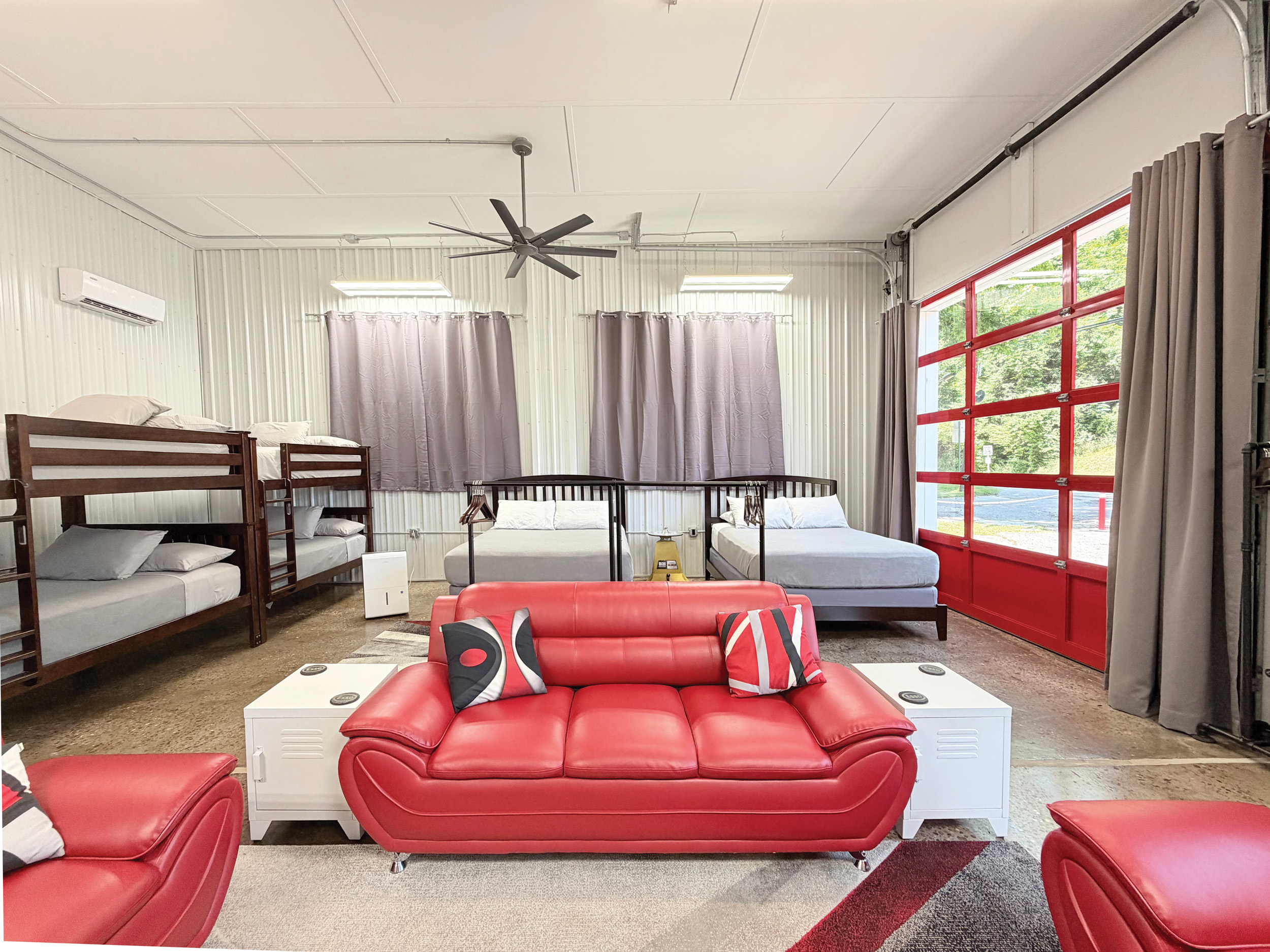
Louie’s in Gilbert | Photographed by Nikki Bowman Mills
The “Stops and Smells the Roses”
There’s nothing wrong with a little dilly-dally—and there’s plenty of places to do so in Trails Heaven.
Stay at one of southern West Virginia’s most unique digs …
The Depot Lodge in Man (a former train depot)
Historical Matewan Lockup & City Hall in Matewan (a former jail and city hall)
Louie’s at Main Street Lodging in Gilbert (a former 1950s gas station)
Experience the local wildlife. You can expect to see wild horses, wild goats, elk who have wandered over from the herd in Kentucky, and—if you take an airboat tour with Hatfield & McCoy Airboat Tours—bald eagles and herons.
Visit the Almost Heaven Swing at the Death Rock overlook, located in the Buffalo Mountain Trail System. Find the trailhead near Williamson.
The Adventure Seeker
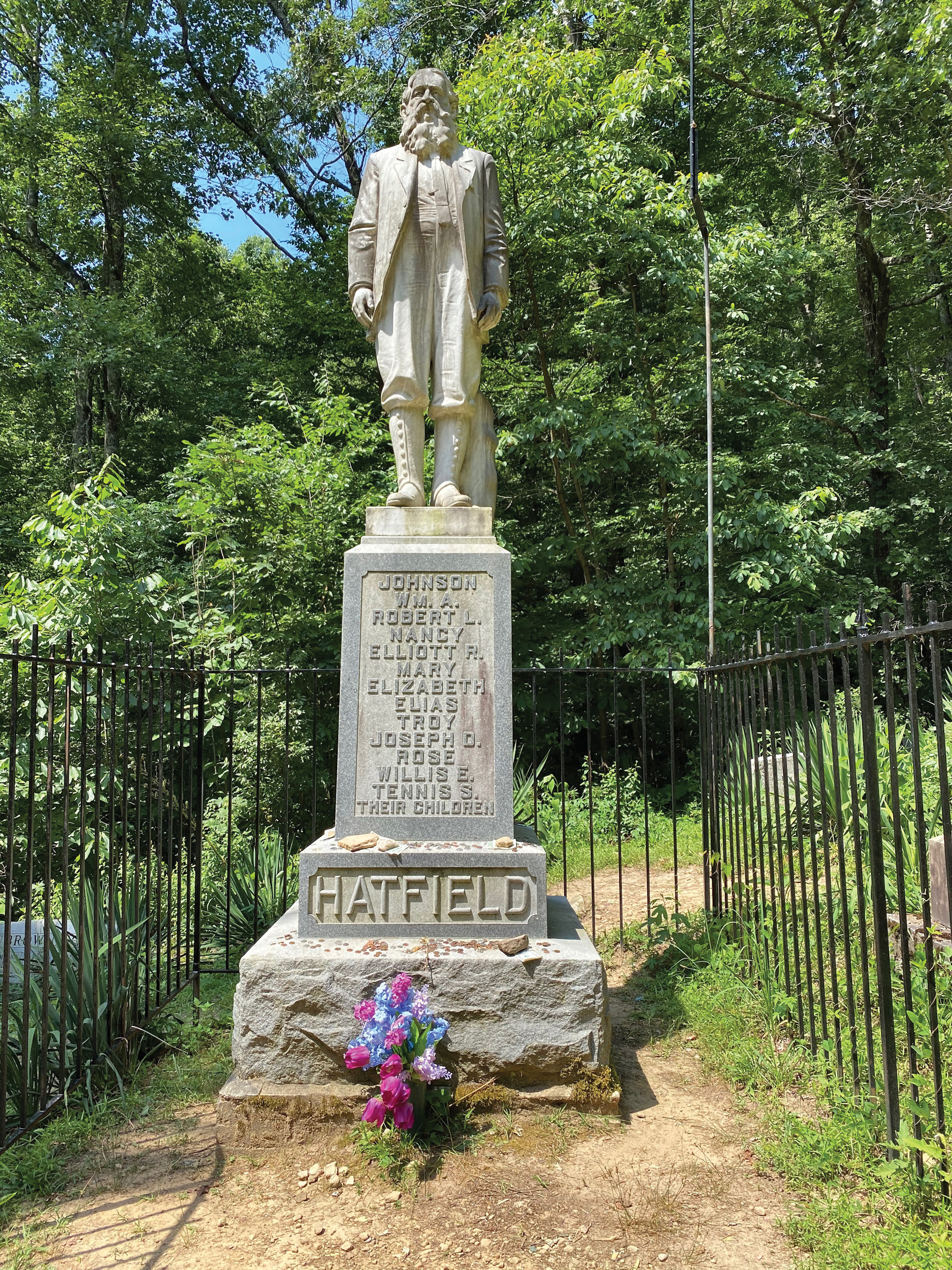
Hatfield Cemetery | Photographed by Nikki Bowman Mills
If you learned to drive an ATV before you learned to walk, this is the trail-riding experience for you.
Stay at an all-inclusive ATV resort, like …
Devil’s Backbone Adventure Resort in Matewan
Ashland Resort in Northfork
Appalachian Outpost in Lyburn
Explore the historic town of Matewan and see the actual bullet holes left behind after the Matewan Massacre, then head over to the West Virginia Mine Wars Museum to learn about the ensuing labor uprising.
Ride the trails to historic Hatfield Cemetery in Sarah Ann, then make the short climb to the gravesite of “Devil Anse” Hatfield.
This barely scratches the surface of local entrepreneurs who are serving local and out-of-town trail riders alike—visit trailsheaven.com for more lodging, machine rental, and permit vendor options. That’s also where you’ll learn more about the 13 trail systems and what makes each one unique.