


We at Highland Outdoors love insects. But there are a few we can’t stand, and those are the invasive ones. They disrupt ecosystems, cause millions of dollars in agricultural damage, and compete with or prey on Appalachia’s beloved native species.
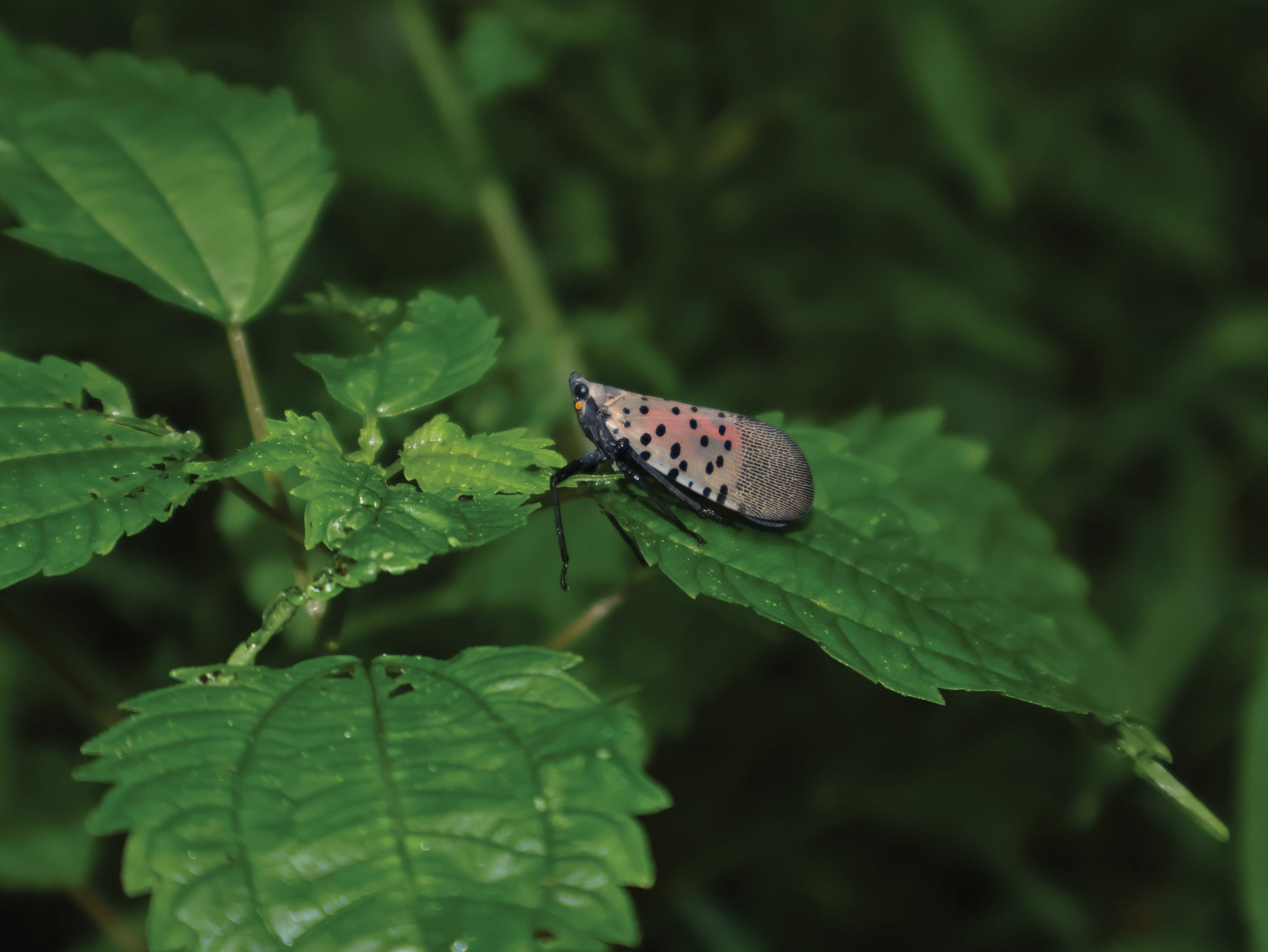
We’ll use the infamous spotted lanternfly as a vivid current example. This polka dot–wearing bug has become common on rural roadsides and urban sidewalks, where the public has been called upon by environmentalists to squash them. But how does an insect become invasive, why are they so good at being bad, and does squashing them really help?
The spotted lanternfly is native to parts of Asia, but in 2014, it was found in Pennsylvania. Although we can’t ask the bugs how they found themselves on American soil, it’s often because of international trade—either eggs or live insects hitchhiked in shipping containers.
Some non-native species become naturalized, meaning they live and reproduce outside of their native range with minimal impact. But others find themselves on this new frontier with plenty of food and not enough natural predators—and like a fox in a henhouse, they take it too far. They rapidly reproduce, causing sizable damage to the region’s economy and native species in the meantime. That’s how a non-native species turns invasive.
But can a little bug really cause that much harm? Yep. It really can. Especially when it’s got thousands of co-conspirators.
Some invasive species aren’t picky about their destruction—like the spotted lanternfly. It feeds on anything from grapevines to hops to hardwood trees, excreting a sugary fluid called honeydew that causes sooty mold growth. This can kill some crops—grapevines, for example—costing millions of dollars in agricultural losses.
On the flipside, invasive species like the emerald ash borer and hemlock woolly adelgid are specialists. The former feeds almost exclusively on ash trees. Since it was introduced to North America in the 1990s, it’s killed tens of millions of ash trees across the continent.
The hemlock woolly adelgid similarly feeds only on hemlock trees. You can see why this would be an issue in Appalachia, where hemlock is a pillar of riparian (stream- and lakeside) ecosystems. Trees infested by adelgids can die within just a few years, and up to 80% of hemlocks in Shenandoah National Park have suffered that exact fate.
So, how are scientists stopping this reign of terror, and can you do anything to help?
Admittedly, stomping on spotted lanternflies during your Sunday stroll likely doesn’t do much to slow their spree. It certainly doesn’t hurt—anyone except the lanternflies, that is—but more can be done.
What scientists are doing
Biocontrol Remember how we said invasive insects often don’t have natural predators on their new turf? Sometimes scientists will introduce non-native natural predators after determining they will eat only the targeted species. For example, the United States Department of Agriculture is considering the introduction of a parasitic wasp that is known to attack the spotted lanternfly in its native range.
What you can do
Chemical control Insecticides have the drawback of potentially harming non-targeted native species. But if systemic insecticides—which are applied to a plant’s base and spread to even its highest leaves—are used after a plant has flowered, harm to pollinators can be avoided.
Homemade traps What do you get when you zip tie an empty milk jug, plastic bag, and some window screening to a tree? A big ol’ bag of lanternflies that can damage your tree no more. The bugs crawl up a tree’s trunk and right into the trap. Unlike a glue trap, this avoids harm to other species—and this method can trap nymphs before they reach maturity and lay eggs. Penn State Extension has directions for a DIY spotted lanternfly trap on its website.